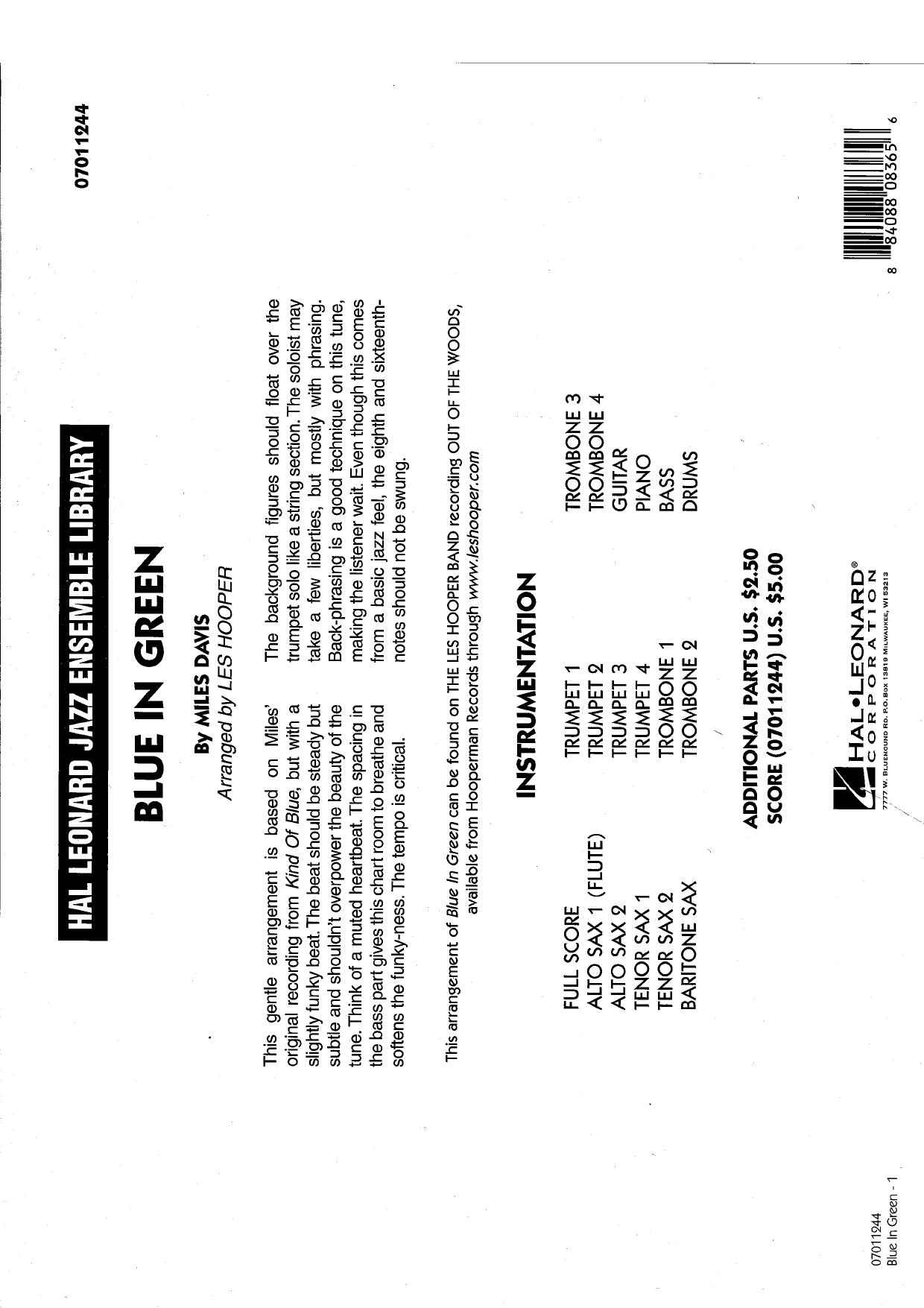
Blue In Green (L.Hooper)
Composed by Miles Davis
Arranged by Les Hooper
- Ensemble: Big Band
- Pages: 29
- Instruments (17): Alto Sax 1 (Flute), Alto Sax 2, Tenor Sax 1, Tenor Sax 2, Baritone Sax, Trumpet 1, Trumpet 2, Trumpet 3, Trumpet 4, Trombone 1, Trombone 2, Trombone 3, Trombone 4, Guitar, Piano, Bass, Drums
- Difficulty: medium
- Content: Individual Parts
- Format: PDF Download (Instant)
- Price: $24.99
Originating from the landmark 1959 Columbia Records masterpiece *Kind of Blue*, "Blue in Green" stands as one of the most sublime modal jazz compositions in the American songbook. Credited primarily to Miles Davis and Bill Evans, this ten-bar cyclical masterpiece explores the profound emotional depths of minimalism, utilizing a haunting harmonic framework derived from Evans's sophisticated chord voicings. The piece represents the zenith of the modal jazz movement, stripping away complex chord changes to allow improvisers to focus entirely on linear melody, atmosphere, and space. Over the decades, it has transitioned from a daring stylistic departure into an essential jazz standard, revered for its melancholic beauty and introspective gravity. Les Hooper’s magnificent big band interpretation transforms this delicate, intimate quartet blueprint into a lush, cinematic canvas for a standard 17-piece jazz orchestra. Moving at a relaxed, atmospheric tempo, the arrangement retains the haunting, nocturnal mood of the original recording while expanding the sonic palette through rich, contemporary chord extensions and dense, impressionistic voicings. The emotional trajectory shifts from whispered intimacy to sweeping, dynamic climaxes, evoking a sense of poignant urban solitude contrasted with soaring, bittersweet crescendos. Hooper expertly avoids cluttering the sparse original theme, instead using the expanded brass and reed sections to paint subtle shades of light and shadow beneath the primary melodic lines. The architectural genius of this chart lies in how Hooper distributes the thematic material across the ensemble. The woodwinds—featuring doubling on flute in the lead alto chair—initially carry the fragile melody, weaving delicate counterlines that echo Bill Evans's original piano voicings. Featured solo space allows a sensitive trumpet or tenor saxophone player to stretch out over the modal vamps, supported by shimmering, muted brass beds. Technical demands center less on sheer velocity and far more on blend, intonation, and dynamic control. Players must maintain a sustained, chamber-ensemble sensitivity while navigating sophisticated rubato-esque pacing and lush harmonic suspensions that require immaculate section tuning. Advanced college ensembles, elite high school jazz bands, and professional repertory orchestras will find this chart to be a profoundly rewarding centerpiece for a concert program. Because the primary hurdles are interpretive rather than technical—demanding mature phrasing, deep emotional commitment, and exquisite dynamic shading—it serves as an ideal vehicle for teaching stylistic nuance and ensemble listening. Concluding with a breath-taking, fading resolution, Hooper’s arrangement honors the fragile DNA of Miles Davis's original vision while offering a masterclass in modern big band orchestration. Conductors approaching this chart must prioritize a hyper-sensitive, atmospheric balance over sheer volume. The tempo should feel organic and unhurried, avoiding any rigid metronomic stiffness that could suffocate the modal flow. Key technical challenges involve the pristine execution of lush, extended chord voicings in the brass; trumpet players must master warm, controlled flugelhorn or muted tones, while trombones require exceptional slide technique to blend seamless chordal shifts. Ensure the rhythm section treats the underlying pulse with extreme subtlety—the ride cymbal and bass should converse rather than drive aggressively. Rehearsals should begin with sectional work to isolate intonation issues within the close-position saxophone and brass harmonies. Pay close attention to dynamic markings, as the emotional impact relies heavily on the ensemble's ability to swell and recede organically from a whisper to a rich, full-ensemble peak without ever forcing the tone. Q: What instrumentation and parts are included in this publication? A: This arrangement is scored for a standard 17-piece big band, including Alto Saxophone 1 (with flute double), Alto Saxophone 2, Tenor Saxophone 1, Tenor Saxophone 2, Baritone Saxophone, 4 Trumpets, 4 Trombones, Piano, Guitar, Bass, and Drums, alongside a comprehensive conductor score spanning 29 pages. Q: What is the difficulty level of this Les Hooper arrangement? A: This chart is best suited for advanced high school, collegiate, and professional jazz ensembles due to its heavy reliance on mature ensemble blend, intonation, close-interval chord reading, and sophisticated stylistic interpretation. Q: How does this arrangement relate to the historical Miles Davis recording? A: While Miles Davis and Bill Evans originally recorded "Blue in Green" as an intimate, sparse modal ballad on *Kind of Blue*, Hooper honors this historic framework by translating its melancholic, impressionistic mood into a rich, multi-layered big band context. Q: What makes this specific arrangement by Les Hooper unique? A: Hooper uniquely captures the delicate, minimalist essence of modal jazz within a full-ensemble setting, utilizing clever woodwind doublings, shifting textures, and contemporary harmonic extensions rather than relying on traditional loud shout choruses. Q: What is the general tempo and performance duration of the piece? A: The arrangement is performed at a slow, lingering ballad tempo with a spacious, floating feel, typically lasting between 5 to 7 minutes depending on the length of the improvised solo sections.
Questions and answers
- What is included in the Blue In Green (L.Hooper) PDF?
- The verified current file contains a conductor score and individual parts across 29 pages.
- How many instruments or parts are listed for Blue In Green (L.Hooper)?
- The verified instrumentation list contains 17 entries for this Big Band arrangement.
- Who is credited for Blue In Green (L.Hooper)?
- Composer: Miles Davis. Arranger: Les Hooper.
- What difficulty is listed for Blue In Green (L.Hooper)?
- The verified difficulty level is medium.
- Can I preview Blue In Green (L.Hooper) before buying?
- Yes. The product page provides a preview generated from the current PDF file.
- How is Blue In Green (L.Hooper) delivered?
- After successful payment, the digital PDF is made available for download. The displayed price is $24.99.
Musicians Also Search For
Blue In Green Les Hooper PDF • Blue In Green Les Hooper sheet music • Blue In Green arranged by Les Hooper • Les Hooper big band charts • Les Hooper jazz arrangements PDF • Blue In Green Miles Davis sheet music • Blue In Green Miles Davis big band arrangements • Miles Davis big band charts • Blue In Green big band arrangements • Blue In Green big band PDF download • Blue In Green jazz sheet music • big band sheet music download • Blue In Green conductor score PDF • Blue In Green individual parts download • Blue In Green sheet music PDF • buy Blue In Green sheet music • download Blue In Green PDF • Blue In Green jazz charts • best Les Hooper big band arrangements • Miles Davis arranged by Les Hooper • Blue In Green printable sheet music • big band repertoire PDF