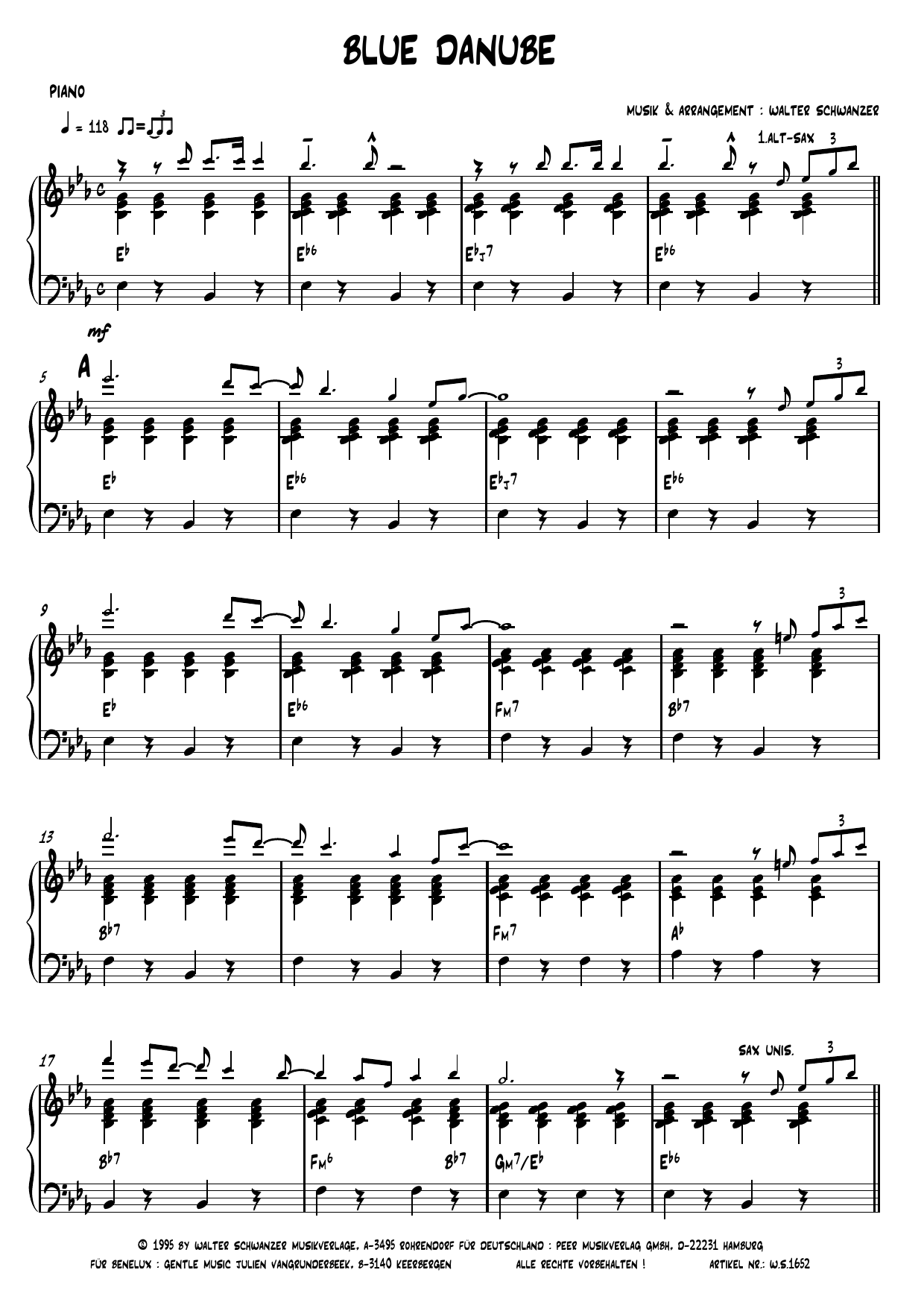
Blue Danube (W.Scwanzer)
Composed by Johann Strauss II
Arranged by W.Scwanzer
- Ensemble: Big Band Dance
- Style: Big Band Dance
- Pages: 20
- Instruments (17): 1. Alt-Saxophon, 2. Alt-Saxophon, 1. Tenor-Saxophon, 2. Tenor-Saxophon, Baritonsaxophon, 1. Trompete, 2. Trompete, 3. Trompete, 4. Trompete, 1. Posaune, 2. Posaune, 3. Posaune, 4. Posaune, Gitarre, Piano, Bass, Drums
- Difficulty: easy
- Content: Individual Parts
- Format: PDF Download (Instant)
- Price: $24.99
Johann Strauss II's "The Blue Danube" (German: An der schönen blauen Donau, Op. 314), composed in 1866, stands as one of the most iconic pieces of classical music, epitomizing the Viennese waltz tradition of the High Romantic era. Originally conceived as a choral piece to uplift Austrian spirits after a military defeat, its orchestral adaptation for the 1867 Paris World's Fair propelled it to international fame, earning Strauss the moniker "the Waltz King." This enduring melody, a staple of classical repertoire and an unofficial Austrian national anthem, has transcended its origins, becoming a cultural touchstone recognized globally and even featured in films like "2001: A Space Odyssey." Its initial reception was only a mild success, but the instrumental version quickly became a sensation, with sheet music sales reaching millions. W.Scwanzer's arrangement masterfully re-imagines this classical gem as a vibrant Big Band Dance chart, transforming the elegant 3/4 waltz into a swinging 4/4 groove while retaining the original's melodic charm and grandeur. The musical character is one of sophisticated, medium-tempo swing, evoking the golden age of big band dance orchestras. It maintains the celebratory and romantic mood of the original but infuses it with the irresistible rhythmic drive and harmonic richness characteristic of the jazz idiom. The arrangement is primarily in a bright, accessible key, allowing the iconic themes to shine through a fresh, danceable lens. The energy is consistently buoyant, designed to invite movement and create a joyful atmosphere, making it an excellent choice for both concert and dance hall performances. W.Scwanzer's distinctive approach to "Blue Danube" showcases a deep understanding of both classical orchestration and jazz arranging techniques. Expect lush, carefully crafted voicings that highlight the ensemble's sections, particularly the saxophones and brass. The arrangement features prominent soli sections that allow the saxophone and brass choirs to shine with intricate melodic lines, demonstrating the arranger's skill in creating exciting interplay. While the melody is primarily carried by the full ensemble, there are strategically placed solo features for trumpet, trombone, and alto saxophone, offering opportunities for improvisation over changes that cleverly adapt Strauss's harmonies. The arrangement builds dynamically, culminating in a powerful shout chorus that provides a thrilling climax, a hallmark of effective big band writing. This arrangement is ideally suited for college, community, and semi-professional big bands seeking a challenging yet highly rewarding piece for their repertoire. The technical demands are moderate to advanced, requiring solid ensemble precision, dynamic control, and stylistic authenticity. Performers will find immense satisfaction in navigating the intricate soli passages and delivering the powerful shout chorus. The blend of familiar melody with fresh, swinging harmonies makes it particularly engaging for audiences, offering a unique take on a beloved classic. Its 20 pages suggest a substantial and well-developed chart, providing ample musical content for a memorable performance. Approaching W.Scwanzer's "Blue Danube" requires a keen focus on rhythmic precision and stylistic authenticity to truly capture its Big Band Dance essence. The primary technical challenge lies in maintaining a consistent, relaxed medium swing feel throughout the transformation from the original waltz meter. Conductors should emphasize a strong, yet unforced, 4/4 pulse, ensuring the rhythm section lays down a solid foundation. Brass sections will need to articulate clearly and with appropriate jazz inflections, particularly during the powerful soli sections and the climactic shout chorus, paying close attention to dynamic contrasts and releases. The saxophone soli passages demand tight ensemble playing and blend, with careful attention to intonation and phrasing to achieve a cohesive sound. Soloists should be encouraged to embrace the jazz language, utilizing blues scales and arpeggios over the provided chord changes, while still honoring the melodic contours of the original piece. Rehearsal time should be dedicated to isolating and polishing the soli sections, ensuring precise entrances and cutoffs, and developing a unified interpretation of the swing rhythms. Q: What instruments are included in this arrangement? A: This arrangement is scored for a standard big band dance ensemble, including Alto Saxophone, Tenor Saxophone, Trumpet, Trombone, Piano, Bass, and Drums. Q: What is the difficulty level of "Blue Danube (W.Scwanzer)"? A: This arrangement is rated as moderate to advanced, suitable for college, community, and semi-professional big bands due to its intricate voicings, soli sections, and solo improvisation opportunities. Q: How does this arrangement relate to the original "Blue Danube" by Johann Strauss II? A: W.Scwanzer transforms Johann Strauss II's classical waltz into a vibrant 4/4 Big Band Dance chart, retaining the original's melodic themes while infusing them with a medium swing feel and jazz harmonies. Q: What makes W.Scwanzer's arrangement of "Blue Danube" unique? A: This arrangement is unique for its successful conversion of a classical waltz into a swinging big band piece, featuring rich voicings, engaging soli sections, and a powerful shout chorus, all while providing opportunities for jazz improvisation. Q: What is the approximate performance duration and tempo of this piece? A: The arrangement is designed for a medium swing tempo, and while specific duration can vary with interpretation and solos, it typically runs approximately 4-5 minutes, making it an ideal length for a concert or dance set.
Questions and answers
- What is included in the Blue Danube (W.Scwanzer) PDF?
- The verified current file contains individual parts across 20 pages.
- How many instruments or parts are listed for Blue Danube (W.Scwanzer)?
- The verified instrumentation list contains 17 entries for this Big Band Dance arrangement.
- Who is credited for Blue Danube (W.Scwanzer)?
- Composer: Johann Strauss II. Arranger: W.Scwanzer.
- What difficulty is listed for Blue Danube (W.Scwanzer)?
- The verified difficulty level is easy.
- What style is listed for Blue Danube (W.Scwanzer)?
- The catalog lists the style as Big Band Dance.
- Can I preview Blue Danube (W.Scwanzer) before buying?
- Yes. The product page provides a preview generated from the current PDF file.
- How is Blue Danube (W.Scwanzer) delivered?
- After successful payment, the digital PDF is made available for download. The displayed price is $24.99.
Musicians Also Search For
Blue Danube W.Scwanzer PDF • Blue Danube W.Scwanzer sheet music • Blue Danube arranged by W.Scwanzer • W.Scwanzer big band dance charts • W.Scwanzer jazz arrangements PDF • Blue Danube Johann Strauss II sheet music • Blue Danube Johann Strauss II big band dance arrangements • Johann Strauss II big band dance charts • Blue Danube big band dance arrangements • Blue Danube big band dance PDF download • Blue Danube jazz sheet music • big band dance sheet music download • Blue Danube individual parts download • Blue Danube sheet music PDF • Blue Danube Big Band Dance charts • Big Band Dance big band dance arrangements • buy Blue Danube sheet music • download Blue Danube PDF • Blue Danube jazz charts • best W.Scwanzer big band dance arrangements • Johann Strauss II arranged by W.Scwanzer • Blue Danube printable sheet music • big band dance repertoire PDF