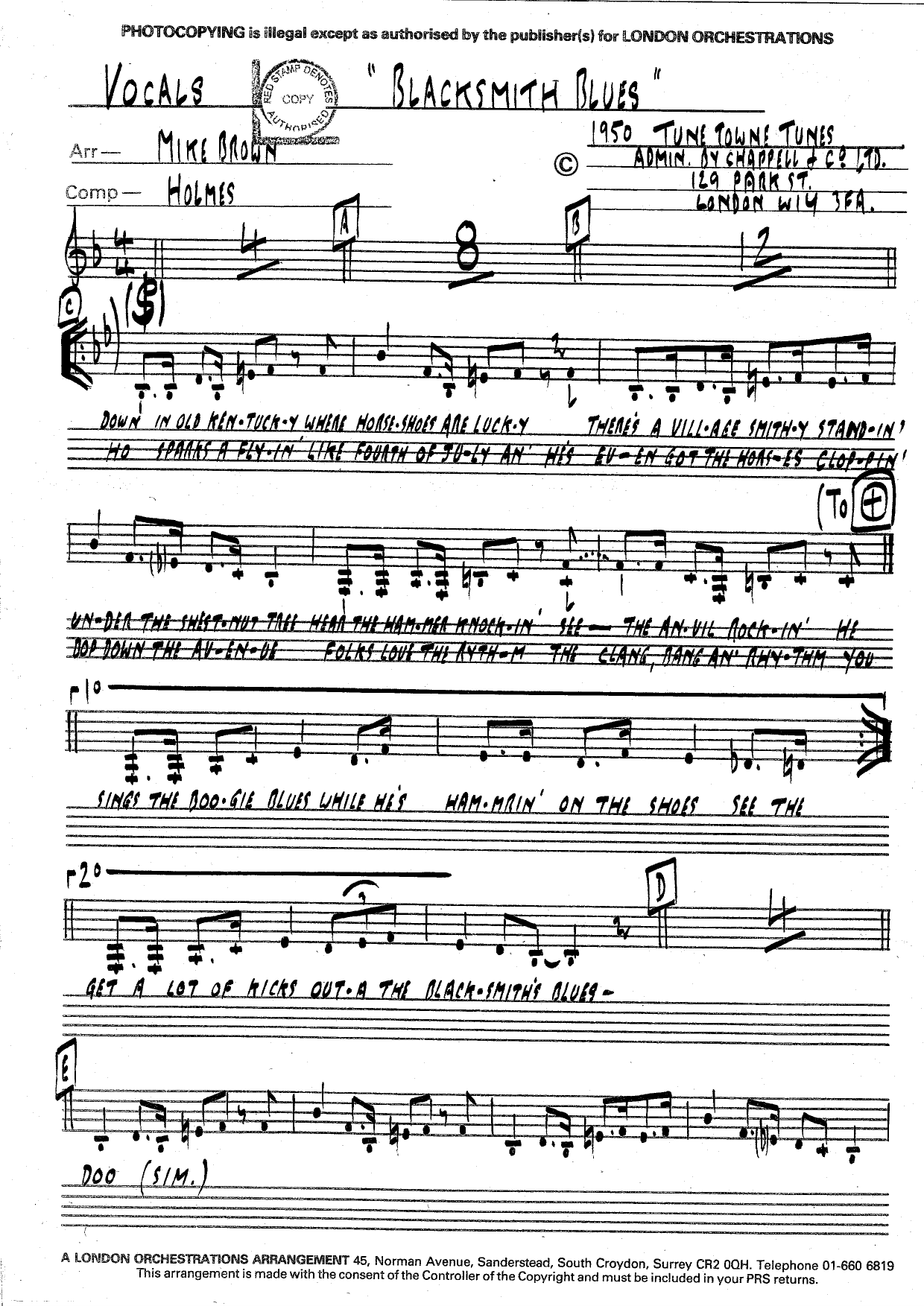
Blacksmith Blues (M.Brown)
Composed by Jack Holmes
Arranged by M.Brown
- Ensemble: Big Band
- Pages: 35
- Instruments (18): Vocals, Keyboard, Bass, Guitar (Opt.), Drums, Perc., Trombone 1, Trombone 2, Trombone 3/4, Alto Sax 1, Alto Sax 2, Tenor Sax 1, Tenor Sax 2, Baritone Sax, Trumpet 1, Trumpet 2, Trumpet 3, Trumpet 4
- Difficulty: medium
- Content: Individual Parts
- Format: PDF Download (Instant)
- Price: $24.99
Originating from the post-war novelty and rhythm-and-blues crossover era that famously yielded hits for artists like Ella Mae Morse and bandleaders such as Harry James, "The Blacksmith Blues" captures the buoyant, infectious energy of early 1950s popular jazz. Originally composed by Jack Holmes with roots stretching back to traditional American work-song imagery, the tune blends traditional blues structure with a witty, driving swing rhythm. It represents a golden intersection where novelty pop lyrics met sophisticated big band orchestration, transforming everyday imagery into a toe-tapping, high-spirited jazz standard. Driving forward with a medium swing feel anchored around 130 beats per minute, the chart opens with an unmistakable, playful swagger that evokes the rhythmic clanging of an anvil and hammer. The harmonic language is firmly rooted in traditional blues changes enriched by bright, brassy dominant extensions and clever chromatic passing tones. The overall mood is high-energy, humorous, and immensely engaging, alternating between tongue-in-cheek lyrical storytelling and powerhouse ensemble sections that evoke classic Capitol Records arrangements from the mid-century era. M.Brown approaches this chart by emphasizing textural contrast between the vocal line and the punchy, tightly voiced horn sections. The arrangement utilizes classic block voicings for the saxophones and bright, conversational plunger-muted punctuations in the brass, evoking the iconic style of studio arrangers like Billy May and Nelson Riddle. Rather than relying on a traditional studio fade-out, M.Brown crafts a definitive, high-impact shout chorus that builds tension through sequential modulations and a roaring full-ensemble climax before a punchy comedic tag ending. The vocalists carry the primary narrative load, supported closely by interwoven countermelodies in the alto and tenor saxophones. Instrumental features include concise, blues-inflected solo spaces for the piano and trumpet that maintain the track's driving momentum without sacrificing accessibility. Technical challenges center primarily on maintaining a crisp, lightweight swing articulation across the brass and keeping the rhythm section locked into a steady, unhurried groove. Performers will find immense satisfaction in the clever interplay between the rhythm section's anvil-like backbeats and the soaring, dynamic peaks of the ensemble. Advanced high school ensembles, collegiate jazz orchestras, and professional community big bands will find this arrangement an ideal fit for programming. It provides a refreshing stylistic departure from standard bebop or heavy modal charts, offering audiences a heavy dose of nostalgia while demanding disciplined ensemble phrasing, stylistic versatility, and strong stylistic cohesion. The primary technical challenge in this arrangement lies in achieving a crisp, unified articulation that mimics the mechanical, rhythmic pulse of a blacksmith's shop without rushing the tempo. Conductor and musicians must lock in a steady medium swing feel at approximately 130 BPM, ensuring that eighth notes are appropriately swung rather than played straight or overly dotted. Brass players should utilize cup mutes and gentle plunger effects where indicated to achieve the signature, vocal-like growls and wah-wah textures intrinsic to the 1950s novelty-swing style. The rhythm section acts as the primary engine: the drummer should carefully balance the backbeat with auxiliary percussion textures (such as a simulated anvil or metallic rim clicks) to recreate the song's iconic sound design. Rehearsals should initially focus on sectional balance, ensuring the accompanying horn lines sit comfortably beneath the vocal soloist without sacrificing punchy accents on off-beats. Pay close attention to the dynamics in the shout chorus, building a gradual crescendo that peaks organically just before the final punchy resolution. Q: What instruments and parts are included in this arrangement? A: This chart is scored for a standard 18-instrument big band lineup consisting of a vocal lead, 5 saxophones (no doubles required), 4 trumpets, 4 trombones, piano/keyboard, guitar, acoustic/electric bass, and drum set, accompanied by a complete conductor score across 35 pages. Q: What is the difficulty level of this big band chart? A: This arrangement is graded at a medium difficulty level, making it well-suited for proficient high school groups, college ensembles, and community jazz bands looking to feature a vocalist. Q: What is the style and historical context of "Blacksmith Blues"? A: The piece is a medium swing jazz tune rooted in the 1950s crossover era popularized by artists like Ella Mae Morse and arranger Nelson Riddle, blending playful work-song lyrical themes with traditional blues-based big band harmonies. Q: What makes M.Brown's arrangement unique compared to other versions? A: While studio recordings typically relied on fade-outs, M.Brown incorporates a fully written, high-energy shout chorus and a clever, definitive tag ending tailored specifically for live performance settings. Q: What is the recommended performance tempo and duration? A: The arrangement is designed to be performed at a comfortable medium swing tempo of around 130 BPM, yielding a total performance duration of approximately 3 minutes.
Questions and answers
- What is included in the Blacksmith Blues (M.Brown) PDF?
- The verified current file contains a conductor score and individual parts across 35 pages.
- How many instruments or parts are listed for Blacksmith Blues (M.Brown)?
- The verified instrumentation list contains 18 entries for this Big Band arrangement.
- Who is credited for Blacksmith Blues (M.Brown)?
- Composer: Jack Holmes. Arranger: M.Brown.
- What difficulty is listed for Blacksmith Blues (M.Brown)?
- The verified difficulty level is medium.
- Can I preview Blacksmith Blues (M.Brown) before buying?
- Yes. The product page provides a preview generated from the current PDF file.
- How is Blacksmith Blues (M.Brown) delivered?
- After successful payment, the digital PDF is made available for download. The displayed price is $24.99.
Musicians Also Search For
Blacksmith Blues M.Brown PDF • Blacksmith Blues M.Brown sheet music • Blacksmith Blues arranged by M.Brown • M.Brown big band charts • M.Brown jazz arrangements PDF • Blacksmith Blues Jack Holmes sheet music • Blacksmith Blues Jack Holmes big band arrangements • Jack Holmes big band charts • Blacksmith Blues big band arrangements • Blacksmith Blues big band PDF download • Blacksmith Blues jazz sheet music • big band sheet music download • Blacksmith Blues conductor score PDF • Blacksmith Blues individual parts download • Blacksmith Blues sheet music PDF • buy Blacksmith Blues sheet music • download Blacksmith Blues PDF • Blacksmith Blues jazz charts • best M.Brown big band arrangements • Jack Holmes arranged by M.Brown • Blacksmith Blues printable sheet music • big band repertoire PDF