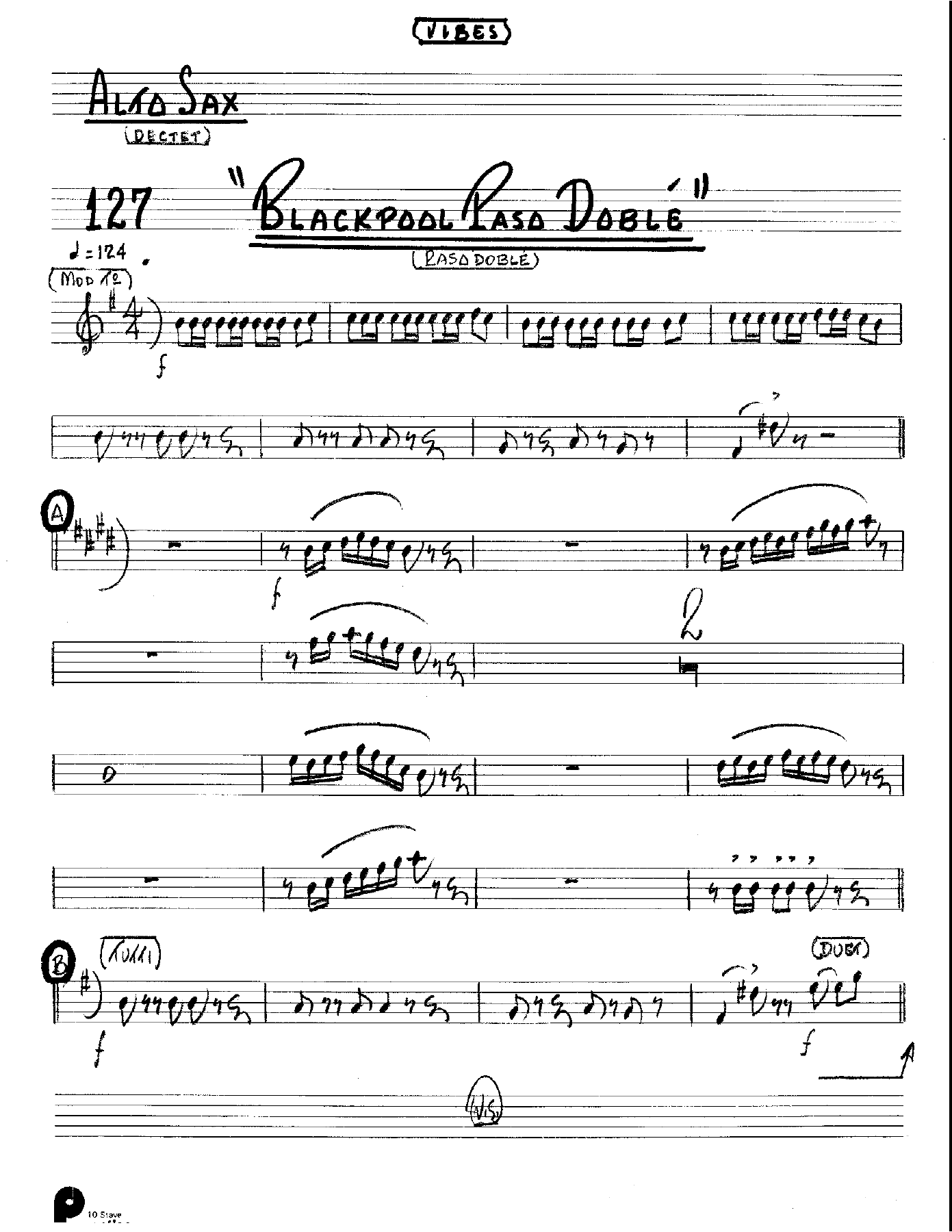
Blackpool Paso Doble (Kenton Dectet #127) sheet music preview

Blackpool Paso Doble (Kenton Dectet #127)

Composed by Traditional

Arranged by Stan Kenton Dected 176

  • Ensemble: Small Ensemble
  • Style: Jazz Standard
  • Pages: 20
  • Instruments (10): Alto Sax, Tenor Sax, Baritone Sax, Trumpet 1, Trumpet 2, Trombone, Piano, Bass, Drums, Vibes
  • Difficulty: easy
  • Content: Individual Parts
  • Format: PDF Download (Instant)
  • Price: $12.99

"Blackpool Paso Doble (Kenton Dectet #127)" presents a captivating reinterpretation of a traditional melody, imbued with the distinctive sonic signature of the Stan Kenton Dectet. The original "Paso Doble" genre, a lively and theatrical Spanish dance, emerged in the late 19th and early 20th centuries, often associated with bullfighting and military marches. While the core melodic material is traditional, its transformation into a jazz standard by Kenton's innovative small ensemble places it firmly within the post-WWII progressive jazz movement. This particular arrangement, cataloged as Dectet #127, showcases Kenton's enduring influence on jazz orchestration, even in a smaller format, demonstrating how a traditional form can be elevated and reimagined through sophisticated jazz harmony and rhythm. This arrangement establishes a vibrant, medium-up Latin groove, specifically a driving paso doble feel in 4/4 time, though it often evokes a 2/4 march-like pulse within its jazz framework. The primary key is C minor, lending a dramatic and somewhat melancholic character to the initial statements, which then shifts dynamically through various harmonic landscapes. The mood oscillates between the inherent grandeur of the paso doble and the intricate, often angular, jazz voicings that are a hallmark of Kenton's style. The energy is consistently high, propelled by a robust rhythm section and punctuated by brass and woodwind interjections that demand precision and stylistic authenticity. It evokes a sense of theatricality and sophisticated swing, making it a compelling piece for both performers and audiences. Stan Kenton Dectet 176's approach to "Blackpool Paso Doble" is immediately recognizable through its characteristic dense, often dissonant voicings and its emphasis on ensemble precision. Expect rich, tightly-voiced brass and saxophone soli sections that showcase Kenton's signature "walls of sound," even within the smaller ensemble context. The arrangement features intricate counterpoint and unexpected harmonic turns, moving beyond conventional jazz harmonies to explore more advanced polychords and clusters. While the melody is initially presented by a lead trumpet or alto saxophone, the arrangement frequently passes melodic fragments and contrapuntal lines between different sections, creating a dynamic interplay. There are opportunities for featured solos, typically for trumpet and alto saxophone, allowing for individual improvisation within the structured framework. Performing "Blackpool Paso Doble" is a rewarding challenge that demands a high level of musicianship. The technical demands include precise articulation, strong rhythmic integrity, and an understanding of Kenton's unique harmonic language. The ensemble must navigate complex rhythmic figures and maintain a unified, powerful sound throughout the dynamic shifts. The rewarding aspect lies in mastering the intricate ensemble passages and delivering the dramatic impact inherent in both the original paso doble form and Kenton's progressive jazz interpretation. This arrangement is ideally suited for advanced high school, collegiate, community, and professional jazz ensembles that possess strong sight-reading skills and an appreciation for sophisticated jazz orchestration. Conductors should emphasize maintaining a consistent, driving medium-up Latin groove with a clear paso doble rhythmic underpinning, even during the more harmonically dense sections. The primary technical challenge lies in the precise execution of Kenton's signature tight voicings and rapid ensemble figures, particularly in the brass and saxophone soli sections. Encourage musicians to listen across the ensemble for blend and balance, ensuring that the intricate counterpoint is clear without any single voice dominating. Articulation should be sharp and unified, with particular attention to short, accented notes that drive the rhythmic momentum. No special techniques like plunger mutes or falls are explicitly notated, but a strong, full brass sound and vibrant saxophone tone are crucial. Rehearsal time should focus on breaking down complex rhythmic passages and ensuring harmonic accuracy in the extended chords, practicing slowly before gradually increasing tempo. Q: What instruments and parts are included in the "Blackpool Paso Doble (Kenton Dectet #127)" arrangement? A: This arrangement for small ensemble typically includes parts for lead trumpet, alto saxophone, tenor saxophone, trombone, piano, bass, and drums, reflecting the standard Kenton Dectet instrumentation. Q: What is the difficulty level of this arrangement? A: This arrangement is considered advanced, suitable for collegiate, community, and professional jazz ensembles due to its complex harmonies, intricate rhythmic figures, and demanding ensemble precision. Q: What is the musical style and historical context of "Blackpool Paso Doble"? A: It's a jazz standard arrangement of a traditional paso doble melody, reimagined in the progressive jazz style characteristic of Stan Kenton's Dectet from the post-WWII era. Q: What makes this specific arrangement unique compared to other jazz standards? A: Its uniqueness stems from Stan Kenton Dectet 176's distinctive approach, featuring dense, often dissonant voicings, intricate counterpoint, and a sophisticated transformation of a traditional Latin form into a progressive jazz piece. Q: What is the typical performance duration or recommended tempo for this piece? A: While exact duration can vary with interpretation, "Blackpool Paso Doble" is typically performed at a medium-up tempo, around 140-160 BPM, resulting in a performance time of approximately 3-4 minutes.

Questions and answers

What is included in the Blackpool Paso Doble (Kenton Dectet #127) PDF?
The verified current file contains individual parts across 20 pages.
How many instruments or parts are listed for Blackpool Paso Doble (Kenton Dectet #127)?
The verified instrumentation list contains 10 entries for this Small Ensemble arrangement.
Who is credited for Blackpool Paso Doble (Kenton Dectet #127)?
Composer: Traditional. Arranger: Stan Kenton Dected 176.
What difficulty is listed for Blackpool Paso Doble (Kenton Dectet #127)?
The verified difficulty level is easy.
What style is listed for Blackpool Paso Doble (Kenton Dectet #127)?
The catalog lists the style as Jazz Standard.
Can I preview Blackpool Paso Doble (Kenton Dectet #127) before buying?
Yes. The product page provides a preview generated from the current PDF file.
How is Blackpool Paso Doble (Kenton Dectet #127) delivered?
After successful payment, the digital PDF is made available for download. The displayed price is $12.99.

Musicians Also Search For

Blackpool Paso Doble Stan Kenton Dected 176 PDFBlackpool Paso Doble Stan Kenton Dected 176 sheet musicBlackpool Paso Doble arranged by Stan Kenton Dected 176Stan Kenton Dected 176 small ensemble chartsStan Kenton Dected 176 jazz arrangements PDFBlackpool Paso Doble Traditional sheet musicBlackpool Paso Doble Traditional small ensemble arrangementsTraditional small ensemble chartsBlackpool Paso Doble small ensemble arrangementsBlackpool Paso Doble small ensemble PDF downloadBlackpool Paso Doble jazz sheet musicsmall ensemble sheet music downloadBlackpool Paso Doble individual parts downloadBlackpool Paso Doble sheet music PDFBlackpool Paso Doble Jazz Standard chartsJazz Standard small ensemble arrangementsbuy Blackpool Paso Doble sheet musicdownload Blackpool Paso Doble PDFBlackpool Paso Doble jazz chartsbest Stan Kenton Dected 176 small ensemble arrangementsTraditional arranged by Stan Kenton Dected 176Blackpool Paso Doble printable sheet musicsmall ensemble repertoire PDF

All arrangements by Stan Kenton Dected 176 All Traditional sheet music