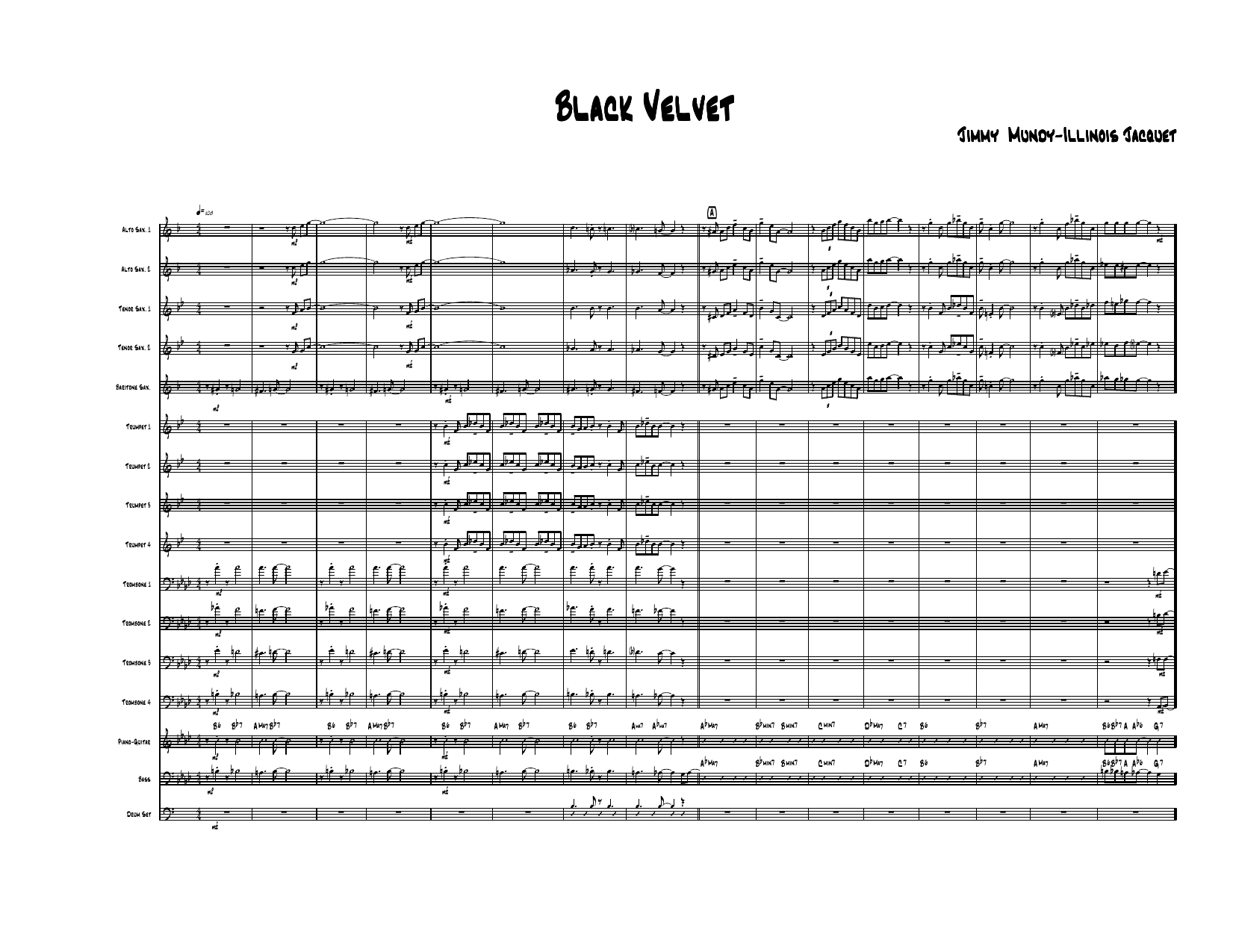
Black Velvet (J.Mundy) sheet music preview

Black Velvet (J.Mundy)

Composed by Jimmy Mundy

Arranged by J.Mundy

  • Ensemble: Big Band
  • Pages: 45
  • Instruments (16): Alto Saxophone 1, Alto Saxophone 2, Tenor Saxophone 1, Tenor Saxophone 2, Baritone Saxophone, Trumpet 1, Trumpet 2, Trumpet 3, Trumpet 4, Trombone 1, Trombone 2, Trombone 3, Trombone 4, Piano-Guitar, Bass, Drum Set
  • Difficulty: medium
  • Content: Individual Parts
  • Format: PDF Download (Instant)
  • Price: $24.99

Rooted in the rich soil of early American jazz and blues traditions, "Black Velvet" occupies a storied space in the big band repertoire, echoing the sophisticated swinging ethos of the swing era's golden age. While the tune's melodic origins stretch back into traditional idioms, it gained its definitive mid-century big band identity through master arrangers who understood how to balance driving rhythmic momentum with lush, sophisticated harmonic textures. This material serves as a quintessential vehicle for showcasing the dynamic capabilities of a standard seventeen-piece jazz orchestra, capturing the smoky, sophisticated ambiance of late-night dance halls and Harlem royalty. Jimmy Mundy’s legendary arranging signature—honed during his defining tenure with the Benny Goodman and Count Basie orchestras—is stamped all over this chart. Mundy approaches the form with an innate sense of architectural pacing, utilizing crisp call-and-response figures between the brass and reed sections that keep the energy perpetually buoyant. The arrangement opens with an inviting, sultry medium-swing groove in 4/4 time, anchored by a walking bassline and subtle hi-hat crispness. Rich, extended chord voicings in the lower reeds and muted brass build a dense, warm harmonic bed. As the chart unfolds, Mundy introduces clever chromatic voice-leading, swinging saxophone solis that effortlessly navigate intricate bebop-adjacent lines, and a towering, high-energy shout chorus that demands precision articulation and balanced section dynamics from the entire ensemble. Navigating this forty-five-page manuscript requires stylistic maturity, particularly in maintaining a relaxed yet driving macro-beat behind the syncopated figures. The lead alto saxophone and first trumpet carry the primary thematic weight, though ample textural variety is distributed across the entire horn line, giving tenor saxophones and trombones vital counter-melodies. Featured solo changes provide an ideal platform for an expressive horn player to stretch out over standard blues or AABA changes, depending on the sectional blueprint. Technical demands center primarily on stylistic unity: getting the section to lock in on short-long articulation patterns, executing clean glissandos, and balancing the brass bleats against the flowing woodwind lines during the dynamic peaks. Advanced high school ensembles with strong section leaders, collegiate jazz orchestras, and professional repertory bands will find this arrangement an exceptionally rewarding centerpiece for a concert or festival program. Because Mundy’s writing relies heavily on transparent textures and dynamic contrast rather than sheer brute velocity, it teaches younger players the nuances of ensemble breathing, intonation within tight section voicings, and the art of swinging at a moderate tempo. Audiences respond enthusiastically to its timeless blend of blues-drenched melancholy and buoyant, foot-tapping swing vitality. Success with this arrangement hinges on achieving an authentic, relaxed medium-swing feel where the eighth notes are properly swung without rushing the pulse. Conductors should emphasize that the backbone of the chart lies in the rhythm section; the drummer must maintain a steady, unhurried ride cymbal ping while feathering the bass drum, allowing the horns space to breathe into their syncopations. Key technical challenges involve the execution of unison saxophone passages at dynamic extremes—ranging from sultry whisper-level subtones to projecting lead lines. Brass players should utilize cup or bucket mutes where indicated to achieve that authentic period warmth, ensuring that plunger effects or falls are clean, stylized, and uniformly executed across the section. During rehearsal, isolate the intricate shout chorus to drill articulation markings (staccatos, tenutos, and accents) meticulously before integrating it back into the macro-form. Balance is paramount: ensure the accompanying brass do not overpower the saxophones during counter-melodic statements. Q: What instruments and parts are included in this arrangement? A: This comprehensive 45-page package includes a full conductor score alongside individual parts for a standard 16-instrument big band, featuring Alto Saxophone 1 & 2, Tenor Saxophone 1 & 2, Baritone Saxophone, Trumpets 1 through 4, Trombones 1 through 3, Bass Trombone, Piano, Guitar, Bass, and Drums. Q: What is the difficulty level of this J.Mundy arrangement? A: This chart is pitched at an advanced high school to collegiate level, requiring solid foundational swing literacy, clean sectional blend, and the ability to navigate moderately complex extended chord voicings and syncopated rhythms. Q: What is the historical style and context of this piece? A: Written in the classic swing era style associated with master arranger J.Mundy, the piece blends traditional blues idioms with sophisticated mid-century jazz orchestration, evoking the golden age of big band dance halls. Q: What makes this specific J.Mundy arrangement unique? A: The chart stands out due to Mundy's signature transparent textures, brilliant dynamic pacing, and clever interplay between the brass and reed sections, culminating in a textbook swinging shout chorus that showcases the entire ensemble. Q: What is the typical performance duration and tempo feel? A: The arrangement is designed around a comfortable, driving medium-swing tempo in 4/4 time, making it an ideal anchor piece that typically runs between 3 to 5 minutes depending on chosen solo choruses.

Questions and answers

What is included in the Black Velvet (J.Mundy) PDF?
The verified current file contains a conductor score and individual parts across 45 pages.
How many instruments or parts are listed for Black Velvet (J.Mundy)?
The verified instrumentation list contains 16 entries for this Big Band arrangement.
Who is credited for Black Velvet (J.Mundy)?
Composer: Jimmy Mundy. Arranger: J.Mundy.
What difficulty is listed for Black Velvet (J.Mundy)?
The verified difficulty level is medium.
Can I preview Black Velvet (J.Mundy) before buying?
Yes. The product page provides a preview generated from the current PDF file.
How is Black Velvet (J.Mundy) delivered?
After successful payment, the digital PDF is made available for download. The displayed price is $24.99.

Musicians Also Search For

Black Velvet J.Mundy PDFBlack Velvet J.Mundy sheet musicBlack Velvet arranged by J.MundyJ.Mundy big band chartsJ.Mundy jazz arrangements PDFBlack Velvet Jimmy Mundy sheet musicBlack Velvet Jimmy Mundy big band arrangementsJimmy Mundy big band chartsBlack Velvet big band arrangementsBlack Velvet big band PDF downloadBlack Velvet jazz sheet musicbig band sheet music downloadBlack Velvet conductor score PDFBlack Velvet individual parts downloadBlack Velvet sheet music PDFbuy Black Velvet sheet musicdownload Black Velvet PDFBlack Velvet jazz chartsbest J.Mundy big band arrangementsJimmy Mundy arranged by J.MundyBlack Velvet printable sheet musicbig band repertoire PDF

All arrangements by J.Mundy All Jimmy Mundy sheet music