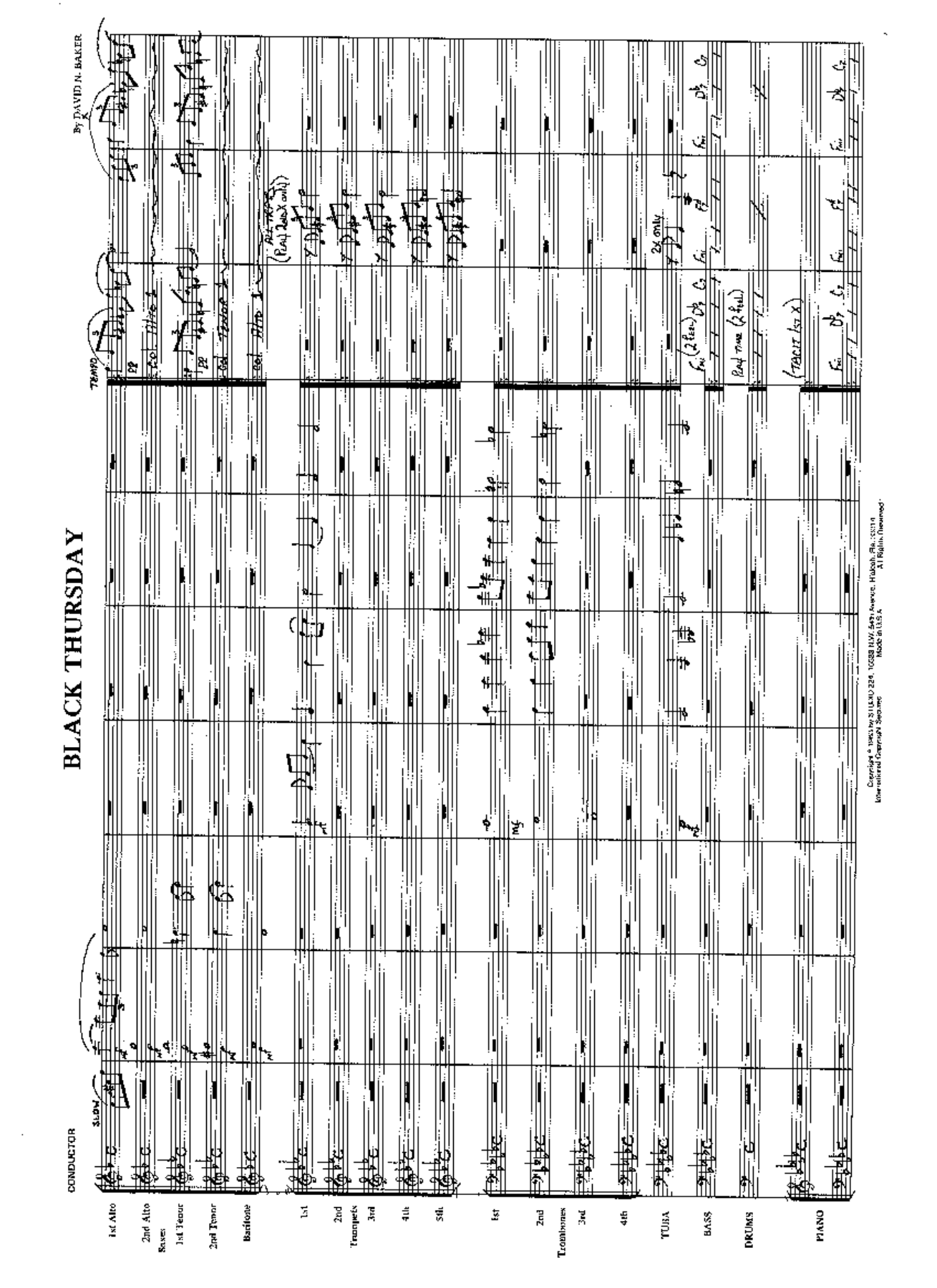
Black Thursday (D.Baker)
Composed by David Baker
Arranged by D.Baker
- Ensemble: Big Band
- Style: Jazz Standard
- Pages: 65
- Instruments (18): 1st Eb Alto Saxophone, 2nd Eb Alto Saxophone, 1st Bb Tenor Saxophone, 2nd Bb Tenor Saxophone, Eb Baritone Saxophone, 1st Trumpet, 2nd Trumpet, 3rd Trumpet, 4th Trumpet, 5th Trumpet, 1st Trombone, 2nd Trombone, 3rd Trombone, 4th Trombone, Tuba, Bass, Drums, Piano
- Difficulty: advanced
- Content: Individual Parts
- Format: PDF Download (Instant)
- Price: $24.99
David Baker's "Black Thursday" stands as a testament to the composer's profound impact on jazz, both as a performer and an educator. Originally composed in the mid-20th century, this piece emerged during a pivotal era for big band jazz, as the genre evolved from the dance-oriented swing of the 1930s and 40s into a more complex, harmonically sophisticated, and improvisation-driven art form. Baker, renowned for his work with George Russell and his groundbreaking contributions to jazz pedagogy at Indiana University, crafted "Black Thursday" as a powerful vehicle for modern jazz expression, showcasing intricate melodic lines and advanced harmonic concepts. While not a "standard" in the traditional sense of being widely covered by countless artists, it is a foundational work within the academic and professional jazz big band repertoire, frequently studied and performed by serious ensembles. This arrangement of "Black Thursday" by D.Baker captures the original's driving, sophisticated character while presenting it in a meticulously crafted big band setting. The piece is characterized by an insistent, medium-up swing tempo in 4/4, maintaining a relentless forward momentum that is both exhilarating and challenging. The overall mood is one of intellectual vigor and rhythmic propulsion, with moments of dense harmonic texture juxtaposed against soaring melodic statements. The key center, often shifting or ambiguous, contributes to its modern jazz feel, demanding a keen ear from all performers. D.Baker's approach to this iconic work is marked by a deep understanding of the source material, translating Baker's original small-group sensibilities into a powerful 17-piece big band canvas. D.Baker's arrangement is distinguished by its intelligent use of the full big band palette. Expect rich, often angular, saxophone soli sections that weave complex counterpoint, characteristic of David Baker's compositional style. The brass sections are employed with precision, delivering punchy, articulate figures that drive the rhythmic intensity, frequently utilizing tight, modern voicings. The arrangement features prominent solo opportunities, notably for Tenor Saxophone and Trumpet, allowing for individual improvisation within the piece's intricate framework. The melody is often passed between sections, creating dynamic textural shifts, and the arrangement culminates in a powerful, layered shout chorus that builds to an electrifying finish. Performing this arrangement is rewarding for its intellectual depth and the sheer thrill of navigating its rhythmic and harmonic complexities. This arrangement is ideally suited for advanced high school, collegiate, community, and professional big bands. Its technical demands, particularly in terms of rhythmic precision, intonation in complex voicings, and the improvisational requirements, necessitate a mature and experienced ensemble. The piece offers an excellent opportunity to explore modern big band writing and the legacy of David Baker, providing a substantial challenge that yields immense musical satisfaction upon mastery. "Black Thursday" demands a tight, unified rhythmic approach from the entire ensemble. Emphasize a strong, consistent medium-up swing feel, ensuring the rhythm section lays down an unwavering foundation while maintaining flexibility for soloists. The intricate saxophone soli passages require meticulous attention to articulation, balance, and intonation; rehearse these sections slowly, focusing on precise attacks and releases to achieve clarity. Brass players should aim for a bright, focused tone, particularly in the punchy ensemble figures, and be prepared for dynamic contrasts. There are no specific extended techniques (like plungers or doits) explicitly marked, but the overall modern jazz aesthetic allows for tasteful, idiomatic inflections from soloists. Conductors should guide the band through the often-dense harmonic landscape, ensuring that melodic lines cut through and that the ensemble maintains its driving energy throughout the piece's dynamic arc. Pay close attention to the ensemble hits and releases, which are critical for conveying the piece's sharp, angular character. Q: What instruments are included in this arrangement? A: This arrangement is scored for a standard 17-piece big band: Alto Saxophone 1, Alto Saxophone 2, Tenor Saxophone 1, Tenor Saxophone 2, Baritone Saxophone, Trumpet 1, Trumpet 2, Trumpet 3, Trumpet 4, Trombone 1, Trombone 2, Trombone 3, Bass Trombone, Piano, Bass, Drums, and Guitar. Q: What is the difficulty level of "Black Thursday (D.Baker)"? A: This arrangement is considered advanced, suitable for collegiate, community, or professional big bands. It requires strong rhythmic precision, advanced harmonic understanding, and proficient improvisational skills from soloists. Q: What is the musical style and historical context of "Black Thursday"? A: "Black Thursday" is a modern jazz big band piece, originally composed by David Baker. It represents the post-bebop era of jazz, showcasing complex harmonies, intricate melodic lines, and a driving medium-up swing feel, characteristic of Baker's influential compositional style. Q: What makes D.Baker's arrangement of "Black Thursday" unique? A: D.Baker's arrangement expertly translates David Baker's original small-group complexities into a full big band setting, featuring sophisticated saxophone soli, powerful brass writing with modern voicings, and prominent solo opportunities, all while maintaining the piece's intellectual vigor and rhythmic drive. Q: What is the typical performance duration and tempo for this piece? A: The typical performance duration for "Black Thursday (D.Baker)" is approximately 5-7 minutes, depending on the length of improvisations. It should be performed at a consistent medium-up swing tempo, around 180-200 BPM, maintaining a relentless forward momentum.
Questions and answers
- What is included in the Black Thursday (D.Baker) PDF?
- The verified current file contains a conductor score and individual parts across 65 pages.
- How many instruments or parts are listed for Black Thursday (D.Baker)?
- The verified instrumentation list contains 18 entries for this Big Band arrangement.
- Who is credited for Black Thursday (D.Baker)?
- Composer: David Baker. Arranger: D.Baker.
- What difficulty is listed for Black Thursday (D.Baker)?
- The verified difficulty level is advanced.
- What style is listed for Black Thursday (D.Baker)?
- The catalog lists the style as Jazz Standard.
- Can I preview Black Thursday (D.Baker) before buying?
- Yes. The product page provides a preview generated from the current PDF file.
- How is Black Thursday (D.Baker) delivered?
- After successful payment, the digital PDF is made available for download. The displayed price is $24.99.
Musicians Also Search For
Black Thursday D.Baker PDF • Black Thursday D.Baker sheet music • Black Thursday arranged by D.Baker • D.Baker big band charts • D.Baker jazz arrangements PDF • Black Thursday David Baker sheet music • Black Thursday David Baker big band arrangements • David Baker big band charts • Black Thursday big band arrangements • Black Thursday big band PDF download • Black Thursday jazz sheet music • big band sheet music download • Black Thursday conductor score PDF • Black Thursday individual parts download • Black Thursday sheet music PDF • Black Thursday Jazz Standard charts • Jazz Standard big band arrangements • buy Black Thursday sheet music • download Black Thursday PDF • Black Thursday jazz charts • best D.Baker big band arrangements • David Baker arranged by D.Baker • Black Thursday printable sheet music • big band repertoire PDF