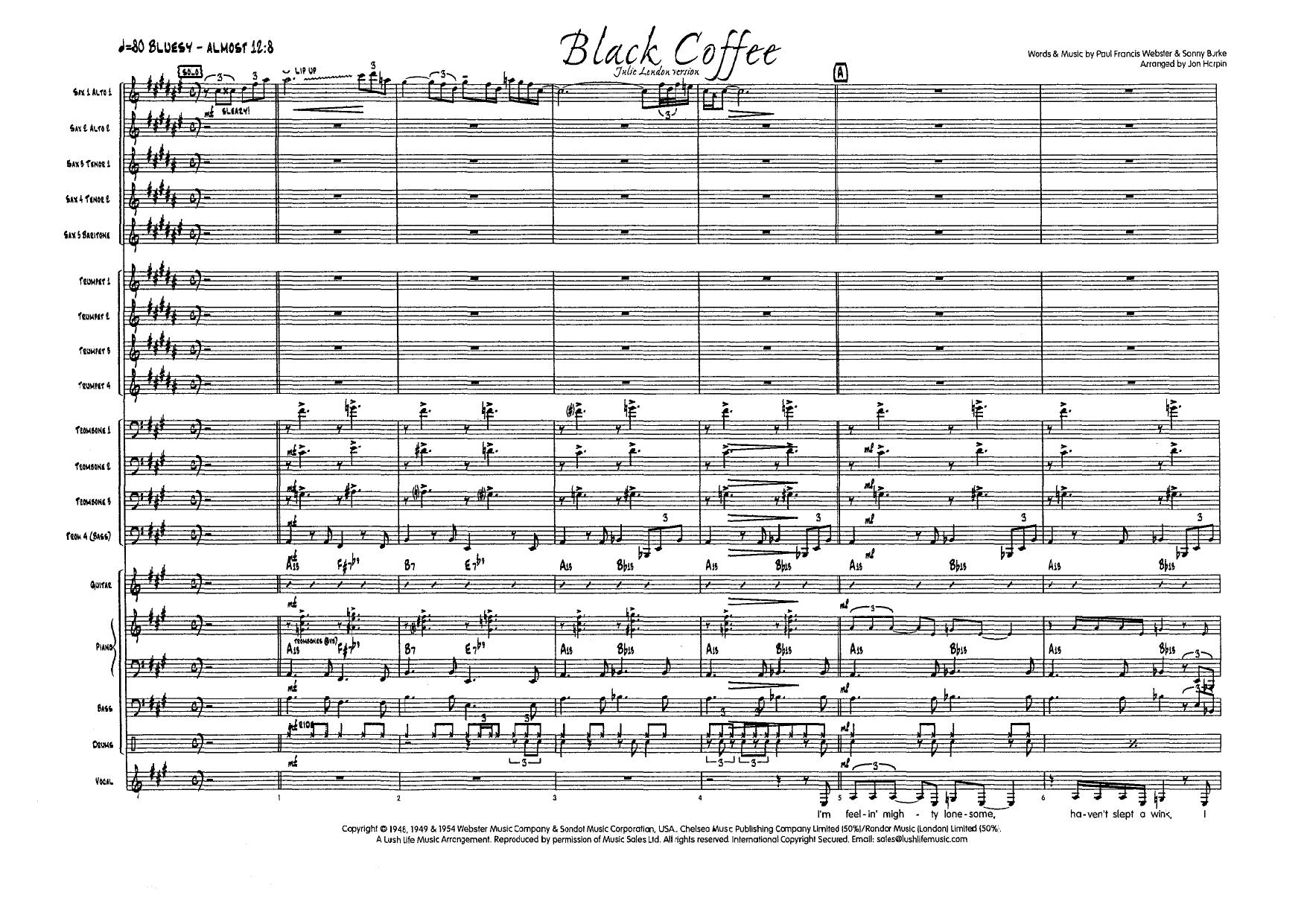
Black Coffee - Ruud Bergamin (R.Sergamin)
Composed by Webster, Burke
Arranged by Ruud Sergamin
- Ensemble: Big Band Vocal
- Style: Jazz Standard
- Pages: 40
- Instruments (19): Vocal, Sax 1 Alto 1, Sax 2 Alto 2, Sax 3 Tenor 1, Sax 4 Tenor 2, Sax 5 Baritone, Bari (if no bass bone), Trumpet 1, Trumpet 2, Trumpet 3, Trumpet 4, Trombone 1, Trombone 2, Trombone 3, Trombone 4 (Bass), Piano, Guitar, Bass, Drums
- Difficulty: medium
- Content: Individual Parts
- Format: PDF Download (Instant)
- Price: $24.99
"Black Coffee," a poignant ballad penned by Sonny Burke and Paul Francis Webster, emerged in 1948, quickly becoming a quintessential jazz standard. Its melancholic lyrics and evocative melody captured the post-war sentiment of longing and solitude, resonating deeply with audiences. While initially recorded by artists like Sarah Vaughan, it was largely made famous by Peggy Lee's iconic 1953 Capitol recording, solidifying its place in the jazz vocal canon. The song itself is a masterclass in emotional storytelling, often performed as a slow, expressive ballad, characterized by its minor key and blues-infused harmonic progressions, making it a staple for vocalists seeking to convey deep sentiment. Ruud Sergamin's arrangement of "Black Coffee" for big band and vocalist masterfully captures the song's inherent drama while infusing it with sophisticated big band textures. Sergamin maintains the original's slow ballad tempo, typically around 60-70 BPM, in a 4/4 time signature, allowing the vocalist ample space for expressive phrasing. The arrangement is primarily set in the key of D minor, providing a rich, somber palette. Sergamin’s signature approach often involves lush, dense voicings for the horn sections, creating a warm, enveloping soundscape that supports the vocal line without overpowering it. Expect carefully crafted ensemble passages that build and recede, employing extended harmonies (9ths, 11ths, 13ths) to enhance the emotional depth, particularly in the brass and sax soli sections. This arrangement features the vocalist prominently throughout, carrying the main melody with the big band providing a tapestry of accompaniment. Sergamin introduces subtle counter-melodies in the saxophones and brass, adding intricate layers to the texture. While the focus remains on the vocalist, there is a beautifully written, optional improvised solo section, typically for tenor saxophone or trumpet, offering a moment for instrumental expression that complements the vocal narrative. The arrangement builds towards a powerful, yet controlled, ensemble climax before returning to a more intimate vocal statement for the conclusion. Technical challenges include precise control of dynamics, particularly in the softer passages, and achieving a unified, expressive blend within the horn sections. The rewarding aspect lies in the opportunity to perform a timeless standard with a sophisticated, emotionally charged big band backing. This arrangement is ideally suited for college-level jazz ensembles, advanced community big bands, and professional groups. Its harmonic sophistication and dynamic demands require musicians with strong reading skills, excellent intonation, and a mature understanding of ballad performance. High school bands with exceptionally strong sections and a dedicated vocalist could also tackle this, provided ample rehearsal time is allocated to nuance and blend. The 40 pages indicate a comprehensive score and parts, promising a detailed and rewarding performance experience that showcases both the vocalist and the ensemble's expressive capabilities. Conductors should emphasize a consistent, unhurried slow ballad tempo (quarter note = 60-70 BPM) with a deeply felt, expressive swing eighth-note feel, avoiding any tendency to rush. The primary technical challenge lies in achieving seamless dynamic contrasts, particularly in the softer ensemble sections where blend and intonation are paramount. Encourage brass players to use cup mutes where indicated for a darker, more intimate sound, and ensure careful execution of sustained chords, allowing them to bloom. Rehearsal time should focus on vocal-ensemble balance, ensuring the band supports rather than competes with the vocalist. Pay close attention to the lead trumpet's phrasing and sound, as they often guide the ensemble's melodic shape. The optional improvised solo should be approached with sensitivity, maintaining the song's melancholic mood. Q: What instruments and parts are included in this arrangement? A: This big band vocal arrangement typically includes a full score, a vocal lead sheet, and individual parts for 5 saxophones (AATTB), 4 trumpets, 4 trombones, piano, bass, drums, and guitar. Q: What is the difficulty level of "Black Coffee - Ruud Sergamin" for big band and vocalist? A: This arrangement is rated as medium-advanced. It requires strong ensemble playing, precise dynamics, and a vocalist capable of expressive ballad interpretation, making it suitable for college, advanced community, or professional ensembles. Q: What musical style and historical context does this arrangement represent? A: This is a classic jazz standard, originally composed in 1948, famous for its melancholic mood and evocative lyrics. Ruud Sergamin's arrangement captures the slow ballad style, reminiscent of mid-20th century big band vocal features. Q: What makes Ruud Sergamin's arrangement of "Black Coffee" unique? A: Sergamin's treatment is distinguished by its lush, sophisticated voicings, rich harmonic language, and careful dynamic shaping that fully supports the vocalist while providing engaging ensemble textures and an optional, tastefully integrated instrumental solo. Q: What is the approximate performance duration and recommended tempo for this arrangement? A: The approximate performance duration is 4-5 minutes, depending on the soloist and vocal interpretation. The recommended tempo is a slow ballad, around 60-70 beats per minute (quarter note).
Questions and answers
- What is included in the Black Coffee - Ruud Bergamin (R.Sergamin) PDF?
- The verified current file contains a conductor score and individual parts across 40 pages.
- How many instruments or parts are listed for Black Coffee - Ruud Bergamin (R.Sergamin)?
- The verified instrumentation list contains 19 entries for this Big Band Vocal arrangement.
- Who is credited for Black Coffee - Ruud Bergamin (R.Sergamin)?
- Composer: Webster, Burke. Arranger: Ruud Sergamin.
- What difficulty is listed for Black Coffee - Ruud Bergamin (R.Sergamin)?
- The verified difficulty level is medium.
- What style is listed for Black Coffee - Ruud Bergamin (R.Sergamin)?
- The catalog lists the style as Jazz Standard.
- Can I preview Black Coffee - Ruud Bergamin (R.Sergamin) before buying?
- Yes. The product page provides a preview generated from the current PDF file.
- How is Black Coffee - Ruud Bergamin (R.Sergamin) delivered?
- After successful payment, the digital PDF is made available for download. The displayed price is $24.99.
Musicians Also Search For
Black Coffee - Ruud Bergamin Ruud Sergamin PDF • Black Coffee - Ruud Bergamin Ruud Sergamin sheet music • Black Coffee - Ruud Bergamin arranged by Ruud Sergamin • Ruud Sergamin big band vocal charts • Ruud Sergamin jazz arrangements PDF • Black Coffee - Ruud Bergamin Webster, Burke sheet music • Black Coffee - Ruud Bergamin Webster, Burke big band vocal arrangements • Webster, Burke big band vocal charts • Black Coffee - Ruud Bergamin big band vocal arrangements • Black Coffee - Ruud Bergamin big band vocal PDF download • Black Coffee - Ruud Bergamin jazz sheet music • big band vocal sheet music download • Black Coffee - Ruud Bergamin conductor score PDF • Black Coffee - Ruud Bergamin individual parts download • Black Coffee - Ruud Bergamin sheet music PDF • Black Coffee - Ruud Bergamin Jazz Standard charts • Jazz Standard big band vocal arrangements • buy Black Coffee - Ruud Bergamin sheet music • download Black Coffee - Ruud Bergamin PDF • Black Coffee - Ruud Bergamin jazz charts • best Ruud Sergamin big band vocal arrangements • Webster, Burke arranged by Ruud Sergamin • Black Coffee - Ruud Bergamin printable sheet music • big band vocal repertoire PDF