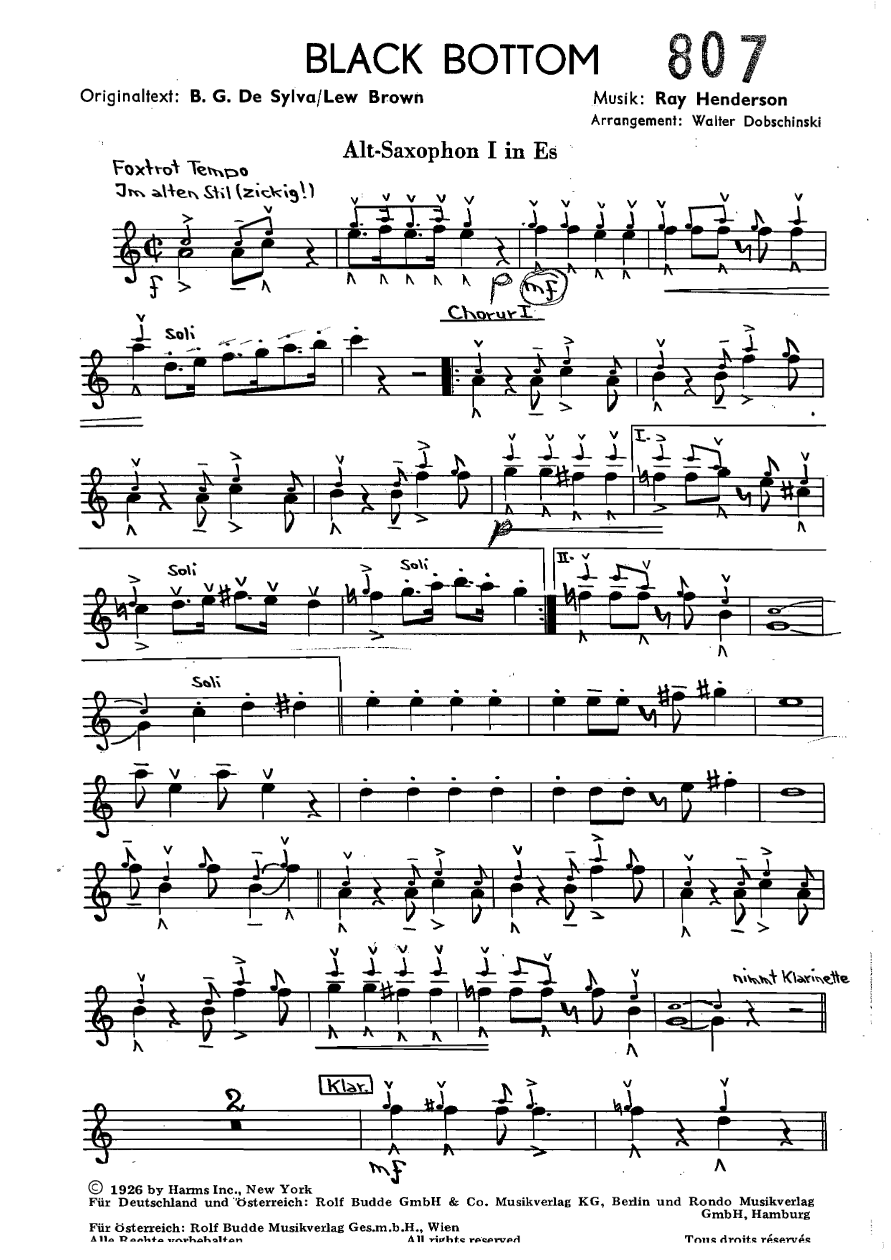
Black Bottom (W.Dobschinski)
Composed by Ray Henderson, Buddy DeSylva, Lew Brown
Arranged by W. Dobschinski
- Ensemble: Big Band Dance
- Style: Foxtrot
- Pages: 39
- Instruments (17): Alto Saxophone 1, Alto Saxophone 2, Tenor Saxophone 1, Tenor Saxophone 2, Baritone Saxophone, Trumpet 1, Trumpet 2, Trumpet 3, Trumpet 4, Trombone 1, Trombone 2, Trombone 3, Bass Trombone, Piano, Bass, Drums, Guitar
- Difficulty: medium
- Content: Individual Parts
- Format: PDF Download (Instant)
- Price: $24.99
"Black Bottom," a vibrant Foxtrot, transports listeners directly to the heart of the Roaring Twenties, an era defined by explosive social change, burgeoning jazz, and the infectious energy of new dance crazes. Originally composed by the prolific songwriting trio of Ray Henderson, Buddy DeSylva, and Lew Brown, the song became a cornerstone of the 1920s dance hall repertoire. While not a traditional "jazz standard" in the improvisational sense, its enduring popularity as a dance tune made it an essential part of the early big band and dance orchestra canon, embodying the syncopated rhythms and lively spirit that captivated a generation. Its association with the "Black Bottom" dance, a precursor to the Charleston, cemented its place in American cultural history, often performed by prominent dance bands of the time like those led by Paul Whiteman and Fletcher Henderson. W. Dobschinski's arrangement of "Black Bottom" captures the authentic spirit of a 1920s big band dance orchestra, presented with a clarity and precision suitable for contemporary ensembles. The musical character is an undeniable up-tempo Foxtrot, designed to evoke the lively, syncopated bounce of the original dance. Dobschinski masterfully employs traditional big band voicings, emphasizing tight section work and a driving rhythmic pulse. The arrangement is primarily in a bright major key, contributing to its inherently cheerful and energetic mood. Expect a consistent 4/4 meter with a crisp, non-swinging but highly rhythmic feel, characteristic of the era's dance music, rather than a modern swing interpretation. The arrangement's energy is high and sustained, aiming for a celebratory, almost boisterous atmosphere that encourages movement. Dobschinski's distinctive approach to this classic is evident in his meticulous scoring, which prioritizes idiomatic writing for each section. The melody is predominantly carried by the saxophone section, often in unison or close harmony, with brass interjections providing punch and rhythmic counterpoint. There are no extended improvised solo sections, aligning with the dance orchestra tradition where arrangements were king. Instead, the "solos" are typically written-out soli passages, showcasing the collective dexterity of the saxophone or brass sections. Expect a dynamic interplay between the brass and reeds, with well-placed shout choruses that build excitement. The technical challenges lie primarily in achieving precise articulation, unified rhythmic execution, and maintaining the relentless, energetic tempo. Rewarding to perform for its historical authenticity and sheer fun, this arrangement offers a fantastic opportunity to explore the foundational sounds of big band music. This arrangement is ideally suited for college, community, and professional big band dance ensembles seeking to authentically recreate the sound of the 1920s. Its demands for ensemble precision and rhythmic drive make it an excellent educational tool for understanding early big band arranging techniques and performance practices. While high school bands with strong section leaders and a dedicated rhythm section could tackle it, the sustained energy and precise ensemble playing required suggest a slightly more experienced group will find it most rewarding. Conductors should aim for a bright, unyielding tempo, around quarter note = 180-200 bpm, emphasizing a crisp, non-swinging Foxtrot feel rather than a modern jazz swing. The rhythmic precision in the brass and saxophone sections is paramount; focus on unified attacks and releases, particularly in the numerous syncopated figures. Articulation should be light and detached for most passages, with clear accents driving the rhythmic momentum. Rehearsal time should be dedicated to balancing the interplay between the melody-carrying saxophones and the brass counter-melodies/punctuations. Ensure the rhythm section maintains a steady, driving pulse without rushing, with the bass and drums locking into a solid two-beat or four-beat feel appropriate for the era. The absence of improvised solos means all musicians must contribute to the ensemble's collective energy and precision. Q: What instruments and parts are included in the "Black Bottom" arrangement? A: This arrangement is scored for a standard 17-piece big band dance orchestra, including Alto Saxophone 1, Alto Saxophone 2, Tenor Saxophone 1, Tenor Saxophone 2, Baritone Saxophone, Trumpet 1, Trumpet 2, Trumpet 3, Trumpet 4, Trombone 1, Trombone 2, Trombone 3, Bass Trombone, Piano, Bass, Guitar, and Drums. Q: What is the difficulty level of this arrangement? A: This arrangement is rated as medium-advanced. While it doesn't feature complex harmonic progressions or extended improvisation, it demands high levels of rhythmic precision, unified articulation, and sustained ensemble energy at a brisk tempo, making it suitable for college, community, and professional big bands. Q: What musical style and historical context does "Black Bottom" represent? A: "Black Bottom" is a classic Foxtrot from the 1920s, embodying the lively, syncopated dance music prevalent during the Roaring Twenties. It reflects the early big band dance orchestra sound, characterized by tight section writing and a driving, non-swinging rhythmic feel. Q: What makes W. Dobschinski's arrangement of "Black Bottom" unique? A: Dobschinski's arrangement stands out for its authentic recreation of the 1920s big band dance sound, featuring idiomatic voicings, prominent saxophone soli sections, and dynamic brass interjections, all meticulously scored to capture the historical essence of the original piece. Q: What is the typical performance duration or tempo for this arrangement? A: "Black Bottom" is designed to be performed at a brisk, consistent Foxtrot tempo, typically in the range of quarter note = 180-200 bpm. This sustained up-tempo feel usually results in a performance duration of approximately 2.5 to 3.5 minutes, depending on the conductor's interpretation.
Musicians Also Search For
Black Bottom W. Dobschinski PDF • Black Bottom W. Dobschinski sheet music • Black Bottom arranged by W. Dobschinski • W. Dobschinski big band dance charts • W. Dobschinski jazz arrangements PDF • Black Bottom Ray Henderson, Buddy DeSylva, Lew Brown sheet music • Black Bottom Ray Henderson, Buddy DeSylva, Lew Brown big band dance arrangement • Ray Henderson, Buddy DeSylva, Lew Brown big band dance charts • Black Bottom big band dance arrangement • Black Bottom big band dance PDF download • Black Bottom jazz ensemble sheet music • big band dance sheet music instant download • Black Bottom individual parts download • Black Bottom sheet music with parts • Black Bottom Foxtrot chart • Foxtrot big band dance arrangements • buy Black Bottom sheet music online • download Black Bottom PDF • Black Bottom jazz chart • best W. Dobschinski big band dance arrangements • Ray Henderson, Buddy DeSylva, Lew Brown songs arranged by W. Dobschinski • Black Bottom printable sheet music • big band dance repertoire PDF