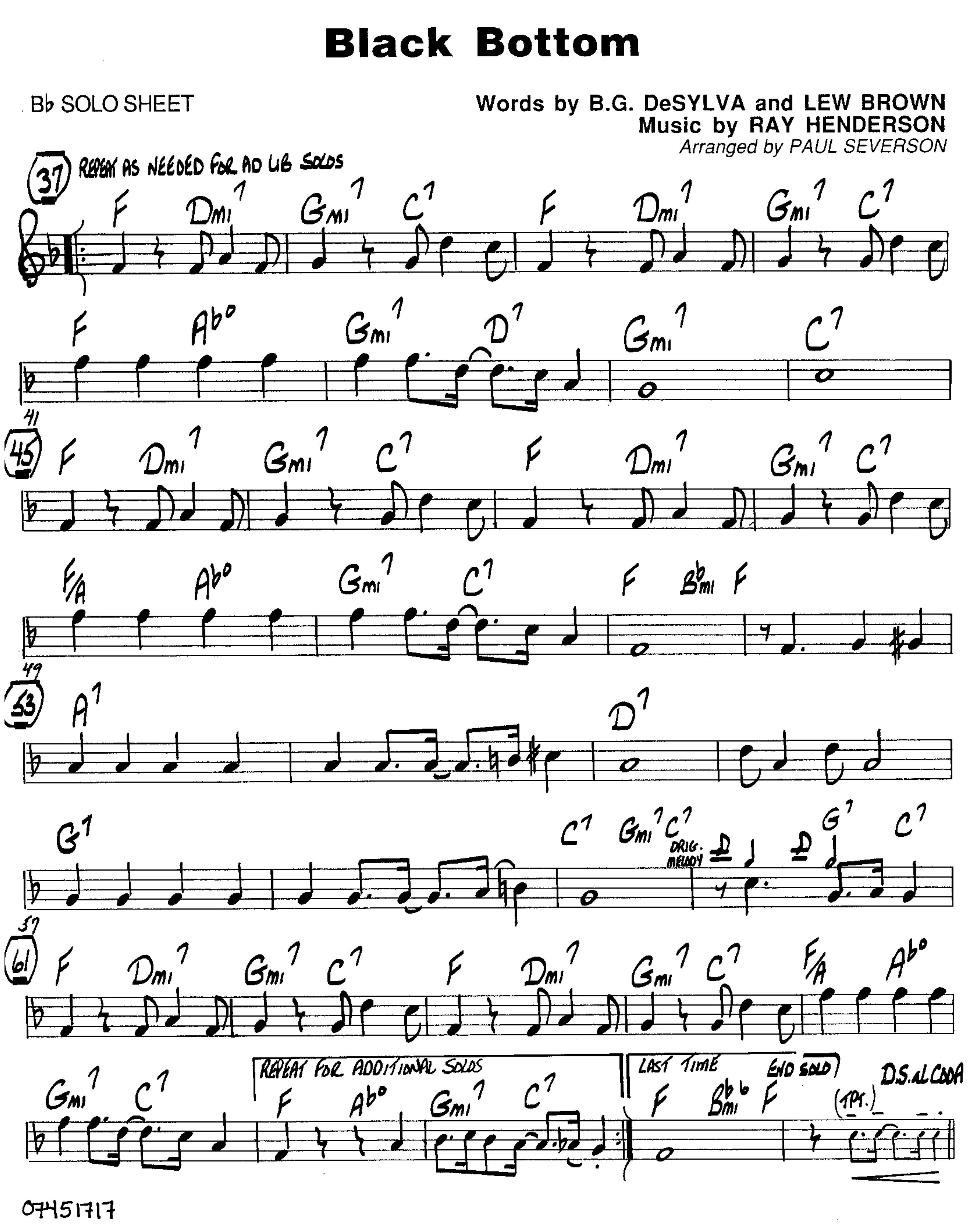
Black Bottom (Severson)
Composed by Ray Henderson, Buddy DeSylva, Lew Brown
Arranged by Severson
- Ensemble: Dixieland Band
- Style: Jazz Standard
- Pages: 12
- Instruments (10): Bb Solo Sheet, Clarinet, Tenor Sax, Trumpet, C Solo Sheet, Trombone, Bass / Tuba, Drums, Guitar / Banjo, Piano / Conductor
- Difficulty: easy
- Content: Individual Parts
- Format: PDF Download (Instant)
- Price: $18.99
"Black Bottom," originally composed by the prolific songwriting trio of Ray Henderson, Buddy DeSylva, and Lew Brown, emerged during the vibrant Jazz Age of the 1920s, a period synonymous with cultural upheaval and the popularization of new dance forms. The tune gained immense popularity as a dance craze, rivaling the Charleston in its widespread appeal, and became a staple of early jazz and dance bands. Its infectious rhythm and spirited melody perfectly encapsulated the exuberance and carefree spirit of the era, cementing its place as a foundational jazz standard that continues to be celebrated for its historical significance and enduring charm. This piece is a quintessential example of the hot jazz sound that defined the Roaring Twenties, often associated with speakeasies, flappers, and the birth of American popular music. Severson's arrangement of "Black Bottom" for Dixieland band captures the authentic spirit of the 1920s with a medium-up tempo feel, firmly rooted in a classic 4/4 swing. The arrangement is set in the bright key of B-flat major, evoking a joyous and celebratory mood that is characteristic of the genre. The energy is consistently high, driven by a buoyant rhythm section and the interplay of the front line. Severson masterfully employs traditional Dixieland counterpoint, allowing each voice—clarinet, trumpet, and trombone—to maintain its distinct melodic and harmonic role while contributing to a cohesive ensemble sound. The arrangement features a lively, often raucous, texture that conjures images of bustling dance halls and spirited street parades. What distinguishes Severson's treatment is his deep understanding of Dixieland idiom combined with a flair for engaging ensemble writing. The arrangement opens with a classic Dixieland collective improvisation feel, establishing the piece's historical context immediately. The melody is initially carried by the trumpet, with clarinet obbligato and trombone counter-melodies, before transitioning into a full ensemble soli section that showcases Severson's clever voicings. There are designated solo opportunities for clarinet and trumpet, allowing for individual expression within the traditional framework, typically over a clear, driving rhythm section vamp. A hallmark of Severson's style is his ability to craft shout choruses that build excitement through rhythmic unison figures and dynamic contrasts, culminating in a spirited final chorus that often features a return to collective improvisation, ensuring a thrilling and satisfying conclusion. This arrangement is ideally suited for high school, college, and community Dixieland ensembles seeking to perform historically authentic and musically engaging repertoire. The technical demands are moderate, focusing more on stylistic accuracy, rhythmic precision, and ensemble blend rather than extreme virtuosity. Musicians will find reward in navigating the intricate counterpoint, developing a strong sense of swing, and mastering the art of collective improvisation within a structured arrangement. Specific musical moments, such as the spirited call-and-response passages between the front-line instruments and the driving rhythm section breaks, make this a particularly enjoyable and educational piece to perform, offering a genuine taste of early jazz. To capture the authentic spirit of "Black Bottom," maintain a consistent medium-up swing tempo, around 180-200 BPM, with a light, buoyant feel. Emphasize the two-beat feel in the rhythm section during initial choruses, transitioning to a walking bass line as energy builds. The key technical challenge lies in achieving clear, balanced counterpoint within the front line; encourage individual voices (trumpet, clarinet, trombone) to project their lines without overpowering the others, especially during collective improvisation sections. Articulation should be crisp and precise, with a focus on short, detached notes for rhythmic drive. Ensure the clarinet's obbligato lines are fluid and expressive. Encourage stylistic embellishments like subtle scoops and falls, particularly from the trumpet and trombone, to enhance the Dixieland character. Rehearsal should focus on rhythmic tightness and dynamic shaping to build excitement towards the shout choruses and the final, spirited collective improvisation. Q: What instruments and parts are included in this arrangement of "Black Bottom (Severson)"? A: This Dixieland band arrangement includes parts for Trumpet, Clarinet, Trombone, Piano, Bass (or Tuba), and Drums, providing a complete score for a traditional six-piece ensemble. Q: What is the difficulty level of this arrangement? A: This arrangement is rated as medium difficulty, making it appropriate for high school, college, and community Dixieland bands. It requires solid instrumental technique and a good understanding of early jazz stylistic conventions. Q: What musical style and historical context does "Black Bottom (Severson)" represent? A: This arrangement is a classic Dixieland jazz standard from the 1920s, embodying the energetic and dance-oriented "hot jazz" style of the Jazz Age, originally popularized as a dance craze. Q: What makes Severson's arrangement of "Black Bottom" unique? A: Severson's arrangement is distinguished by its authentic Dixieland counterpoint, clever ensemble voicings, well-placed solo opportunities for clarinet and trumpet, and spirited shout choruses that build to an exciting, collectively improvised finale. Q: What is the typical performance duration or tempo for this piece? A: "Black Bottom (Severson)" is designed for a medium-up swing tempo, typically around 180-200 BPM, resulting in a performance duration of approximately 3 to 4 minutes, depending on the number and length of solos.
Questions and answers
- What is included in the Black Bottom (Severson) PDF?
- The verified current file contains a conductor score and individual parts across 12 pages.
- How many instruments or parts are listed for Black Bottom (Severson)?
- The verified instrumentation list contains 10 entries for this Dixieland Band arrangement.
- Who is credited for Black Bottom (Severson)?
- Composer: Ray Henderson, Buddy DeSylva, Lew Brown. Arranger: Severson.
- What difficulty is listed for Black Bottom (Severson)?
- The verified difficulty level is easy.
- What style is listed for Black Bottom (Severson)?
- The catalog lists the style as Jazz Standard.
- Can I preview Black Bottom (Severson) before buying?
- Yes. The product page provides a preview generated from the current PDF file.
- How is Black Bottom (Severson) delivered?
- After successful payment, the digital PDF is made available for download. The displayed price is $18.99.
Musicians Also Search For
Black Bottom Severson PDF • Black Bottom Severson sheet music • Black Bottom arranged by Severson • Severson dixieland band charts • Severson jazz arrangements PDF • Black Bottom Ray Henderson, Buddy DeSylva, Lew Brown sheet music • Black Bottom Ray Henderson, Buddy DeSylva, Lew Brown dixieland band arrangements • Ray Henderson, Buddy DeSylva, Lew Brown dixieland band charts • Black Bottom dixieland band arrangements • Black Bottom dixieland band PDF download • Black Bottom jazz sheet music • dixieland band sheet music download • Black Bottom conductor score PDF • Black Bottom individual parts download • Black Bottom sheet music PDF • Black Bottom Jazz Standard charts • Jazz Standard dixieland band arrangements • buy Black Bottom sheet music • download Black Bottom PDF • Black Bottom jazz charts • best Severson dixieland band arrangements • Ray Henderson, Buddy DeSylva, Lew Brown arranged by Severson • Black Bottom printable sheet music • dixieland band repertoire PDF