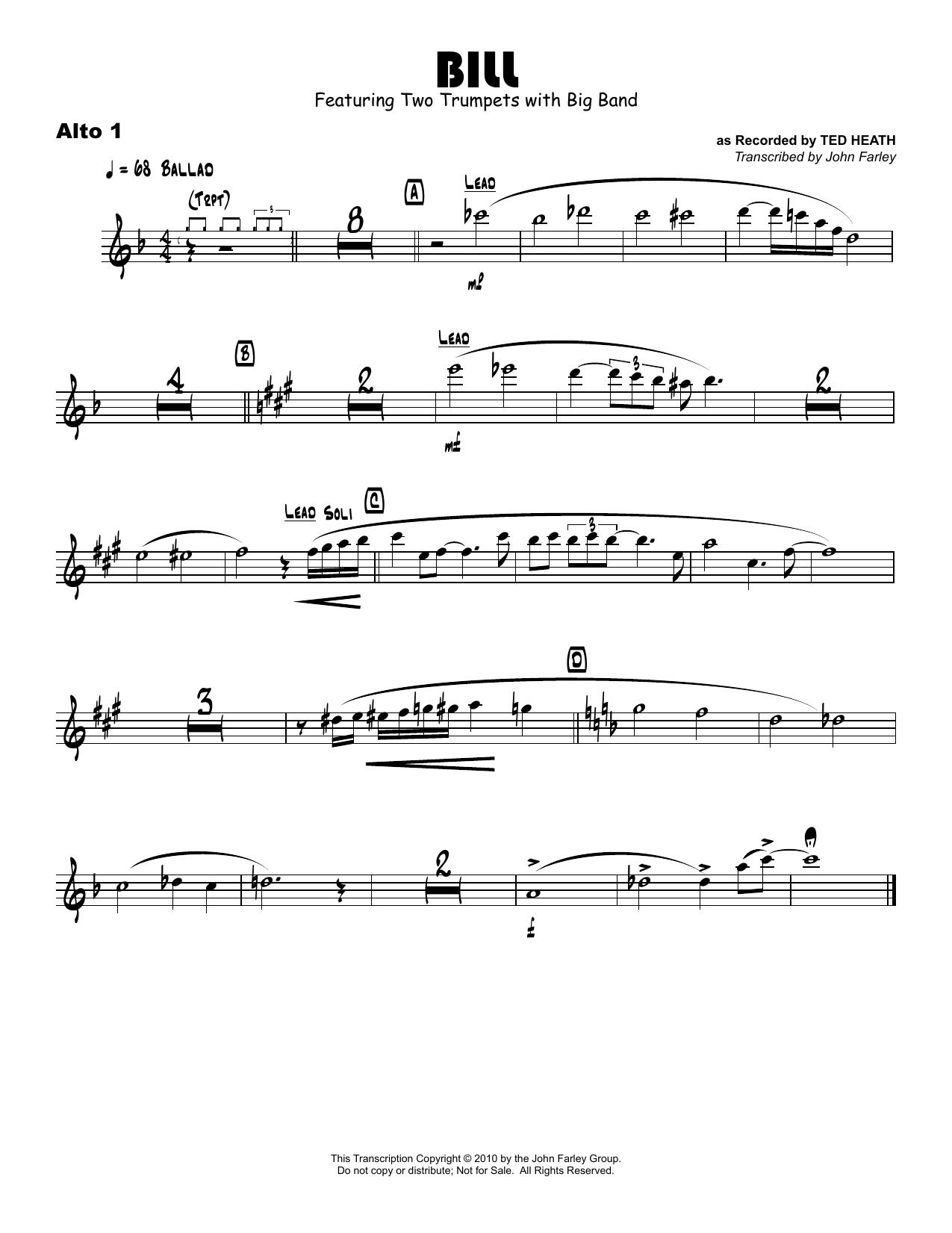
Bill (J.Farley) sheet music preview

Bill (J.Farley)

Composed by Jerome Kern

Arranged by John Farley

  • Ensemble: Big Band
  • Pages: 26
  • Instruments (18): Alto 1, Alto 2, Tenor 1, Tenor 2, Bari, Trumpet 1, Trumpet 2, Trumpet 3, Trumpet 4, Trombone 1, Trombone 2, Trombone 3, Trombone 4, Guitar, Piano, Bass, Drums, Male Vocal
  • Difficulty: medium
  • Content: Individual Parts
  • Format: PDF Download (Instant)
  • Price: $24.99

Jerome Kern and P.G. Wodehouse originally penned "Bill" for the 1918 musical *Oh, Lady! Lady!!*, though it ultimately achieved its legendary status when interpolated into the 1927 landmark Broadway masterpiece *Show Boat*, with lyrics later revised by Oscar Hammerstein II. Immortalized in jazz history by vocal luminaries like Helen Morgan and later reinterpreted by instrumental jazz icons, this poignant standard represents the pinnacle of Golden Age American songwriting. Its sophisticated, melancholy harmonic framework and narrative-driven melody have long invited jazz artists to explore deep emotional territory outside of the standard upbeat 32-bar AABA convention, making it a revered vehicle for expressive, expressive small-group and large-ensemble writing. John Farley’s masterful big band adaptation reimagines Kern’s theatrical ballad as a lush, introspective vehicle characterized by a gentle, flowing 4/4 rubato-to-medium swing feel. Evoking a smoky, late-night West Coast atmosphere, the arrangement balances rich, extended chord voicings with sparse, transparent textures that allow the underlying bittersweet emotion to take center stage. The mood shifts seamlessly from hushed, intimate woodwind and muted brass interplay to swelling, cinematic peaks that evoke the grandeur of classic Hollywood scoring, while maintaining an underlying jazz sensibility through subtle harmonic reharmonizations and chromatic descents. Farley structures the 26-page score with an acute awareness of big band color, expertly utilizing the 8-instrument instrumentation—featuring a frontline of two trumpets, alto saxophone, tenor saxophone, trombone, and rhythm section support—to achieve maximum sonic depth without sounding congested. The arrangement opens with a rubato preamble before settling into a sustained, flowing tempo where the alto and tenor saxophones frequently carry intertwined contrapuntal melodic lines. A striking middle section features an improvised solo space over a sophisticated modal-inflected bridge, supported by shimmering chordal voicings in the upper brass. Farley avoids a heavy, aggressive shout chorus, opting instead for a soaring, lyrical ensemble tutti that builds organically through dynamic contouring before resolving into a peaceful, haunting final chord. Advanced high school, collegiate, and professional jazz ensembles will find this arrangement an exceptional vehicle for developing ensemble blend, intonation, and mature ballad phrasing. Because of the exposed nature of the 8-player instrumentation, individual players must possess strong tone control and excellent dynamic sensitivity. The primary technical demands center on breath support during long, sustained phrases, precise intonation on close-position chord voicings, and the stylistic maturity required to interpret a classic vocal standard as a sophisticated instrumental tone poem. Conductors should approach "Bill" with a strong emphasis on rubato flexibility and linear phrasing, treating the tempo not as a rigid metronomic grid, but as a breathing, malleable pulse. The opening section requires extreme control from the trumpet and trombone sections; ensure that any muted passages blend seamlessly without pinching the sound. Balance is critical given the 8-instrument configuration—players must constantly listen across sections to ensure internal chord voicings are balanced, particularly when the harmony moves through chromatic passing tones. The rhythm section plays a pivotal role in establishing the mood: the pianist should voice chords sparingly, utilizing sparse, impressionistic rootless voicings, while the bassist provides a warm, half-note or two-beat feel that anchors the harmonic movement without overpowering the horns. Soloists should be encouraged to treat their features as a lyrical extension of the melody, prioritizing melodic development and space over dense bebop-line execution. Pay careful attention to dynamic markings; the emotional impact of this arrangement relies entirely on the contrast between delicate, whispered pianissimo passages and full-throated, resonant climaxes. Q: What instruments and parts are included in this 26-page arrangement? A: The arrangement is scored for an 8-instrument ensemble, specifically featuring two trumpets, alto saxophone, tenor saxophone, trombone, and a full rhythm section (piano, bass, drums), complete with full conductor and instrumental parts. Q: What is the difficulty level of John Farley’s big band arrangement of "Bill"? A: This arrangement is best suited for advanced high school, collegiate, and professional jazz ensembles due to its demanding requirements for blend, intonation, extended harmonic interpretation, and mature ballad phrasing. Q: What is the historical style and musical context of this piece? A: Originating from the 1927 Broadway musical *Show Boat* by Jerome Kern and Oscar Hammerstein II, this piece is treated here as a sophisticated, late-night jazz ballad that bridges early American musical theater with modern jazz harmony. Q: What makes this specific arrangement by John Farley unique? A: Farley’s adaptation uniquely condenses the lush orchestrations of a full big band into a transparent 8-instrument texture, utilizing rich extended harmonies, contrapuntal saxophone writing, and a cinematic dynamic arc instead of a traditional heavy shout chorus. Q: What is the performance tempo and expected duration of the piece? A: The arrangement is performed at a flexible, ballad-to-medium swing tempo (around 72–80 BPM) with rubato sections, and typically runs between 4 to 5 minutes depending on the length of the improvised solo choruses.

Questions and answers

What is included in the Bill (J.Farley) PDF?
The verified current file contains a conductor score and individual parts across 26 pages.
How many instruments or parts are listed for Bill (J.Farley)?
The verified instrumentation list contains 18 entries for this Big Band arrangement.
Who is credited for Bill (J.Farley)?
Composer: Jerome Kern. Arranger: John Farley.
What difficulty is listed for Bill (J.Farley)?
The verified difficulty level is medium.
Can I preview Bill (J.Farley) before buying?
Yes. The product page provides a preview generated from the current PDF file.
How is Bill (J.Farley) delivered?
After successful payment, the digital PDF is made available for download. The displayed price is $24.99.

Musicians Also Search For

Bill John Farley PDFBill John Farley sheet musicBill arranged by John FarleyJohn Farley big band chartsJohn Farley jazz arrangements PDFBill Jerome Kern sheet musicBill Jerome Kern big band arrangementsJerome Kern big band chartsBill big band arrangementsBill big band PDF downloadBill jazz sheet musicbig band sheet music downloadBill conductor score PDFBill individual parts downloadBill sheet music PDFbuy Bill sheet musicdownload Bill PDFBill jazz chartsbest John Farley big band arrangementsJerome Kern arranged by John FarleyBill printable sheet musicbig band repertoire PDF

All arrangements by John Farley All Jerome Kern sheet music