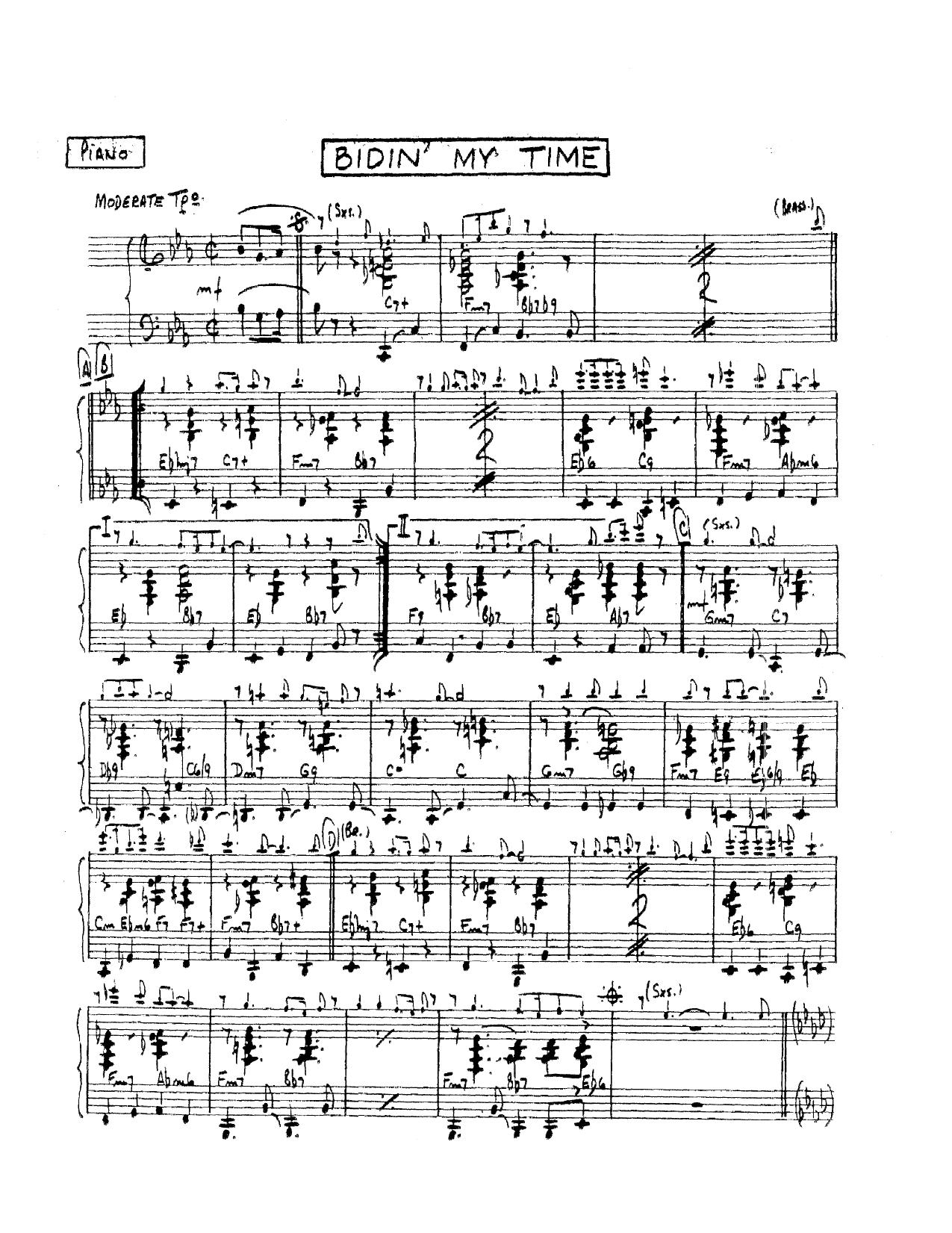
Bidin' My Time (L.Elgart) sheet music preview

Bidin' My Time (L.Elgart)

Composed by George Gershwin

Arranged by Les Elgart

  • Ensemble: Big Band
  • Pages: 18
  • Instruments (17): Piano, Bass, Drums, Guitar, 1st Alto Saxophone, 2nd Alto Saxophone, 3rd Tenor Saxophone, 4th Tenor Saxophone, 5th Baritone Saxophone, Trumpet I, Trumpet II, Trumpet III, Trumpet IV, Trombone I, Trombone II, Trombone 3, Trombone 4
  • Difficulty: easy
  • Content: Individual Parts
  • Format: PDF Download (Instant)
  • Price: $24.99

George Gershwin’s timeless melody "Bidin' My Time," originally introduced in the 1930 Broadway musical *Girl Crazy*, occupies a treasured space in the Great American Songbook. While initially conceived as a relaxed, humorous vocal tune, the composition's infectious, blues-infused pentatonic structure and laid-back cadence naturally invited jazz interpretation. In the hands of bandleader and trumpeter Les Elgart—a prominent architect of the swinging, high-gloss dance band style of the 1950s—the tune undergoes a sophisticated stylistic transformation. Elgart, famous for his crisp articulation, buoyant swing feels, and sophisticated yet accessible charts recorded for Columbia Records, reimagines Gershwin’s classic as a quintessential mid-century big band swinger that balances tight, brass-driven punchiness with relaxed, effortless groove. Built around a medium-tempo swing feel in 4/4 time, this chart exudes a cool, confident energy reminiscent of the finest New York supper clubs and television variety show orchestras of the Eisenhower era. The mood is upbeat, sophisticated, and relentlessly optimistic, driven by a characteristic Elgart rhythm section pulse that lays down a feather-light yet propulsive walking bass line and crisp ride cymbal interaction. Rather than playing the theme as a heavy-handed stomp, the arrangement relies on witty call-and-response figures between the saxophones and muted brass, creating a playful dynamic interplay that keeps both the performers and the audience thoroughly engaged from the opening measure to the final sustained chord. Elgart’s signature arranging approach shines through in the clever economy of the scoring and the sparkling woodwind voicings. The melody is initially introduced by a light saxophone soli, rich in close-position harmonic movement, before the full ensemble gradually builds in volume and density. Brass sections utilize subtle cup and straight mutes to color the texture during the head statements, allowing the crisp articulation of the rhythm section to cut cleanly through the ensemble. The arrangement avoids over-complexity in favor of impeccable stylistic authenticity, featuring bright, swinging counter-melodies, a tightly knit shout chorus that ramps up the rhythmic tension without sacrificing the tune's inherent lightness, and smooth harmonic transitions that honor Gershwin's original chordal integrity while injecting mid-century dance band sheen. Advanced high school, collegiate, and professional community big bands will find this arrangement remarkably rewarding to prepare. While the individual technical demands on range and rhythm are moderate, the true challenge—and joy—lies in mastering the stylistic nuances: achieving a unified, lightweight swing articulation, locking in the backbeat, and balancing the delicate dynamic shifts between muted brass and open reeds. The chart provides an exceptional vehicle for developing sectional blend and swing phrasing, making it an ideal showcase piece for mid-concert pacing where an ensemble needs to pivot from high-octane burners to sophisticated, swinging elegance. Success with this Les Elgart arrangement hinges on restraint, precision, and stylistic unity. The tempo should remain a comfortable medium swing—avoid the temptation to push the metronome, as the tune relies heavily on a relaxed, behind-the-beat pocket to achieve its signature 1950s dance band swagger. Rhythm section players must prioritize a transparent texture; the pianist should comp sparingly with crisp, isolated chord shells, while the drummer maintains a steady, feather-light ride cymbal pattern with a gentle, two-beat-feel transition into four-four swing. Horn players need to pay meticulous attention to dynamic markings, particularly when transitioning from muted passages to open bell flourishes. Ensure that all brass mutes (cup and straight) are standardized across sections to maintain a cohesive timbre. Rehearsals should initially focus on the unison saxophone lines and the rhythmic accuracy of the short, punchy background figures behind the melodic statements, ensuring that every eighth-note is swung evenly and cleanly articulated without heavy tongue accents. Q: What instruments and parts are included in this arrangement? A: This chart is scored for a standard 17-instrument big band instrumentation, comprising 5 saxophones (Alto 1, Alto 2, Tenor 1, Tenor 2, Baritone), 4 trumpets, 4 trombones, and a 4-piece rhythm section featuring piano, bass, drum set, and guitar/auxiliary parts spread across an 18-page score and set of parts. Q: What is the difficulty level of this Les Elgart arrangement? A: It is moderately challenging, making it exceptionally well-suited for advanced high school ensembles, college jazz bands, and professional community big bands looking to refine their medium-swing style and ensemble blend. Q: How does this chart fit into the jazz historical context? A: It bridges the gap between classic 1930s Gershwin theater composition and the polished, radio-friendly swing and dance band aesthetics popularized by Les Elgart during the 1950s jazz and pop crossover era. Q: What makes this specific arrangement unique compared to standard vocal charts of "Bidin' My Time"? A: Rather than treating the tune as a slow vocal ballad, Elgart reimagines it as an instrumental medium-swing showcase, utilizing clever muted brass interplay, transparent rhythm section writing, and sophisticated saxophone solis. Q: What is the recommended performance tempo and duration for this piece? A: The arrangement is set at a comfortable medium-swing tempo (approximately 120-126 BPM) and typically runs around 3 to 4 minutes in duration, depending on the chosen head repeats and solo rotations.

Questions and answers

What is included in the Bidin' My Time (L.Elgart) PDF?
The verified current file contains individual parts across 18 pages.
How many instruments or parts are listed for Bidin' My Time (L.Elgart)?
The verified instrumentation list contains 17 entries for this Big Band arrangement.
Who is credited for Bidin' My Time (L.Elgart)?
Composer: George Gershwin. Arranger: Les Elgart.
What difficulty is listed for Bidin' My Time (L.Elgart)?
The verified difficulty level is easy.
Can I preview Bidin' My Time (L.Elgart) before buying?
Yes. The product page provides a preview generated from the current PDF file.
How is Bidin' My Time (L.Elgart) delivered?
After successful payment, the digital PDF is made available for download. The displayed price is $24.99.

Musicians Also Search For

Bidin' My Time Les Elgart PDFBidin' My Time Les Elgart sheet musicBidin' My Time arranged by Les ElgartLes Elgart big band chartsLes Elgart jazz arrangements PDFBidin' My Time George Gershwin sheet musicBidin' My Time George Gershwin big band arrangementsGeorge Gershwin big band chartsBidin' My Time big band arrangementsBidin' My Time big band PDF downloadBidin' My Time jazz sheet musicbig band sheet music downloadBidin' My Time individual parts downloadBidin' My Time sheet music PDFbuy Bidin' My Time sheet musicdownload Bidin' My Time PDFBidin' My Time jazz chartsbest Les Elgart big band arrangementsGeorge Gershwin arranged by Les ElgartBidin' My Time printable sheet musicbig band repertoire PDF

All arrangements by Les Elgart All George Gershwin sheet music