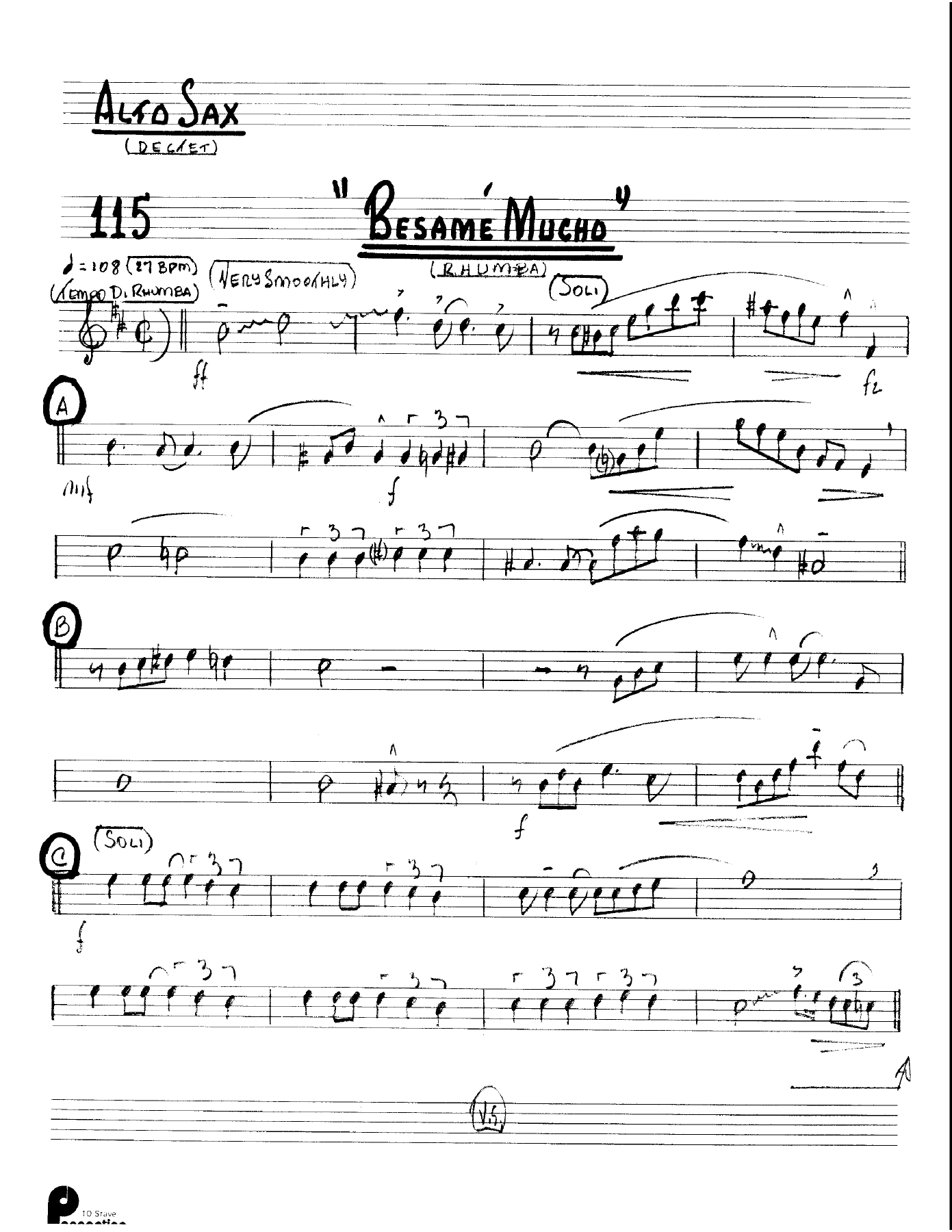
Besame Mucho (6.Dectet)
Composed by Consuelo Velázquez
Arranged by 6 horns + Rhythm - Stan Kenton Dectet
- Ensemble: Small Ensemble
- Style: Jazz Standard
- Pages: 25
- Difficulty: easy
- Content: Sheet Music
- Format: PDF Download (Instant)
- Price: $12.99
"Bésame Mucho," composed by the Mexican songwriter Consuelo Velázquez in 1940, stands as one of the most enduring and frequently recorded Latin standards of all time. Its genesis occurred during the golden age of Mexican bolero, a romantic ballad style, and it quickly transcended cultural boundaries to become a global phenomenon. The song's initial success was propelled by a multitude of recordings, notably by artists like Jimmy Dorsey and his Orchestra in 1944, and later by The Beatles, Nat King Cole, and Elvis Presley, solidifying its status as a timeless classic. Its evocative melody and tender lyrical theme of a passionate kiss have resonated across generations, making it a staple in both Latin and jazz repertoires, emblematic of mid-20th-century romanticism and musical elegance. This particular arrangement, titled "Besame Mucho (6.Dectet)," reimagines the beloved standard through the distinctive lens of the Stan Kenton Dectet style, specifically tailored for a 6-horn and rhythm section. While the original composition often lends itself to a slow, passionate bolero or rhumba feel, this arrangement likely infuses it with a sophisticated, perhaps slightly angular, modern jazz sensibility characteristic of Kenton's smaller ensembles. Expect intricate harmonies, often featuring dense voicings and a rich, full sound despite the small ensemble size. The musical character will likely lean towards a medium-slow, expressive swing or a refined Latin-jazz groove, maintaining the song's inherent romance while adding a layer of harmonic and rhythmic complexity. The mood is one of sophisticated yearning, with moments of lush warmth juxtaposed against the precision typical of Kenton's arrangements. The arranger's approach, channeling the Stan Kenton Dectet, is immediately distinctive. Kenton's smaller groups were renowned for their innovative voicings, often employing close-knit harmonies and a powerful, orchestral sound within a compact setting. For "Besame Mucho," this translates to a treatment where the six horns (likely trumpets, trombones, and saxophones) are utilized with remarkable dexterity, creating rich soli sections that weave intricate melodic and harmonic lines. Expect sophisticated counterpoint and possibly unexpected harmonic substitutions that add a contemporary edge to the classic melody. The arrangement will feature the melody passed between various instruments, ensuring each voice has moments to shine, and will undoubtedly include a dedicated solo section, likely over a harmonically rich backdrop provided by the ensemble. Technical demands will include precise articulation, blend, and intonation within the close voicings, making it a rewarding challenge for advanced players. Performing this arrangement offers a unique opportunity to explore a jazz standard through a historically significant and musically rich stylistic prism. The technical challenges lie in achieving the characteristic Kenton sound: powerful yet controlled brass, expressive woodwinds, and a rhythm section that provides both drive and harmonic support. The arrangement is ideally suited for college-level jazz ensembles, advanced community big bands looking for small group challenges, or professional groups seeking to expand their repertoire with a classic piece in a sophisticated setting. The intricate soli passages and the nuanced harmonic landscape require mature musicianship and a keen ear for ensemble balance, promising a deeply satisfying and impressive performance. This arrangement of "Besame Mucho" demands meticulous attention to blend and balance within the 6-horn ensemble. The key technical challenge lies in executing the dense, often close-voiced soli sections with precise intonation and unified articulation. Conductors should emphasize listening across the section, particularly in harmonized melodic lines. The tempo should be maintained at a medium-slow, expressive Latin-jazz groove or a refined swing, ensuring the romantic essence of the piece is preserved without dragging. While no specific extended techniques like plunger mutes are explicitly required, dynamic control and shaping of phrases are paramount. Rehearsal time should focus on isolating challenging harmonic passages, ensuring each voice contributes to the overall rich texture, and developing a cohesive ensemble sound that captures the sophisticated Kenton Dectet style. Q: What instruments and parts are included in the "Besame Mucho (6.Dectet)" arrangement? A: This arrangement is scored for a 6-horn and rhythm section. The specific horn instrumentation typically aligns with a Stan Kenton Dectet setup, often including two trumpets, one or two trombones, and two or three saxophones, plus piano, bass, and drums. Q: What is the difficulty level of this arrangement? A: This arrangement is considered advanced, suitable for college-level jazz ensembles, advanced community bands, or professional groups. It requires strong technical proficiency, mature musicianship, and a keen ear for complex harmonies and ensemble balance. Q: What is the musical style and historical context of this arrangement? A: This arrangement takes the classic Latin standard "Bésame Mucho," originally a Mexican bolero from 1940, and reinterprets it in the sophisticated, modern jazz style of the Stan Kenton Dectet, blending romanticism with intricate harmonies and precise ensemble work. Q: What makes this arrangement unique compared to other versions of "Besame Mucho"? A: Its uniqueness stems from its specific instrumentation (6 horns + rhythm) and its adherence to the Stan Kenton Dectet's signature sound, featuring dense, innovative voicings, intricate soli sections, and a sophisticated harmonic approach that elevates the standard. Q: What is the typical performance duration or tempo for this arrangement? A: While specific duration can vary with interpretation, this arrangement is designed for a medium-slow, expressive Latin-jazz groove or a refined swing tempo, allowing for melodic and harmonic nuance. A typical performance would likely range from 4 to 6 minutes, depending on the number and length of solos.
Musicians Also Search For
Besame Mucho 6 horns + Rhythm - Stan Kenton Dectet PDF • Besame Mucho 6 horns + Rhythm - Stan Kenton Dectet sheet music • Besame Mucho arranged by 6 horns + Rhythm - Stan Kenton Dectet • 6 horns + Rhythm - Stan Kenton Dectet small ensemble charts • 6 horns + Rhythm - Stan Kenton Dectet jazz arrangements PDF • Besame Mucho Consuelo Velázquez sheet music • Besame Mucho Consuelo Velázquez small ensemble arrangement • Consuelo Velázquez small ensemble charts • Besame Mucho small ensemble arrangement • Besame Mucho small ensemble PDF download • Besame Mucho jazz ensemble sheet music • small ensemble sheet music instant download • Besame Mucho sheet music with parts • Besame Mucho Jazz Standard chart • Jazz Standard small ensemble arrangements • buy Besame Mucho sheet music online • download Besame Mucho PDF • Besame Mucho jazz chart • best 6 horns + Rhythm - Stan Kenton Dectet small ensemble arrangements • Consuelo Velázquez songs arranged by 6 horns + Rhythm - Stan Kenton Dectet • Besame Mucho printable sheet music • small ensemble repertoire PDF