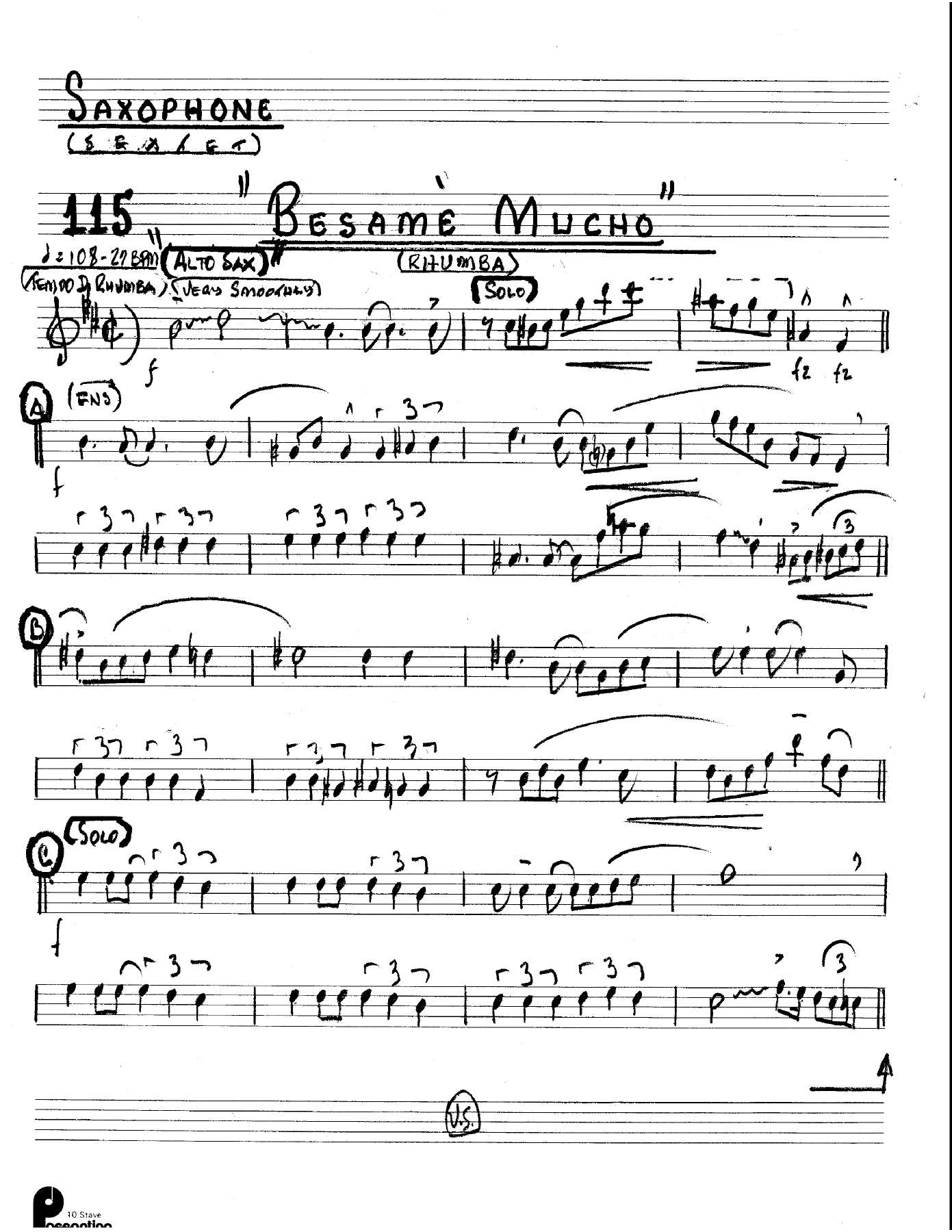
Besame Mucho (3.Sextet)
Composed by Consuelo Velázquez
Arranged by 3 horns + Rhythm - Stan Kenton Sextet
- Ensemble: Small Ensemble
- Style: Jazz Standard
- Pages: 15
- Instruments (6): Alto Saxophone, Trumpet, Trombone, Piano, Bass, Drums
- Difficulty: easy
- Content: Individual Parts
- Format: PDF Download (Instant)
- Price: $12.99
"Bésame Mucho," composed by the Mexican songwriter Consuelo Velázquez in 1940, stands as one of the most enduring and globally recognized Latin American boleros. Its poignant melody and romantic lyrics quickly transcended cultural boundaries, becoming a staple in popular music and a frequent subject for jazz interpretation. The song's initial surge in popularity during World War II resonated deeply, as its theme of longing for a kiss before a potential farewell struck a chord with audiences worldwide. Over the decades, it has been recorded by an astonishing array of artists, from The Beatles and Frank Sinatra to Diana Krall and Andrea Bocelli, solidifying its status as a timeless standard that bridges genres and generations. Its harmonic richness and melancholic beauty make it particularly fertile ground for jazz musicians, who often explore its inherent Latin rhythms and expressive melodic contours. This particular arrangement, "Besame Mucho (3.Sextet)," reimagines Velázquez's classic through the sophisticated lens of the Stan Kenton Sextet, tailored for a three-horn plus rhythm section. The musical character is defined by a sultry, medium-slow Latin groove, specifically a bolero feel, which is maintained throughout, providing a sensual and danceable foundation. The key is expertly chosen to enhance the melody's inherent pathos while allowing for rich harmonic extensions. The mood is one of romantic yearning and sophisticated elegance, evoking the golden age of jazz clubs. This arrangement showcases the Kenton Sextet's signature blend of intricate voicings and swinging solo opportunities, translating the original's passion into a refined jazz idiom. The arranger's approach for this 3-horn plus rhythm setting is unmistakably influenced by the Stan Kenton Sextet's sound, known for its tight, often angular voicings and a blend of cool jazz sophistication with a powerful, driving rhythm section. Expect lush, close-voiced harmonies in the horn sections, particularly in the initial melody statements, creating a rich, almost orchestral texture despite the small ensemble size. The melody is predominantly carried by the lead horn, often the trumpet, with the other horns providing intricate counter-melodies and harmonic support. There are clearly delineated sections for improvised solos, typically over the song's familiar chord changes, offering ample space for each horn player to shine. The arrangement builds dynamically, culminating in a powerful, yet controlled, ensemble statement before a refined conclusion. The interplay between the horns and the rhythm section is paramount, requiring a cohesive and sensitive approach to tempo and dynamics. This arrangement is ideally suited for college-level jazz ensembles, advanced community bands, or professional small groups seeking a sophisticated and engaging Latin jazz standard. The technical demands are moderate to challenging, particularly in achieving the precise blend and balance within the horn section and navigating the nuanced Latin rhythmic feel. The rewarding aspect lies in the opportunity to perform a beloved standard with a fresh, elegant interpretation, allowing individual musicians to contribute to a cohesive and stylish ensemble sound. The intricate voicings and the interplay required make it an excellent vehicle for developing ensemble precision and expressive musicality. Approaching "Besame Mucho (3.Sextet)" requires meticulous attention to rhythmic precision and blend. The overriding tempo feel is a medium-slow Latin groove, specifically a bolero, which necessitates a steady, unhurried pulse from the rhythm section, emphasizing the clave feel without being overly rigid. Drummers should focus on a sensitive brush or stick pattern that supports the horns without overpowering them. The key technical challenge for the horn section lies in achieving a seamless blend and accurate intonation within the close voicings; careful listening across the section is crucial. Dynamics are paramount, with subtle crescendos and decrescendos enhancing the romantic mood. Soloists should aim for melodic improvisation that respects the bolero's inherent lyricism. Rehearsal tips include isolating horn voicings to perfect balance and intonation, and having the rhythm section practice the groove independently to solidify the foundation. No special techniques like plunger mutes or falls are explicitly notated, allowing for performer discretion within the stylistic boundaries. Q: What instruments/parts are included in this arrangement? A: This arrangement is scored for a 3-horn plus rhythm section, typically including Trumpet, Alto Saxophone, Tenor Saxophone (or other common jazz horn combinations like Trumpet, Tenor Sax, Trombone), Piano, Bass, and Drums. The specific instrumentation is detailed on the score. Q: What is the difficulty level of "Besame Mucho (3.Sextet)"? A: This arrangement is considered intermediate to advanced. While the melody is familiar, the intricate voicings, nuanced Latin groove, and demands for ensemble precision require experienced musicians. Q: What is the musical style and historical context of this arrangement? A: This is a jazz standard arrangement of the classic bolero "Bésame Mucho," originally composed by Consuelo Velázquez in 1940. This particular setting is inspired by the sophisticated small group sound of the Stan Kenton Sextet, blending Latin romance with cool jazz harmonies. Q: What makes this arrangement unique compared to other versions of "Bésame Mucho"? A: Its uniqueness stems from its specific scoring for a 3-horn sextet, utilizing the distinctive tight voicings and sophisticated harmonic approach characteristic of the Stan Kenton Sextet, offering a refined and elegant jazz interpretation of the beloved standard. Q: What is the typical performance duration or tempo for this arrangement? A: The arrangement is designed for a medium-slow Latin groove, specifically a bolero feel. A typical performance duration would be approximately 4 to 5 minutes, depending on the length of improvised solos.
Questions and answers
- What is included in the Besame Mucho (3.Sextet) PDF?
- The verified current file contains individual parts across 15 pages.
- How many instruments or parts are listed for Besame Mucho (3.Sextet)?
- The verified instrumentation list contains 6 entries for this Small Ensemble arrangement.
- Who is credited for Besame Mucho (3.Sextet)?
- Composer: Consuelo Velázquez. Arranger: 3 horns + Rhythm - Stan Kenton Sextet.
- What difficulty is listed for Besame Mucho (3.Sextet)?
- The verified difficulty level is easy.
- What style is listed for Besame Mucho (3.Sextet)?
- The catalog lists the style as Jazz Standard.
- Can I preview Besame Mucho (3.Sextet) before buying?
- Yes. The product page provides a preview generated from the current PDF file.
- How is Besame Mucho (3.Sextet) delivered?
- After successful payment, the digital PDF is made available for download. The displayed price is $12.99.
Musicians Also Search For
Besame Mucho 3 horns + Rhythm - Stan Kenton Sextet PDF • Besame Mucho 3 horns + Rhythm - Stan Kenton Sextet sheet music • Besame Mucho arranged by 3 horns + Rhythm - Stan Kenton Sextet • 3 horns + Rhythm - Stan Kenton Sextet small ensemble charts • 3 horns + Rhythm - Stan Kenton Sextet jazz arrangements PDF • Besame Mucho Consuelo Velázquez sheet music • Besame Mucho Consuelo Velázquez small ensemble arrangements • Consuelo Velázquez small ensemble charts • Besame Mucho small ensemble arrangements • Besame Mucho small ensemble PDF download • Besame Mucho jazz sheet music • small ensemble sheet music download • Besame Mucho individual parts download • Besame Mucho sheet music PDF • Besame Mucho Jazz Standard charts • Jazz Standard small ensemble arrangements • buy Besame Mucho sheet music • download Besame Mucho PDF • Besame Mucho jazz charts • best 3 horns + Rhythm - Stan Kenton Sextet small ensemble arrangements • Consuelo Velázquez arranged by 3 horns + Rhythm - Stan Kenton Sextet • Besame Mucho printable sheet music • small ensemble repertoire PDF