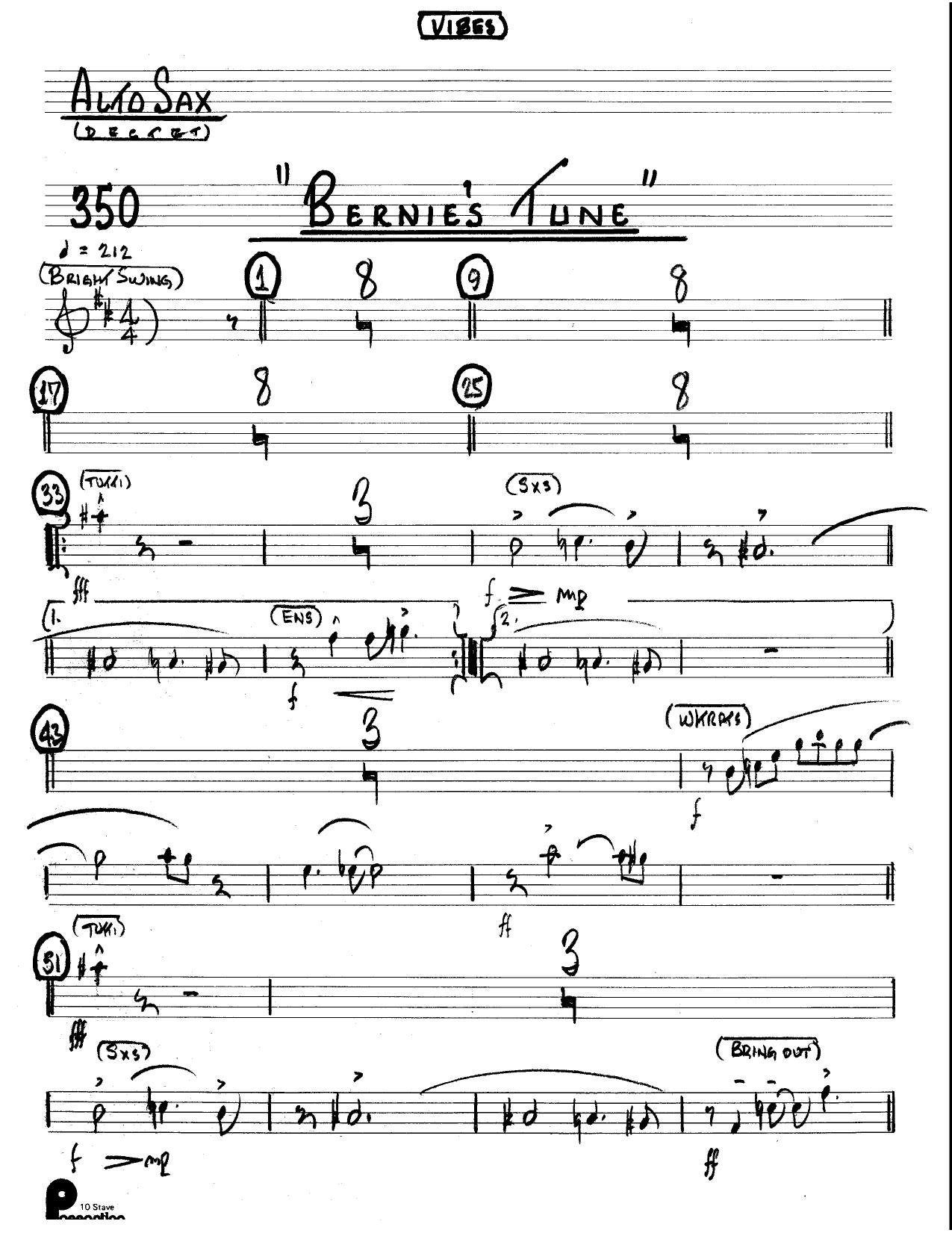
Bernie's Tune (Kenton Dectet #350) sheet music preview

Bernie's Tune (Kenton Dectet #350)

Composed by Jerry Leiber, Mike Stoller, and Bernie Miller

Arranged by Kenton Dectet #350

  • Ensemble: Small Ensemble
  • Style: Bebop
  • Pages: 41
  • Instruments (10): Alto Sax, Tenor Sax, Baritone Sax, Trumpet 1, Trumpet 2, Trombone, Piano, Bass, Drums, Vibes
  • Difficulty: easy
  • Content: Individual Parts
  • Format: PDF Download (Instant)
  • Price: $12.99

"Bernie's Tune," a bebop staple, was originally composed by Jerry Leiber, Mike Stoller, and Bernie Miller in the early 1950s. This era marked a pivotal shift in jazz, moving from the big band swing of the 1940s to the more intricate, harmonically sophisticated, and virtuosic improvisational style of bebop. While many artists recorded it, the tune gained significant traction through interpretations by iconic figures like Gerry Mulligan and Chet Baker, solidifying its place as a jazz standard frequently revisited for its infectious melody and harmonic richness. Its enduring appeal lies in its deceptively simple, yet highly adaptable, melodic line over a classic rhythm changes-esque harmonic progression, providing a fertile ground for improvisation and inventive arranging. Kenton Dectet #350's arrangement of "Bernie's Tune" is a vibrant, up-tempo bebop exploration, infused with the distinctive harmonic and textural palette characteristic of the Kenton Dectet sound. The piece is set in a bright medium-up swing feel, typically around 200-220 BPM, in the key of F major, radiating an energetic and sophisticated mood. The arrangement immediately establishes its character with tight, angular voicings that define the bebop aesthetic, often featuring close-knit saxophone and brass lines. The energy remains consistently high, propelled by a driving rhythm section that lays down a solid, yet flexible, foundation for the intricate horn work. This arrangement evokes a sense of exhilarating musical interplay and technical precision, a hallmark of the Dectet's approach. The arranger's treatment of "Bernie's Tune" showcases a mastery of small ensemble writing, blending intricate counterpoint with powerful unison lines. The melody is primarily carried by the alto saxophone and trumpet in unison or close harmony, often punctuated by crisp, rhythmic figures from the other horns. Kenton Dectet #350's signature can be heard in the sophisticated, often slightly dissonant, voicings that add a modern edge to the bebop framework, particularly in the soli sections where the ensemble shines with tightly orchestrated melodic and harmonic passages. Featured solos are typically allocated to trumpet and alto saxophone, offering ample space for improvisation over the familiar chord changes. A powerful shout chorus builds intensity before a final recapitulation of the theme, demonstrating the arranger's skill in crafting dynamic arcs within the piece. Performing this arrangement is a rewarding challenge suitable for advanced high school, college, community, and professional jazz ensembles. The technical demands include precise articulation, tight ensemble blend, and navigating rapid melodic lines and complex harmonies. The interplay between the horns requires keen listening and rhythmic accuracy. The rewarding aspect lies in mastering the intricate voicings and experiencing the thrill of executing a sophisticated bebop arrangement with precision and swing. Specific musical moments, such as the tightly voiced soli sections and the energetic shout chorus, stand out as highlights, showcasing the ensemble's collective prowess and the arranger's inventive spirit. "Bernie's Tune (Kenton Dectet #350)" demands a precise, driving medium-up swing feel, ideally between 200-220 BPM. Conductors should emphasize rhythmic accuracy and a consistent pulse throughout, as any wavering will compromise the bebop integrity. Key technical challenges include the rapid, articulate passages in the horn lines and the intricate voicings in the soli sections. Musicians should practice these sections slowly and meticulously, focusing on clean articulation and intonation within the close harmonies. The rhythm section needs to maintain a strong, interactive groove, with the bass providing a walking line that propels the ensemble and the drums offering tasteful, driving accompaniment. No special techniques like plunger mutes or falls are explicitly required, but a strong command of jazz articulation (e.g., ghost notes, scoops, stabs) is essential. Rehearsal time should be dedicated to balancing the horn voicings, ensuring each voice is heard clearly without overpowering the others, and developing a cohesive ensemble sound that embodies the Dectet's characteristic blend of precision and swing. Q: What instruments/parts are included in this arrangement? A: This arrangement is scored for a small ensemble, typically including alto saxophone, tenor saxophone, baritone saxophone, trumpet, trombone, piano, bass, and drums, consistent with the Kenton Dectet instrumentation. Q: What is the difficulty level of "Bernie's Tune (Kenton Dectet #350)"? A: This arrangement is considered advanced, suitable for experienced high school, college, community, and professional jazz ensembles due to its technical demands, intricate voicings, and required bebop stylistic understanding. Q: What is the musical style and historical context of this arrangement? A: This is an up-tempo bebop arrangement of "Bernie's Tune," a jazz standard from the early 1950s, reflecting the sophisticated harmonic and improvisational characteristics of that post-swing era. Q: What makes this specific arrangement unique? A: This arrangement is distinguished by Kenton Dectet #350's signature approach, featuring tight, angular voicings, intricate soli sections, and a powerful shout chorus that provides a modern, sophisticated take on the bebop classic. Q: What is the typical performance duration or tempo for this piece? A: "Bernie's Tune (Kenton Dectet #350)" is designed for a medium-up swing tempo, typically performed between 200-220 BPM, resulting in a performance duration of approximately 3-5 minutes depending on the number and length of improvised solos.

Questions and answers

What is included in the Bernie's Tune (Kenton Dectet #350) PDF?
The verified current file contains individual parts across 41 pages.
How many instruments or parts are listed for Bernie's Tune (Kenton Dectet #350)?
The verified instrumentation list contains 10 entries for this Small Ensemble arrangement.
Who is credited for Bernie's Tune (Kenton Dectet #350)?
Composer: Jerry Leiber, Mike Stoller, and Bernie Miller. Arranger: Kenton Dectet #350.
What difficulty is listed for Bernie's Tune (Kenton Dectet #350)?
The verified difficulty level is easy.
What style is listed for Bernie's Tune (Kenton Dectet #350)?
The catalog lists the style as Bebop.
Can I preview Bernie's Tune (Kenton Dectet #350) before buying?
Yes. The product page provides a preview generated from the current PDF file.
How is Bernie's Tune (Kenton Dectet #350) delivered?
After successful payment, the digital PDF is made available for download. The displayed price is $12.99.

Musicians Also Search For

Bernie's Tune Kenton Dectet #350 PDFBernie's Tune Kenton Dectet #350 sheet musicBernie's Tune arranged by Kenton Dectet #350Kenton Dectet #350 small ensemble chartsKenton Dectet #350 jazz arrangements PDFBernie's Tune Jerry Leiber, Mike Stoller, and Bernie Miller sheet musicBernie's Tune Jerry Leiber, Mike Stoller, and Bernie Miller small ensemble arrangementsJerry Leiber, Mike Stoller, and Bernie Miller small ensemble chartsBernie's Tune small ensemble arrangementsBernie's Tune small ensemble PDF downloadBernie's Tune jazz sheet musicsmall ensemble sheet music downloadBernie's Tune individual parts downloadBernie's Tune sheet music PDFBernie's Tune Bebop chartsBebop small ensemble arrangementsbuy Bernie's Tune sheet musicdownload Bernie's Tune PDFBernie's Tune jazz chartsbest Kenton Dectet #350 small ensemble arrangementsJerry Leiber, Mike Stoller, and Bernie Miller arranged by Kenton Dectet #350Bernie's Tune printable sheet musicsmall ensemble repertoire PDF

All arrangements by Kenton Dectet #350 All Jerry Leiber, Mike Stoller, and Bernie Miller sheet music