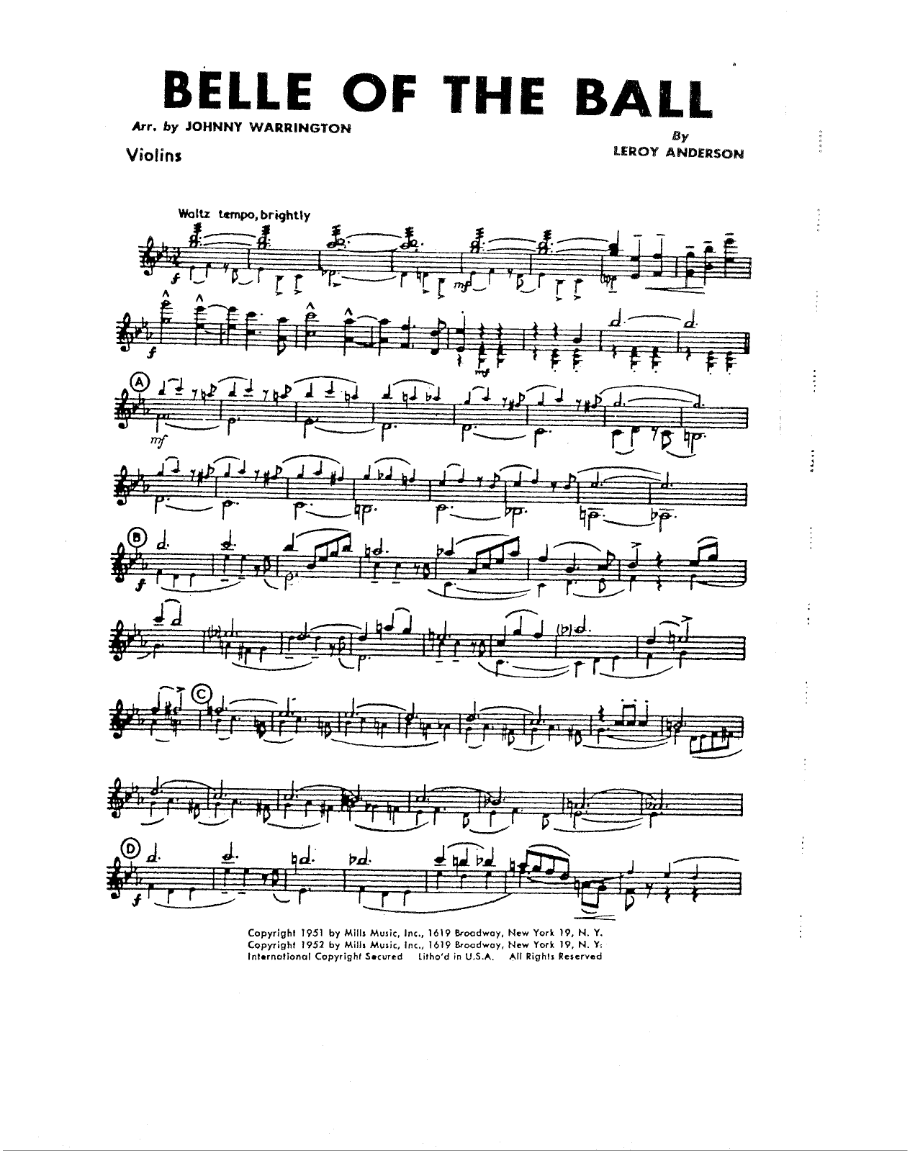
Belle Of The Ball (J.Warrington)
Composed by Leroy Anderson
Arranged by Johnny Warrington
- Ensemble: Big Band Dance
- Style: Big Band Dance
- Pages: 30
- Instruments (7): Alto Sax, Tenor Sax, Trumpet, Trombone, Piano, Bass, Drums
- Difficulty: medium
- Content: Individual Parts
- Format: PDF Download (Instant)
- Price: $18.99
## SECTION 1: Description Leroy Anderson's "Belle of the Ball," originally composed in 1951, stands as a charming exemplar of the light orchestral and "pops" repertoire that defined a significant portion of mid-20th-century American music. While not a jazz standard in the improvisational sense, its enduring melodic appeal and sophisticated yet accessible harmonic structure made it ripe for interpretation by big bands seeking to bridge the gap between dance music and concert hall elegance. This particular arrangement by Johnny Warrington, a prolific and highly respected orchestrator of the era, transforms Anderson's waltz into a captivating big band dance number, re-imagining its inherent grace within a swinging 4/4 meter. It embodies the sophisticated "Big Band Dance" style, evoking the golden age of ballroom dancing and supper clubs where orchestras provided both listening pleasure and irresistible rhythm for dancers. Warrington's treatment of "Belle of the Ball" is a masterclass in re-contextualization. He deftly translates Anderson's lyrical waltz melodies into a medium swing feel, maintaining the original's bright, optimistic mood while infusing it with a propulsive, danceable energy. The arrangement is primarily in the key of C Major, offering a bright, open tonality that complements the piece's cheerful character. Warrington's signature approach often involved lush, harmonically rich voicings, and here he employs close-knit saxophone soli sections that articulate the main theme with a warm, blended sound. The brass sections contribute punchy, yet controlled, figures, often serving as rhythmic punctuation or providing counter-melodies that add depth without overshadowing the primary melodic lines. There are no extended improvised solos in this arrangement, aligning with the "dance band" aesthetic where the ensemble's collective sound and the arranger's craft are paramount. The arrangement opens with a captivating ensemble statement, immediately establishing the medium swing groove. The melody is predominantly carried by the saxophone section, often doubled or reinforced by the trumpet or trombone in octaves, creating a full, resonant sound. Warrington skillfully uses dynamic contrasts and textural shifts to maintain interest, moving from full ensemble passages to more transparent sections featuring individual instrument groups. The technical demands are moderate, focusing on clean articulation, precise rhythmic ensemble playing, and a well-blended section sound. Brass players will encounter some upper-register work, particularly in the trumpet parts, which requires good control and stamina. The trombone parts are melodic and supportive, while the rhythm section provides a steady, swinging foundation. Performing this arrangement is rewarding for its blend of elegance and swing, allowing a band to showcase its precision, balance, and ability to evoke a bygone era of sophisticated dance music. It's an excellent choice for college and advanced high school ensembles, as well as community and professional big bands looking to add a touch of classic charm and danceability to their repertoire. ## SECTION 2: Performance Notes This arrangement of "Belle of the Ball" thrives on a consistent, relaxed medium swing feel, approximately 120-130 BPM. The conductor should emphasize a light, buoyant rhythmic approach, avoiding a heavy or rushed feel. Key technical challenges include precise articulation in the saxophone soli sections and maintaining excellent intonation within the close voicings. Brass players, particularly trumpets, will need to navigate some sustained upper-register notes with good tone and control; encourage a focused air stream rather than excessive force. There are no specific mute requirements or extended techniques like falls or doits, keeping the focus on clean ensemble playing. Rehearsal tips include isolating the saxophone soli passages to ensure blend and rhythmic accuracy, and working on the dynamic swells and releases to shape the melodic phrases effectively. The rhythm section should lay down a steady, unobtrusive groove, allowing the melodic lines to float gracefully above. ## SECTION 3: FAQ Q: What instruments are included in this arrangement? A: This arrangement is scored for a standard big band dance ensemble, including Alto Sax, Tenor Sax, Trumpet, Trombone, Piano, Bass, and Drums. The full set of parts typically includes two alto saxophones, two tenor saxophones, baritone saxophone, four trumpets, four trombones, piano, bass, and drums. Q: What is the difficulty level of "Belle Of The Ball (J.Warrington)"? A: This arrangement is rated as medium difficulty. It requires solid ensemble playing, good intonation, and a comfortable command of the medium swing style, making it suitable for advanced high school, college, community, and professional big bands. Q: What musical style and historical context does this arrangement represent? A: This arrangement falls under the "Big Band Dance" style, reinterpreting Leroy Anderson's 1951 light orchestral piece into a sophisticated 4/4 medium swing. It embodies the sound of mid-20th-century dance orchestras, perfect for evoking a classic ballroom atmosphere. Q: What makes Johnny Warrington's arrangement of "Belle Of The Ball" unique? A: Warrington's arrangement is unique for its masterful transformation of Anderson's original waltz into a swinging 4/4 big band chart. He utilizes lush saxophone soli, precise brass figures, and sophisticated voicings to maintain the original's charm while making it eminently danceable, showcasing his signature arranging style. Q: What is the approximate performance duration and tempo for this piece? A: The approximate performance duration for "Belle Of The Ball (J.Warrington)" is around 2:30 to 3:00 minutes, depending on the chosen tempo. It is intended to be performed at a relaxed medium swing tempo, typically between 120-130 beats per minute.