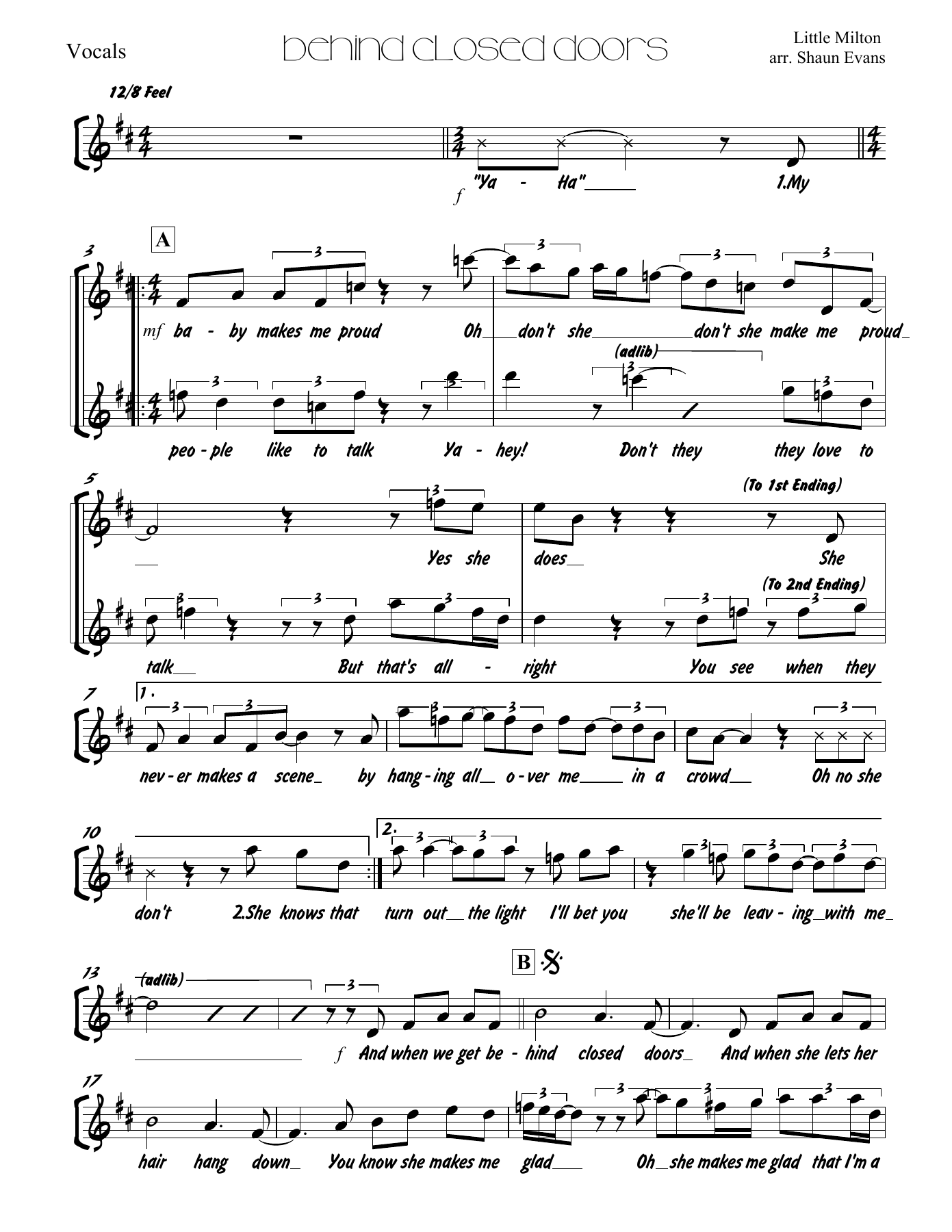
Behind Closed Doors (3.Milton)
Composed by Kenny O'Dell
Arranged by 3 horns + Rhythm - Evans - Little Milton
- Ensemble: Small Ensemble
- Style: Jazz Standard
- Pages: 16
- Instruments (8): Vocals, Bass, Guitar, Drums, Trombone, Trumpet, Tenor Saxophone, Keys
- Difficulty: easy
- Content: Individual Parts
- Format: PDF Download (Instant)
- Price: $12.99
"Behind Closed Doors," originally composed by Kenny O'Dell, gained widespread recognition through its iconic country and pop renditions, most notably by Charlie Rich in 1973, where it became a crossover hit and a Grammy Award winner. While its origins lie in country music, the song's strong melodic and harmonic structure, coupled with its evocative lyrical theme, has long made it ripe for jazz interpretation. It embodies a classic 1970s ballad sensibility, characterized by a smooth, narrative flow and a slightly melancholic yet romantic undertone, perfectly suited for re-imagining within the jazz standard repertoire. The piece's enduring popularity and emotional depth ensure its continued relevance, making it a compelling choice for a small jazz ensemble seeking to explore familiar melodies through a sophisticated lens. This arrangement by 3 horns + Rhythm - Evans - Little Milton transforms the classic into a medium-slow swing ballad in the key of C minor, evoking a sophisticated, late-night club atmosphere. The mood is intimate and reflective, characterized by lush, close voicings that create a rich harmonic tapestry. The energy remains understated throughout, allowing the melodic contours and harmonic subtleties to shine. The arranger's distinctive approach emphasizes a conversational interplay between the horn voices, often featuring intricate counter-melodies and harmonized lines that weave around the primary melody. Expect extended harmonies with judicious use of ninths, elevenths, and thirteenths, adding depth and modern jazz color without obscuring the original melodic intent. The arrangement avoids bombastic shout choruses, instead opting for a more refined build-up of intensity through dynamic shaping and increasing harmonic density. The melody is primarily carried by the lead alto saxophone, often doubled or harmonized by the trumpet and trombone, creating a warm, blended sound. There are designated solo sections for alto saxophone and trumpet, providing ample opportunity for improvisation over the arrangement's sophisticated chord changes. Technical challenges include precise articulation for the horn lines, maintaining a consistent medium-slow swing feel, and navigating the nuanced harmonic progressions during solos. The rewarding aspect lies in the ensemble's ability to achieve a cohesive, expressive blend, delivering the emotional narrative of the piece with sensitivity and stylistic integrity. Specific musical moments, such as the harmonized horn soli after the first chorus and the subtle reharmonizations in the bridge, truly elevate this arrangement. This small ensemble arrangement is ideally suited for college-level jazz combos, community jazz ensembles, or professional groups looking for a refined and engaging addition to their repertoire. Its sophisticated harmonic language and demand for nuanced interplay make it an excellent vehicle for developing advanced ensemble skills, particularly in blending, balance, and expressive interpretation. The manageable instrumentation (alto saxophone, trumpet, trombone, and rhythm section) makes it accessible for groups with limited personnel while still offering a full, rich sound. It provides a superb opportunity to perform a well-known song in a fresh, jazz-oriented setting. This arrangement of "Behind Closed Doors" is best approached as a medium-slow swing ballad, approximately 80-90 BPM. The key to its success lies in establishing a relaxed yet forward-moving swing feel from the outset, with a strong emphasis on a consistent quarter-note pulse in the bass. Horn players should focus on achieving a warm, blended tone, particularly in the harmonized soli sections, paying close attention to intonation within the extended voicings. Articulation should be smooth and legato for the melody, with subtle shaping of phrases. There are no special techniques like plunger mutes or falls required; the focus is on pure tone and expressive delivery. Rehearsal tips include isolating the horn soli passages to ensure precise rhythmic alignment and balance, and working through the solo sections slowly to familiarize improvisers with the harmonic rhythm and chord changes. Encourage the rhythm section to support the horns with sensitivity, allowing the melody and harmonies to breathe. Q: What instruments and parts are included in this arrangement? A: This arrangement is for a small jazz ensemble, specifically featuring alto saxophone, trumpet, trombone, piano, bass, and drums. It includes individual parts for each of these instruments. Q: What is the difficulty level of this arrangement? A: This arrangement is considered intermediate to advanced. It requires solid instrumental technique, a good understanding of jazz harmony, and a developed sense of ensemble playing and interpretation. Q: What is the musical style and historical context of "Behind Closed Doors (3.Milton)"? A: This is a jazz standard arrangement of Kenny O'Dell's 1973 hit "Behind Closed Doors." While the original was a country/pop ballad, this version transforms it into a sophisticated medium-slow jazz swing ballad. Q: What makes this particular arrangement unique? A: The arranger, 3 horns + Rhythm - Evans - Little Milton, provides a distinctive treatment with lush, close voicings, intricate horn counter-melodies, and sophisticated reharmonizations, creating an intimate, refined jazz club atmosphere. Q: What is the recommended performance duration or tempo for this piece? A: The recommended tempo is a medium-slow swing, approximately 80-90 BPM. The overall performance duration will typically be around 4-5 minutes, depending on the length of improvised solos.
Questions and answers
- What is included in the Behind Closed Doors (3.Milton) PDF?
- The verified current file contains individual parts across 16 pages.
- How many instruments or parts are listed for Behind Closed Doors (3.Milton)?
- The verified instrumentation list contains 8 entries for this Small Ensemble arrangement.
- Who is credited for Behind Closed Doors (3.Milton)?
- Composer: Kenny O'Dell. Arranger: 3 horns + Rhythm - Evans - Little Milton.
- What difficulty is listed for Behind Closed Doors (3.Milton)?
- The verified difficulty level is easy.
- What style is listed for Behind Closed Doors (3.Milton)?
- The catalog lists the style as Jazz Standard.
- Can I preview Behind Closed Doors (3.Milton) before buying?
- Yes. The product page provides a preview generated from the current PDF file.
- How is Behind Closed Doors (3.Milton) delivered?
- After successful payment, the digital PDF is made available for download. The displayed price is $12.99.
Musicians Also Search For
Behind Closed Doors 3 horns + Rhythm - Evans - Little Milton PDF • Behind Closed Doors 3 horns + Rhythm - Evans - Little Milton sheet music • Behind Closed Doors arranged by 3 horns + Rhythm - Evans - Little Milton • 3 horns + Rhythm - Evans - Little Milton small ensemble charts • 3 horns + Rhythm - Evans - Little Milton jazz arrangements PDF • Behind Closed Doors Kenny O'Dell sheet music • Behind Closed Doors Kenny O'Dell small ensemble arrangements • Kenny O'Dell small ensemble charts • Behind Closed Doors small ensemble arrangements • Behind Closed Doors small ensemble PDF download • Behind Closed Doors jazz sheet music • small ensemble sheet music download • Behind Closed Doors individual parts download • Behind Closed Doors sheet music PDF • Behind Closed Doors Jazz Standard charts • Jazz Standard small ensemble arrangements • buy Behind Closed Doors sheet music • download Behind Closed Doors PDF • Behind Closed Doors jazz charts • best 3 horns + Rhythm - Evans - Little Milton small ensemble arrangements • Kenny O'Dell arranged by 3 horns + Rhythm - Evans - Little Milton • Behind Closed Doors printable sheet music • small ensemble repertoire PDF