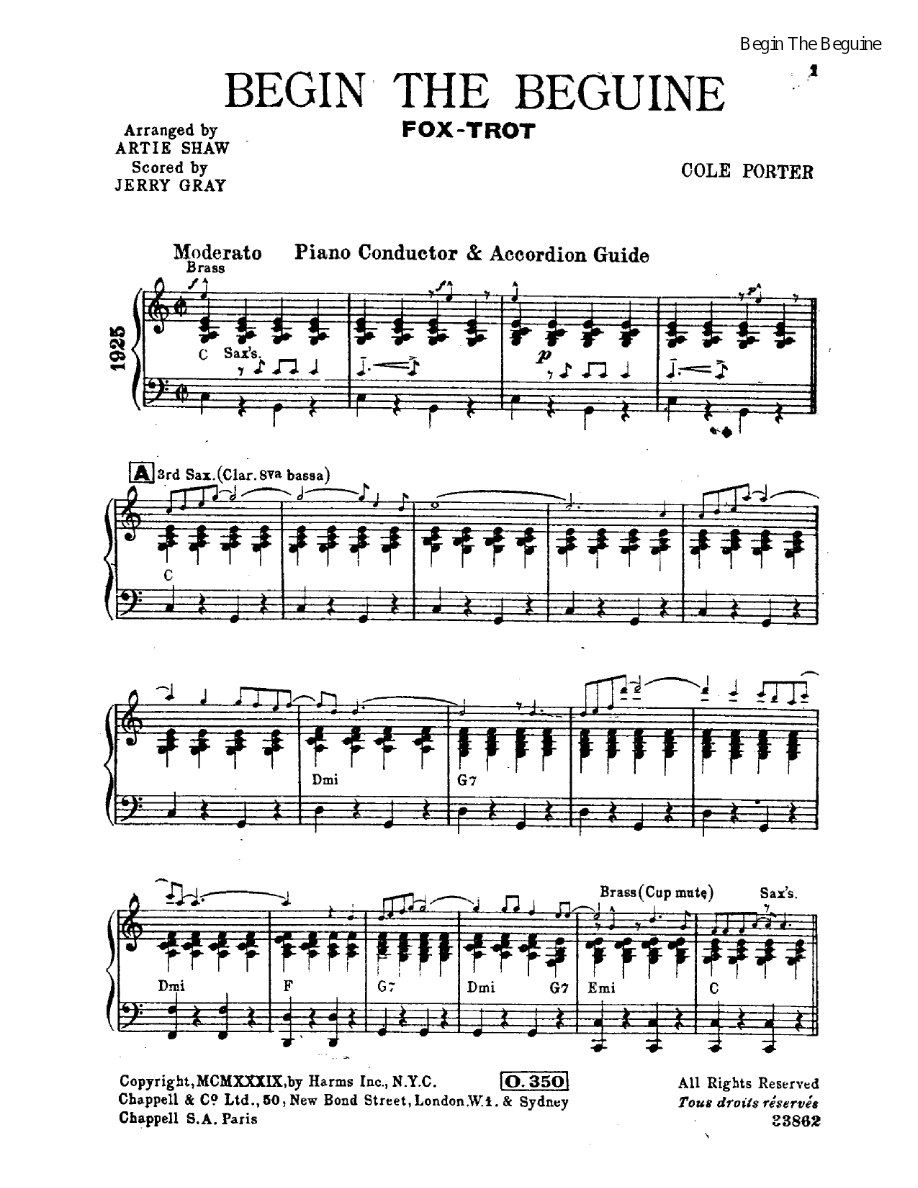
Begin The Beguine (A.Shaw)
Composed by Cole Porter
Arranged by Artie Shaw
- Ensemble: Big Band Dance
- Style: Foxtrot
- Pages: 27
- Instruments (15): Piano, Accordion, Alto Saxophone 2, Alto Saxophone 1, Bass, Baritone Saxophone, Tenor Saxophone 2, Tenor Saxophone 1, Trombone 3, Drum Set, Trombone 1, Trombone 2, Trumpet 2, Trumpet 1, Trumpet 3
- Difficulty: medium
- Content: Individual Parts
- Format: PDF Download (Instant)
- Price: $24.99
Cole Porter's "Begin The Beguine," originally penned in 1935 for the musical *Jubilee*, stands as one of the most enduring and harmonically sophisticated compositions of the Great American Songbook. Its unique 108-bar A-A-B-A-C-A-B-A form, combined with a mesmerizing Latin-tinged melody, immediately set it apart. While the original stage production was not a massive hit, Artie Shaw's iconic 1938 big band recording transformed the tune into a cultural phenomenon, cementing its status as a jazz standard and a definitive piece of the Swing Era. Shaw’s rendition, famous for its extended instrumental passages and driving rhythm, became one of the best-selling records of its time, showcasing the virtuosity and power of the big band format. This particular arrangement by A. Shaw captures the essence of that golden age, presenting "Begin The Beguine" as a vibrant Foxtrot, suitable for a classic big band dance ensemble. This arrangement unfolds at a brisk, yet elegant, tempo, firmly rooted in a classic Foxtrot feel, typically around 160-180 BPM. The initial energy is one of sophisticated exuberance, quickly building to a joyous, full-bodied sound. The key of C Major provides a bright and accessible canvas for Porter's intricate melodic and harmonic development, allowing the brass to shine with clarity and the saxophones to weave intricate lines. The arrangement masterfully balances the tune's inherent romanticism with the driving rhythmic propulsion characteristic of a dance band chart. Listeners will experience a journey from a captivating, almost hypnotic opening to a thrilling, full-ensemble climax, evoking the grandeur and excitement of a 1930s ballroom. A. Shaw's approach to "Begin The Beguine" is characterized by a meticulous attention to ensemble voicings and a brilliant use of the full big band palette. The arrangement opens with the iconic melody carried by the saxophone section, often in lush, close-voiced harmonies, before being passed to the brass for a more declarative statement. Shaw's signature soli sections are prominent, particularly for the saxophones, showcasing intricate counterpoint and tight rhythmic precision. Expect dynamic contrasts, from hushed, almost whispered passages to powerful, full-throated shout choruses that build tension and excitement. While specific solo sections are not explicitly notated for improvisation in the traditional jazz sense, the arrangement itself functions as a virtuosic showcase for the entire ensemble, with intricate melodic lines and rhythmic figures demanding a high level of ensemble cohesion. The arrangement navigates Porter's extended form with seamless transitions and a constant sense of forward motion, ensuring that the listener remains engaged throughout its considerable length. Performing this arrangement is a rewarding experience for a well-rehearsed college or community big band, and certainly for professional ensembles. The technical demands are significant, requiring strong sectional intonation, precise articulation, and a unified rhythmic pulse across all 17 instruments. The saxophones will need excellent blend and agility for the soli sections, while the brass must deliver powerful, controlled fortissimos. The rhythm section is crucial for maintaining the driving Foxtrot feel and providing a solid foundation for the complex ensemble passages. The sheer joy of performing such an iconic and brilliantly arranged piece, especially when the ensemble locks into its infectious groove, makes the rehearsal effort entirely worthwhile. Conductors should aim for a consistent, driving Foxtrot feel, typically between 160-180 BPM, prioritizing rhythmic precision and forward momentum. The extended form of "Begin The Beguine" requires careful pacing; build dynamics gradually towards the shout choruses, ensuring that the full power of the ensemble is unleashed without sacrificing control. Articulation is key: encourage crisp, unified attacks and releases, particularly in the saxophone soli sections and brass figures. The brass section will need to manage endurance for sustained fortissimo passages; emphasize breath support and controlled power. The rhythm section must maintain a rock-solid, yet elastic, groove, providing a clear foundation for the intricate ensemble work. Pay close attention to balance between sections, especially when the melody shifts between saxophones and brass. Rehearsal time should focus on sectional intonation within the dense voicings and achieving a unified blend, particularly in the challenging saxophone soli passages. No special mutes or techniques are explicitly required beyond standard big band performance practices. Q: What instruments are included in this arrangement? A: This arrangement is scored for a standard 17-piece big band dance ensemble, including Alto Saxophone 1, Alto Saxophone 2, Tenor Saxophone 1, Tenor Saxophone 2, Baritone Saxophone, Trumpet 1-4, Trombone 1-4, Piano, Bass, and Drums. Q: What is the difficulty level of "Begin The Beguine (A. Shaw)"? A: This arrangement is considered advanced, suitable for college, community, or professional big bands. It demands strong sectional playing, precise articulation, and excellent ensemble cohesion due to its intricate voicings and extended form. Q: What is the musical style and historical context of this arrangement? A: This is a classic Foxtrot arrangement from the Swing Era, capturing the style made famous by Artie Shaw's iconic 1938 recording. It embodies the sophisticated dance music popular in the late 1930s, showcasing Cole Porter's timeless composition. Q: What makes this specific arrangement unique? A: A. Shaw's arrangement is distinctive for its brilliant ensemble voicings, intricate saxophone soli sections, and powerful shout choruses that build excitement throughout Porter's extended 108-bar form, making it a virtuosic showcase for the entire big band. Q: What is the typical performance duration and tempo for this piece? A: The typical performance duration is approximately 3-4 minutes, depending on the chosen tempo. It is designed to be played at a brisk, elegant Foxtrot tempo, generally between 160-180 beats per minute.
Musicians Also Search For
Begin The Beguine Artie Shaw PDF • Begin The Beguine Artie Shaw sheet music • Begin The Beguine arranged by Artie Shaw • Artie Shaw big band dance charts • Artie Shaw jazz arrangements PDF • Begin The Beguine Cole Porter sheet music • Begin The Beguine Cole Porter big band dance arrangement • Cole Porter big band dance charts • Begin The Beguine big band dance arrangement • Begin The Beguine big band dance PDF download • Begin The Beguine jazz ensemble sheet music • big band dance sheet music instant download • Begin The Beguine conductor score PDF • Begin The Beguine individual parts download • Begin The Beguine sheet music with parts • Begin The Beguine Foxtrot chart • Foxtrot big band dance arrangements • buy Begin The Beguine sheet music online • download Begin The Beguine PDF • Begin The Beguine jazz chart • best Artie Shaw big band dance arrangements • Cole Porter songs arranged by Artie Shaw • Begin The Beguine printable sheet music • big band dance repertoire PDF