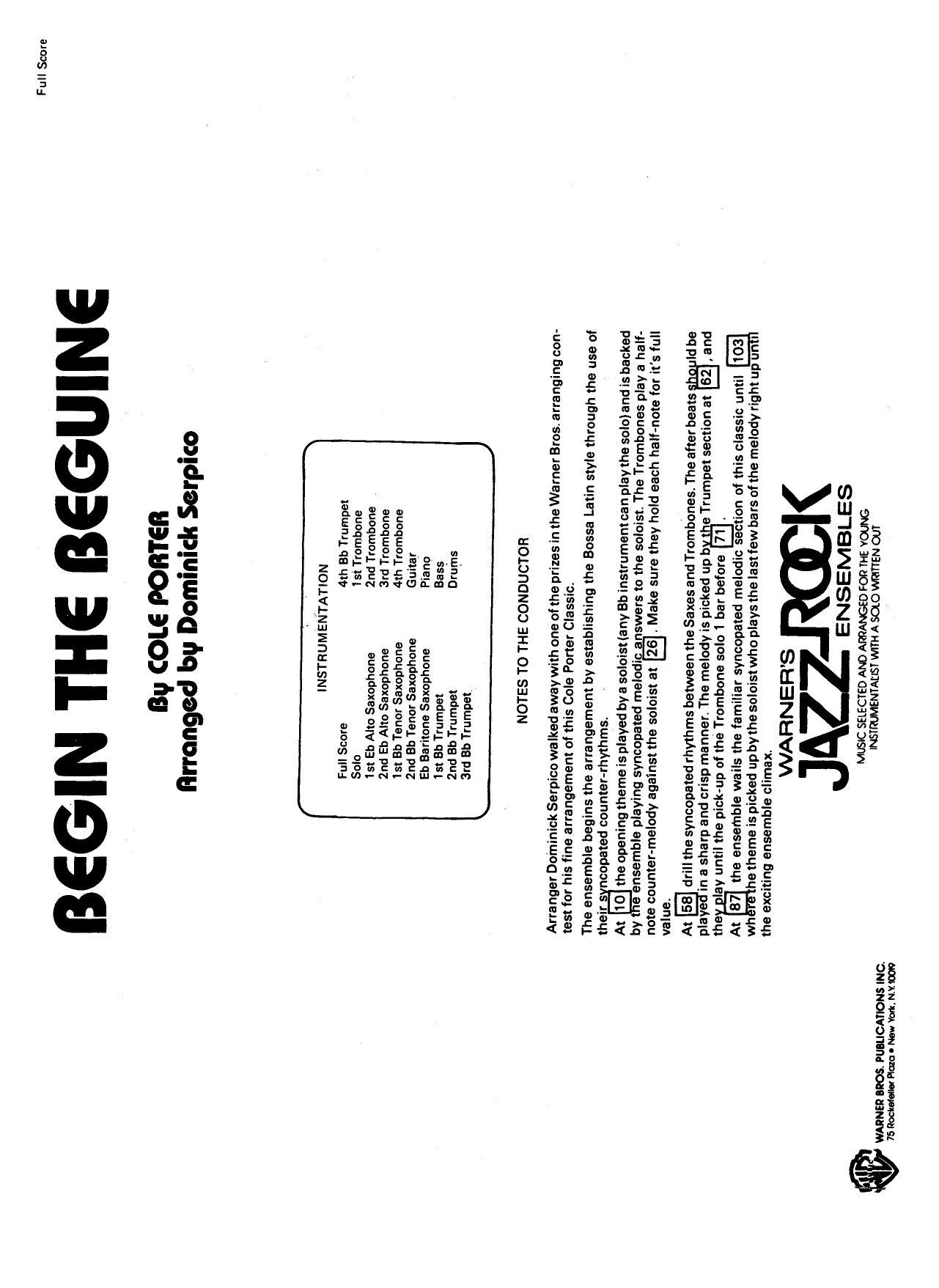
Begin The Beguine (D.Serpico) sheet music preview

Begin The Beguine (D.Serpico)

Composed by Cole Porter

Arranged by D.Serpico

  • Ensemble: Big Band
  • Pages: 59
  • Instruments (19): Full Score, Solo (Bb instrument), 1st Eb Alto Saxophone, 2nd Eb Alto Saxophone, 1st Bb Tenor Saxophone, 2nd Bb Tenor Saxophone, Eb Baritone Saxophone, 1st Bb Trumpet, 2nd Bb Trumpet, 3rd Bb Trumpet, 4th Bb Trumpet, 1st Trombone, 2nd Trombone, 3rd Trombone, 4th Trombone, Guitar, Piano, Bass, Drums
  • Difficulty: advanced
  • Content: Individual Parts
  • Format: PDF Download (Instant)
  • Price: $24.99

Cole Porter’s timeless masterpiece, originally introduced in his 1935 musical *Jubilee* and subsequently immortalized by Artie Shaw’s landmark 1938 swing recording, stands as one of the most sophisticated melodic statements of the mid-20th-century American songbook. Known for its mesmerizing, unrepeating melodic architecture and sultry Iberian-inflected undertones, the composition bridges the gap between traditional Tin Pan Alley craftsmanship and Latin-jazz hybridization. It demands an ensemble that understands both the precision of the swing era and the rhythmic elasticity required by a seamless beguine/rhumba groove. D.Serpico’s distinctive arrangement captures this dual identity by grafting a sophisticated contemporary jazz harmony onto the framework of a classic 7-instrument chamber big band. Unfolding in a moderate, hypnotic Latin-swing tempo, the chart opens with an atmospheric vamp in the piano before the alto and tenor saxophones introduce the sinuous primary theme in parallel thirds. Serpico avoids predictable block-chord writing, instead utilizing open fourths and extended upper extensions (9ths, #11s, and 13ths) to give the horns a lush, modernistic sheen reminiscent of 1960s West Coast modernism. The rhythm section functions as the beating heart of the chart, utilizing an authentic percussion-heavy groove that encourages the bassist to walk fluidly beneath shifting harmonic plateaus. As the chart progresses, the texture thickens dynamically into a tightly-knit counterpoint section where the trumpet and trombone weave independent melodic lines against a cascading piano ostinato. Rather than relying on a massive, roaring traditional shout chorus, Serpico crafts a restrained yet intensely driving developmental peak that highlights a structured improvisational space for the tenor saxophone, backed by shimmering cymbal work and rhythmic horn stabs. The technical demands lie primarily in the realm of rhythmic independence and intonation; because the ensemble features a lean 7-instrument configuration, every player functions as a soloist with nowhere to hide, requiring pristine balance, acute listening, and a mature command of chromatic voice-leading. Advanced high school ensembles, collegiate jazz combos, and professional boutique big bands will find this 59-page score to be an exceptional vehicle for showcasing chamber-jazz interplay and stylistic versatility. The arrangement rewards groups that can transition fluidly from sultry, rubato-flavored ballad phrasing to crisp, articulated Latin-groove ostinatos. It offers a refreshing, highly polished alternative to standard full-ensemble charts, giving smaller horn sections the sonic depth and harmonic complexity of a much larger orchestra without losing transparency or agility. Achieving the authentic atmosphere of D.Serpico’s arrangement requires meticulous attention to the subtle shifting between straight Latin subdivisions and traditional swung eighth notes. The percussion and bass must lock into a steady, unyielding groove from the downbeat, avoiding any tendency to rush during the rhythmically dense modulatory interludes. Horn players should prioritize a warm, centered tone with a minimum of heavy vibrato, particularly during the exposed saxophone soli passages where intonation on altered dominants is critical. Brass players should keep mutes close at hand for textural contrast, ensuring that falls and smears are executed with subtle control rather than overt theatricality. Conductors should use early rehearsals to isolate the complex counterpoint between the trombone and tenor saxophone, ensuring that inner voices balance cleanly against the primary melodic line carried by the trumpet and alto saxophone. Q: What instruments and parts are included in this 59-page score? A: This arrangement is scored for a 7-instrument ensemble featuring Alto Saxophone, Tenor Saxophone, Trumpet, Trombone, Piano, and rhythm section support, complete with full instrumental parts and a comprehensive conductor's score across its 59 pages. Q: What is the difficulty level of this D.Serpico arrangement? A: The chart is tailored for advanced high school, collegiate, and professional musicians who possess strong sight-reading capabilities, precise intonation control, and familiarity with extended chromatic harmonies. Q: How does this arrangement fit into the historical tradition of the composition? A: It honors the seductive Latin-swing roots popularized by Artie Shaw in the late 1930s while infusing the structure with modern West Coast jazz voicings and contemporary modal harmonic shifts. Q: What makes Serpico's treatment unique compared to standard big band charts? A: Instead of relying on a wall-of-sound traditional shout chorus, Serpico utilizes a transparent 7-instrument chamber configuration that emphasizes intricate counterpoint, open-interval voicings, and individualized horn independence. Q: What is the recommended performance tempo and duration? A: The piece is set at a sultry, hypnotic medium Latin-swing tempo of approximately 116 BPM, resulting in a performance duration of roughly 4 to 5 minutes depending on the length of the open solo sections.

Questions and answers

What is included in the Begin The Beguine (D.Serpico) PDF?
The verified current file contains a conductor score and individual parts across 59 pages.
How many instruments or parts are listed for Begin The Beguine (D.Serpico)?
The verified instrumentation list contains 19 entries for this Big Band arrangement.
Who is credited for Begin The Beguine (D.Serpico)?
Composer: Cole Porter. Arranger: D.Serpico.
What difficulty is listed for Begin The Beguine (D.Serpico)?
The verified difficulty level is advanced.
Can I preview Begin The Beguine (D.Serpico) before buying?
Yes. The product page provides a preview generated from the current PDF file.
How is Begin The Beguine (D.Serpico) delivered?
After successful payment, the digital PDF is made available for download. The displayed price is $24.99.

Musicians Also Search For

Begin The Beguine D.Serpico PDFBegin The Beguine D.Serpico sheet musicBegin The Beguine arranged by D.SerpicoD.Serpico big band chartsD.Serpico jazz arrangements PDFBegin The Beguine Cole Porter sheet musicBegin The Beguine Cole Porter big band arrangementsCole Porter big band chartsBegin The Beguine big band arrangementsBegin The Beguine big band PDF downloadBegin The Beguine jazz sheet musicbig band sheet music downloadBegin The Beguine conductor score PDFBegin The Beguine individual parts downloadBegin The Beguine sheet music PDFbuy Begin The Beguine sheet musicdownload Begin The Beguine PDFBegin The Beguine jazz chartsbest D.Serpico big band arrangementsCole Porter arranged by D.SerpicoBegin The Beguine printable sheet musicbig band repertoire PDF

All arrangements by D.Serpico All Cole Porter sheet music