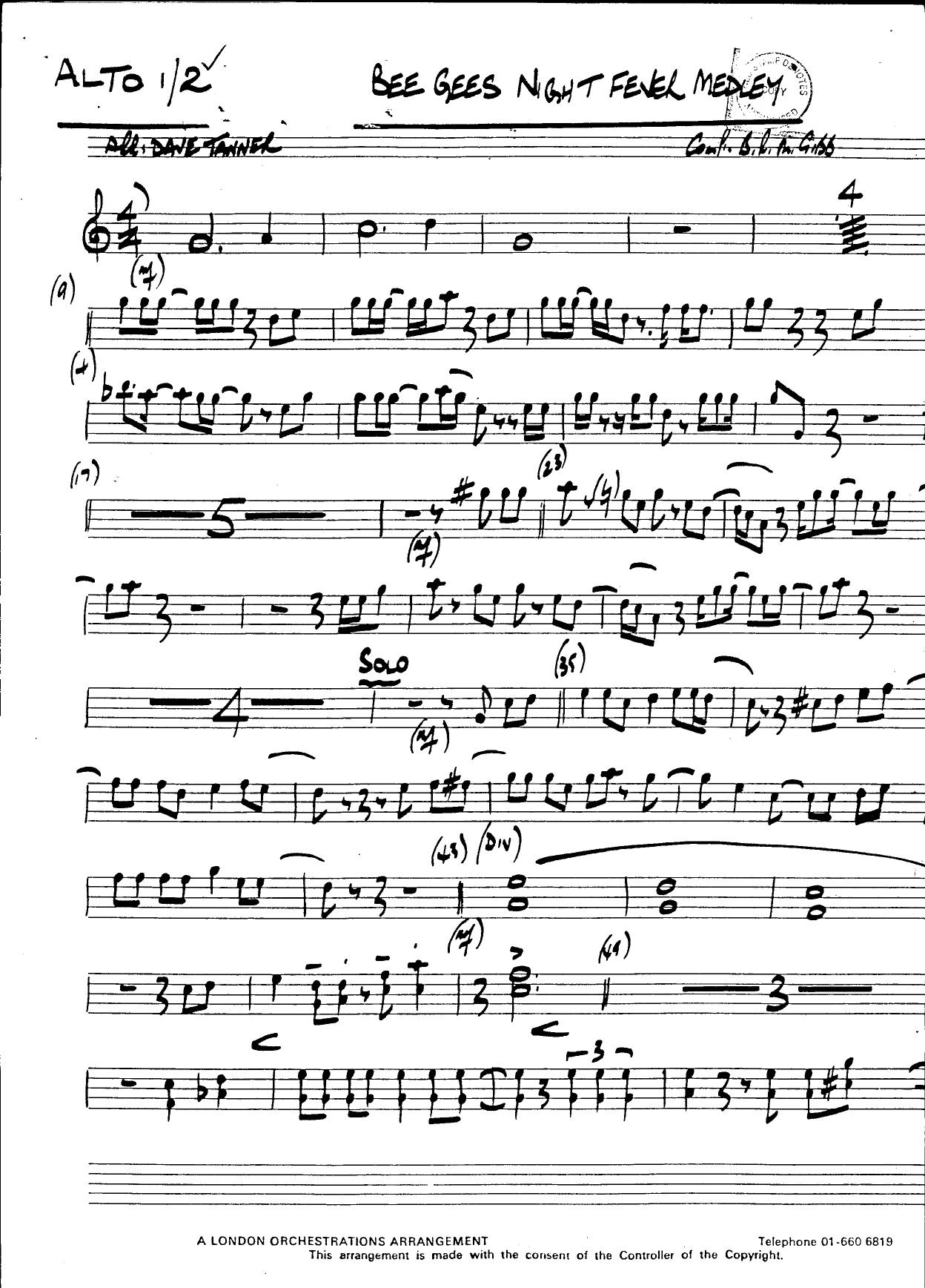
Bee Gees Night Fever Medley (D.Tanner)
Composed by Various
Arranged by Dave Tanner
- Ensemble: Big Band
- Pages: 24
- Instruments (11): Alto Saxophone 1/2, Tenor Saxophone 1/2, Baritone Saxophone, Trombone 1, Trombone 2/3, Trumpet 1/3, Trumpet 2/4, Bass Guitar, Drums, Guitar, Keyboard
- Difficulty: medium
- Content: Individual Parts
- Format: PDF Download (Instant)
- Price: $24.99
Capturing the electrifying pulse of the late 1970s disco revolution, the "Bee Gees Night Fever Medley," expertly arranged by Dave Tanner, translates the iconic infectious rhythms of the Brothers Gibb into a powerhouse big band chart. Originally defined by the Bee Gees' landmark 1977 soundtrack for *Saturday Night Fever*, these songs crystallized an era of cultural transformation, dominating global airwaves and fusing lush vocal harmonies with driving, syncopated rhythm section grooves. Tanner takes these anthemic pop masterpieces and recontextualizes them through a sophisticated jazz lens, bridging the gap between nostalgic commercial appeal and modern big band harmonic sophistication. Propelled by an insistent, driving four-on-the-floor dance groove infused with contemporary jazz-funk syncopation, this arrangement maintains an infectious, high-octane energy from downbeat to final chord. The chart opens with instantly recognizable thematic motifs before expanding into rich, contemporary extended voicings that evoke the polished studio sounds of late-70s West Coast jazz fusion. The dynamic arc moves seamlessly from sultry, brass-laden melodic statements to explosive, high-energy shout choruses that utilize tight block-chord voicings for the saxophones and soaring brass counterlines. The mood shifts effortlessly between sophisticated urban cool and unadulterated celebratory exuberance, making it an undeniable crowd-pleaser that never sacrifices musical integrity for mere nostalgia. Tanner’s signature arranging style shines through in the clever transitions and intricate sectional interplay, ensuring that every player in the ensemble remains actively engaged. The woodwind section carries much of the initial thematic weight with agile, bebop-infused scalar runs, while the low brass and rhythm section lock into a heavy, interdependent groove that demands precision timing. Featured solo space allows improvisers to stretch out over modern modal harmonic frameworks, backed by crisp horn-section background kicks. Technical demands center primarily on maintaining clean articulation through rapid syncopated figures and balancing the dynamic contrast between lightweight funk grooves and thunderous, full-ensemble climaxes. Advanced high school ensembles with strong rhythm sections, as well as collegiate and professional community big bands, will find this chart an ideal centerpiece for concert programming. It offers an exceptional vehicle for showcasing a tight rhythm section and confident lead players while offering accessible yet rewarding challenges for the entire ensemble. Performing this medley provides a masterclass in style fusion, requiring musicians to balance the rhythmic precision of funk with the relaxed articulation and swing sensibilities inherent to contemporary big band performance. Success with Dave Tanner’s "Bee Gees Night Fever Medley" hinges on the rhythm section's ability to lock in a relentless, driving groove without rushing the tempo. The drummer should anchor the ensemble with a crisp, steady pulse, blending a disco-funk hi-hat feel with traditional jazz ride cymbal articulation. Brass players must pay close attention to short, clipped articulations on the syncopated eighth-note figures; avoid over-accentuating the off-beats to prevent the chart from sounding heavy-handed. Trombone and trumpet sections should utilize clean, precise plunger effects and subtle falls where indicated to mimic the vocal nuances of the original recordings without descending into caricature. In rehearsal, isolate the rhythm section first to secure the underlying harmonic transitions before layering in the horns. Directors should spend dedicated time balancing the ensemble during the dense soli sections, ensuring the inner voices of the saxophones project clearly beneath the primary melody. Encourage the lead trumpet to maintain a bright, centered tone that cuts through the thick textures of the shout choruses without forcing the upper register. Q: What instruments and parts are included in this arrangement? A: This chart is scored for a standard 10-instrument big band instrumentation, featuring parts for Alto Saxophone 1 & 2, Tenor Saxophone 1 & 2, Baritone Saxophone, Trombone 1, and combined Trombone 2/3 parts, alongside a comprehensive 24-page full score and rhythm section charts. Q: What is the difficulty level of this arrangement? A: This arrangement is graded as intermediate-advanced, making it well-suited for high school jazz bands with strong section players, as well as collegiate and professional community big bands looking for an engaging crowd-pleaser. Q: What musical style and historical context does this chart represent? A: The chart fuses the iconic 1970s disco-pop hits of the Bee Gees with contemporary jazz-funk arranging styles, bridging the gap between commercial pop history and modern big band tradition. Q: What makes Dave Tanner's arrangement unique? A: Tanner distinguishes the chart through sophisticated extended harmonies, clever episodic transitions between iconic Bee Gees themes, and tight saxophone soli sections that elevate pop melodies into genuine jazz compositions. Q: What is the approximate performance duration and tempo feel? A: The medley runs approximately 4 to 5 minutes in duration and operates at an energetic, driving tempo that demands sustained stamina and precise rhythmic execution from the entire ensemble.
Questions and answers
- What is included in the Bee Gees Night Fever Medley (D.Tanner) PDF?
- The verified current file contains individual parts across 24 pages.
- How many instruments or parts are listed for Bee Gees Night Fever Medley (D.Tanner)?
- The verified instrumentation list contains 11 entries for this Big Band arrangement.
- Who is credited for Bee Gees Night Fever Medley (D.Tanner)?
- Composer: Various. Arranger: Dave Tanner.
- What difficulty is listed for Bee Gees Night Fever Medley (D.Tanner)?
- The verified difficulty level is medium.
- Can I preview Bee Gees Night Fever Medley (D.Tanner) before buying?
- Yes. The product page provides a preview generated from the current PDF file.
- How is Bee Gees Night Fever Medley (D.Tanner) delivered?
- After successful payment, the digital PDF is made available for download. The displayed price is $24.99.
Musicians Also Search For
Bee Gees Night Fever Medley Dave Tanner PDF • Bee Gees Night Fever Medley Dave Tanner sheet music • Bee Gees Night Fever Medley arranged by Dave Tanner • Dave Tanner big band charts • Dave Tanner jazz arrangements PDF • Bee Gees Night Fever Medley Various sheet music • Bee Gees Night Fever Medley Various big band arrangements • Various big band charts • Bee Gees Night Fever Medley big band arrangements • Bee Gees Night Fever Medley big band PDF download • Bee Gees Night Fever Medley jazz sheet music • big band sheet music download • Bee Gees Night Fever Medley individual parts download • Bee Gees Night Fever Medley sheet music PDF • buy Bee Gees Night Fever Medley sheet music • download Bee Gees Night Fever Medley PDF • Bee Gees Night Fever Medley jazz charts • best Dave Tanner big band arrangements • Various arranged by Dave Tanner • Bee Gees Night Fever Medley printable sheet music • big band repertoire PDF