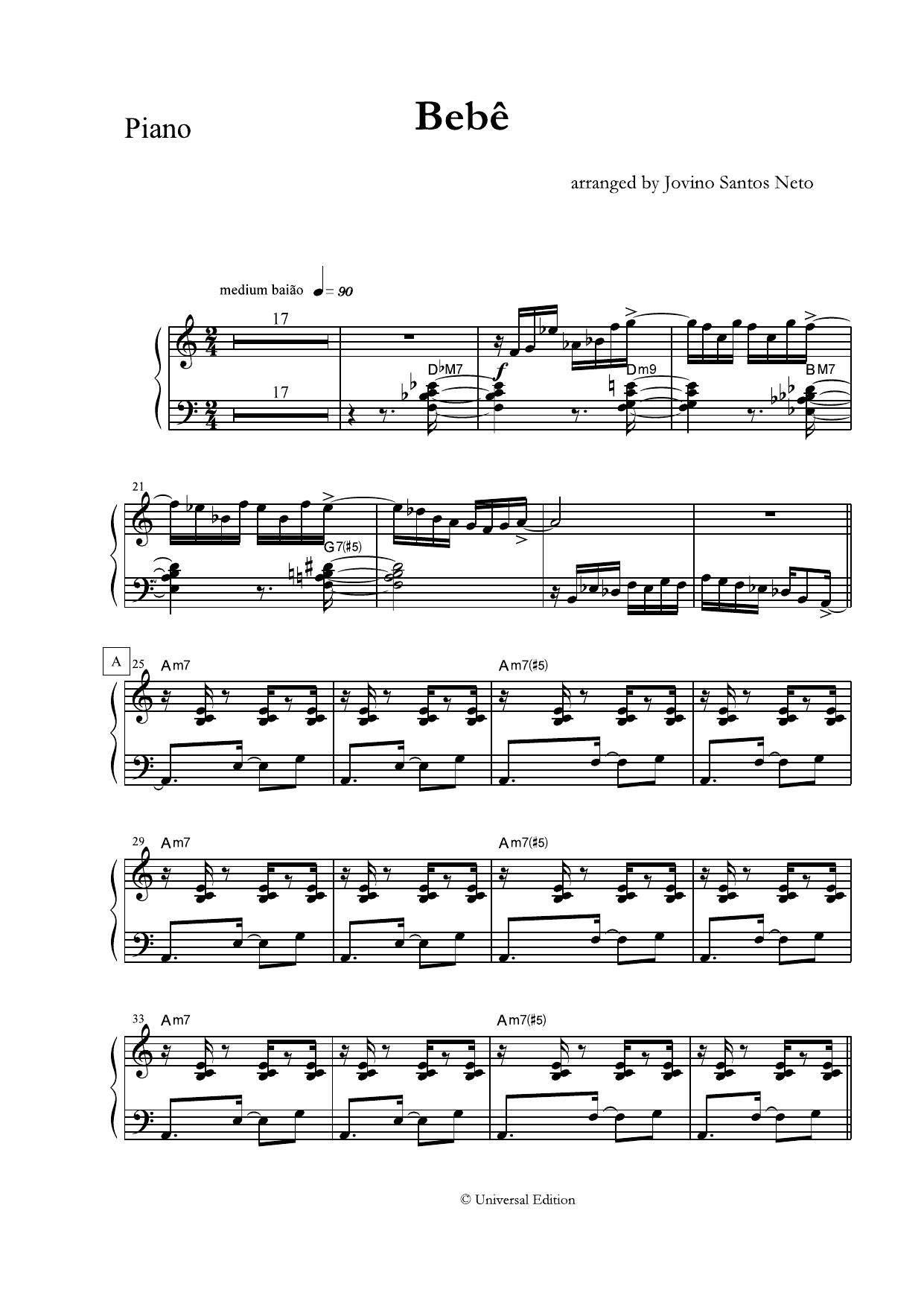
Bebe (J.S.Neto)
Composed by Hermeto Pascoal
Arranged by J.S.Neto
- Ensemble: Big Band
- Style: Jazz Standard
- Pages: 51
- Instruments (20): concert lead, Bb Soprano Saxophone, Eb Alto Saxophone 1, Flute, Eb Alto Saxophone 2, Bb Tenor Saxophone 1, Bb Clarinet, Bb Tenor Saxophone 2, Eb Baritone Saxophone, Bb Bass Clarinet, Trumpet in Bb 1, Trumpet in Bb 2, Trumpet in Bb 3, Trumpet in Bb 4, Trombone 1, Trombone 2, Trombone 3, Trombone 4, Piano, Drum Set
- Difficulty: easy
- Content: Individual Parts
- Format: PDF Download (Instant)
- Price: $24.99
Hermeto Pascoal originally crafted "Bebê" in 1973, dedicating the piece to his newborn son. Over the decades, this composition has transcended its origins as an intimate track on his landmark self-titled debut album to become a revered modern jazz standard, celebrated globally for its ingenious blend of sophisticated harmonic movement and traditional Brazilian folkloric rhythms, specifically the driving syncopations of the *baião* and the intricate melodic architecture of *choro*. The work occupies an essential space in the canon of Latin-jazz fusion, admired by instrumentalists for its deceptive structural simplicity and rich emotional depth, capturing both the playful innocence of its namesake and the breathtaking compositional genius of its creator. Rooted in a vibrant medium-up groove anchored by an infectious *baião* feel, the piece radiates an organic, effervescent energy that balances rhythmic agility with lush, impressionistic lyricism. The harmonic landscape shifts fluidly, evoking a mood that is simultaneously joyful, contemplative, and rhythmically hypnotic. Listeners are swept through an ever-evolving sonic journey where intricate counterpoint rubs shoulders with sweeping, open-air melodies, creating an atmosphere that feels both intimately personal and monumentally celebratory. In this comprehensive big band adaptation, J.S.Neto brilliantly harnesses the vast textural palette of the modern jazz orchestra while maintaining absolute fidelity to Pascoal’s distinctively idiosyncratic writing style. Neto employs intricate brass voicings and rolling woodwind solis that mimic the nimble agility of Brazilian regional instruments, cleverly reinterpreting the angular piano lines and airy flute phrasing of the original recording into rich, interlocking ensemble textures. Extended tertian and quartal harmonies ripple through the saxophone and brass sections, punctuated by ingenious transitional modulations and a dynamic shout chorus that builds organically upon Pascoal's original thematic motifs. The melodic weight is distributed democratically across the ensemble, featuring extended soli passages for the reeds and tight brass intersections that demand absolute rhythmic precision. Solo opportunities are provided for lead voices, allowing improvisers to navigate sophisticated harmonic turnarounds framed by lush, harmonically rich background figures. Technically demanding yet deeply rewarding, the chart requires exceptional ensemble articulation, stylistic versatility, and a secure grasp of mixed-meter feels. Advanced college ensembles, community jazz orchestras, and professional big bands will find this 51-page tour de force an exhilarating centerpiece for concert programming, offering a masterclass in cross-cultural stylistic synthesis. Conducting and performing this arrangement successfully requires an intimate understanding of Brazilian rhythmic phrasing layered over a contemporary big band framework. The underlying *baião* groove must remain light, floating, and relentlessly driving rather than heavy or stiff; the quarter-note pulse should breathe with an authentic dance-like elasticity. Key technical challenges center around the nimble, interlocking woodwind lines and rapid scalar passages that cross register breaks. Conductors should spend early rehearsals isolating these lines at slower tempos, ensuring that articulation markings (particularly detached staccatos and smooth slurs) match precisely across sections. Brass players must exercise restraint during harmonic backgrounds, blending seamlessly to support soloists without masking the intricate inner-voice movements written into the lower staff. No extended auxiliary techniques or unconventional mutes are strictly required, allowing the acoustic warmth of the ensemble to drive the performance. Pay careful attention to dynamic contrasts, particularly during transitional builds where the full band swells into the primary shout choruses, ensuring that the primary melodic voice always punches clearly through the harmonic texture. Q: What instruments and parts are included in this arrangement? A: This 51-page publication features a complete big band instrumentation, including a full conductor score, standard woodwind doublings, four trumpets, four trombones, and a full rhythm section comprising piano, guitar, bass, and drums/percussion. Q: What is the difficulty level of this chart? A: This arrangement is designated for advanced performers, making it ideal for high-level university jazz orchestras, professional big bands, and elite community ensembles capable of tackling complex meter and advanced harmonic concepts. Q: What musical style and historical context define this piece? A: Written originally by Hermeto Pascoal in 1973, the piece merges Brazilian folkloric styles like *baião* and *choro* with contemporary jazz harmonization, representing a cornerstone of post-bossa Brazilian jazz fusion. Q: What makes J.S.Neto's arrangement unique? A: Neto skillfully translates Pascoal's notoriously idiosyncratic small-group and keyboard voicings into a massive big band canvas, utilizing inventive woodwind solis, rich extended harmonies, and carefully constructed shout choruses. Q: What is the performance tempo and duration of the piece? A: The arrangement is set in a brisk, danceable *baião* groove at approximately dotted quarter-note = 90, resulting in a performance duration of roughly 5 to 6 minutes depending on solo extensions.
Questions and answers
- What is included in the Bebe (J.S.Neto) PDF?
- The verified current file contains individual parts across 51 pages.
- How many instruments or parts are listed for Bebe (J.S.Neto)?
- The verified instrumentation list contains 20 entries for this Big Band arrangement.
- Who is credited for Bebe (J.S.Neto)?
- Composer: Hermeto Pascoal. Arranger: J.S.Neto.
- What difficulty is listed for Bebe (J.S.Neto)?
- The verified difficulty level is easy.
- What style is listed for Bebe (J.S.Neto)?
- The catalog lists the style as Jazz Standard.
- Can I preview Bebe (J.S.Neto) before buying?
- Yes. The product page provides a preview generated from the current PDF file.
- How is Bebe (J.S.Neto) delivered?
- After successful payment, the digital PDF is made available for download. The displayed price is $24.99.
Musicians Also Search For
Bebe J.S.Neto PDF • Bebe J.S.Neto sheet music • Bebe arranged by J.S.Neto • J.S.Neto big band charts • J.S.Neto jazz arrangements PDF • Bebe Hermeto Pascoal sheet music • Bebe Hermeto Pascoal big band arrangements • Hermeto Pascoal big band charts • Bebe big band arrangements • Bebe big band PDF download • Bebe jazz sheet music • big band sheet music download • Bebe individual parts download • Bebe sheet music PDF • Bebe Jazz Standard charts • Jazz Standard big band arrangements • buy Bebe sheet music • download Bebe PDF • Bebe jazz charts • best J.S.Neto big band arrangements • Hermeto Pascoal arranged by J.S.Neto • Bebe printable sheet music • big band repertoire PDF