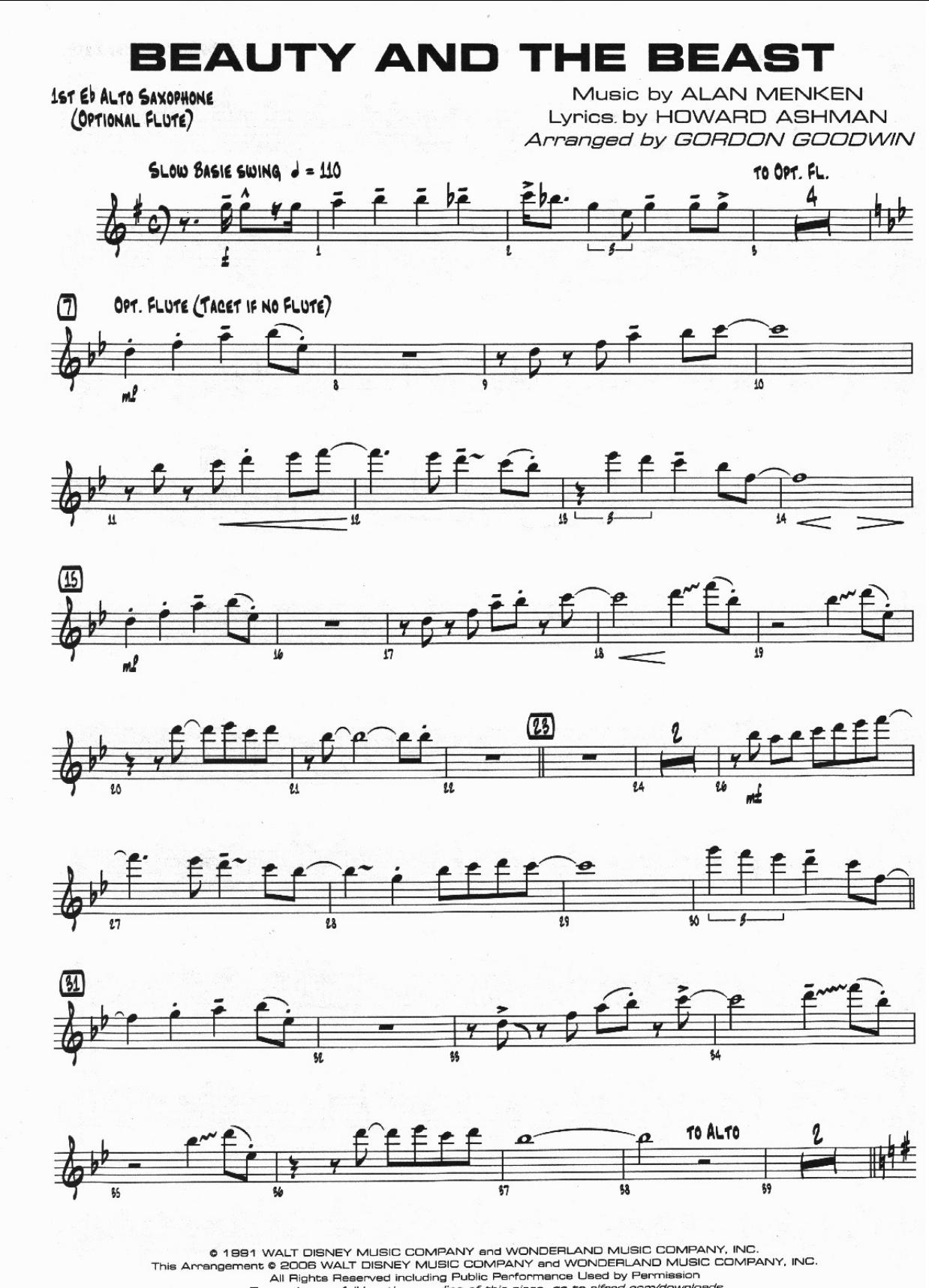
Beauty And The Beast (G.Goodwin) sheet music preview

Beauty And The Beast (G.Goodwin)

Composed by Alan Menken

Arranged by Gordon Goodwin

  • Ensemble: Big Band
  • Pages: 49
  • Instruments (17): 1st Eb Alto Saxophone (Optional Flute), 2nd Eb Alto Saxophone, 1st Bb Tenor Saxophone, 2nd Bb Tenor Saxophone, Eb Baritone Saxophone, 1st Bb Trumpet, 2nd Bb Trumpet, 3rd Bb Trumpet, 4th Bb Trumpet, 1st Trombone, 2nd Trombone, 3rd Trombone, 4th Trombone, Guitar, Piano, Bass, Drums
  • Difficulty: medium
  • Content: Individual Parts
  • Format: PDF Download (Instant)
  • Price: $24.99

Alan Menken’s timeless ballad "Beauty and the Beast," originally penned for the 1991 animated Disney masterpiece and famously recorded by Celine Dion and Peabo Bryson, occupies a unique space where cinematic romance meets Broadway lyricism. Over the decades, the melody has transitioned seamlessly into the modern jazz repertoire, prized for its sophisticated harmonic structure and sweeping, memorable contour. When filtered through the imaginative compositional lens of contemporary big band master Gordon Goodwin, this beloved classic sheds its saccharine exterior and transforms into a lush, dynamically shifting modern jazz orchestration that honors the original melody while exploring rich, expanded harmonic territory. Gordon Goodwin’s treatment reimagines the tune as an expressive, contemporary ballad that gradually swells into a powerful, cinematic statement of emotional intensity. The arrangement opens with an atmospheric, rubato-leaning intro that highlights the woodwinds—featuring versatile doubling on flute—before settling into a flowing, contemporary groove. Goodwin employs his signature thick, lush brass voicings and dense chromatic inner-voice movements, creating a velvety texture reminiscent of his work with the Big Phat Band. As the chart progresses, it utilizes subtle metric shifts and dynamic undulations, moving from delicate, exposed quartet textures to towering, harmonically complex shout choruses that demand absolute precision and blend from the entire ensemble. The emotional core of the chart relies heavily on the lead alto saxophone and lead trumpet chairs, both of which are treated to soaring, lyrical passages that require immense breath control and mature tone production. An improvised solo section provides a featured soloist—ideally on tenor saxophone or flugelhorn—ample room to stretch out over a sophisticated modal-harmonic backdrop before the arrangement builds toward its dramatic climax. Rhythm section players must possess a high level of stylistic adaptability; the drummer is tasked with driving a subtle, evolving feel that shifts from brushwork and light ride cymbal textures to driving, orchestral rolls, while the piano and bass anchor the expansive, extended ninth and eleventh chords that define Goodwin's modern harmonic language. Advanced high school, collegiate, and professional big bands will find this 49-page, 18-instrument chart to be a rewarding centerpiece for a concert program or festival set. Because of its demanding technical requirements—including intricate woodwind doublings, extended range demands for the brass, and the necessity for mature rubato phrasing—it serves as an exceptional vehicle for showcasing an ensemble's collective musicality, dynamic control, and sensitivity to modern big band aesthetics. Achieving success with this arrangement requires meticulous attention to dynamic contrast and intonation, particularly during the dense, harmonically rich chord clusters that Goodwin frequently assigns to the saxes and muted brass. Conductors should spend early rehearsals isolating the rubato introduction to ensure the woodwind doublings—specifically flute—blend effortlessly with the muted brass before locking in the tempo. The rhythm section must approach the groove with an unhurried, floating sense of time; the pianist should voice extended chords carefully to avoid muddying the low register, leaving plenty of room for the acoustic bass. Brass players should practice sustained, soft-dynamic entrances to master the gradual crescendos without forcing the tone. Pay close attention to balance during the climactic shout chorus, ensuring the moving inner voices in the trombones are heard clearly beneath the lead trumpet melody. Emphasize linear phrasing over a strictly metronomic beat to capture the sweeping, cinematic character inherent in Goodwin's writing. Q: What instruments and parts are included in this big band arrangement? A: The 18-instrument orchestration includes standard big band instrumentation featuring Alto Saxophone 1 (with flute double), Alto Saxophone 2, Tenor Saxophone 1, Tenor Saxophone 2, Baritone Saxophone, 4 Trumpets (with flugelhorn options), 4 Trombones, Piano, Guitar, Bass, and Drums, spread across a 49-page score and parts set. Q: What is the difficulty level of this Gordon Goodwin chart? A: This arrangement is graded as advanced, making it best suited for college, advanced high school, community, and professional big bands capable of handling sophisticated harmonies, extended ranges, and subtle stylistic shifts. Q: What style and historical context does this arrangement represent? A: It represents contemporary modern big band jazz, taking Alan Menken’s 1991 Disney theater standard and filtering it through the sophisticated, harmonically dense arranging style pioneered by Gordon Goodwin and his Big Phat Band. Q: What makes this specific arrangement by Gordon Goodwin unique? A: Unlike traditional, straightforward swing charts of show tunes, Goodwin’s version utilizes lush, contemporary chord extensions, rich woodwind doublings, shifting textures, and a cinematic build that transforms a simple ballad into an expressive, modern jazz tour de force. Q: What is the performance duration and tempo feel of the piece? A: The piece functions primarily as a sweeping, expressive contemporary ballad with an evolving tempo feel, featuring both rubato passages and a flowing, sustained groove that typically spans around 4 to 5 minutes in performance length.

Questions and answers

What is included in the Beauty And The Beast (G.Goodwin) PDF?
The verified current file contains individual parts across 49 pages.
How many instruments or parts are listed for Beauty And The Beast (G.Goodwin)?
The verified instrumentation list contains 17 entries for this Big Band arrangement.
Who is credited for Beauty And The Beast (G.Goodwin)?
Composer: Alan Menken. Arranger: Gordon Goodwin.
What difficulty is listed for Beauty And The Beast (G.Goodwin)?
The verified difficulty level is medium.
Can I preview Beauty And The Beast (G.Goodwin) before buying?
Yes. The product page provides a preview generated from the current PDF file.
How is Beauty And The Beast (G.Goodwin) delivered?
After successful payment, the digital PDF is made available for download. The displayed price is $24.99.

Musicians Also Search For

Beauty And The Beast Gordon Goodwin PDFBeauty And The Beast Gordon Goodwin sheet musicBeauty And The Beast arranged by Gordon GoodwinGordon Goodwin big band chartsGordon Goodwin jazz arrangements PDFBeauty And The Beast Alan Menken sheet musicBeauty And The Beast Alan Menken big band arrangementsAlan Menken big band chartsBeauty And The Beast big band arrangementsBeauty And The Beast big band PDF downloadBeauty And The Beast jazz sheet musicbig band sheet music downloadBeauty And The Beast individual parts downloadBeauty And The Beast sheet music PDFbuy Beauty And The Beast sheet musicdownload Beauty And The Beast PDFBeauty And The Beast jazz chartsbest Gordon Goodwin big band arrangementsAlan Menken arranged by Gordon GoodwinBeauty And The Beast printable sheet musicbig band repertoire PDF

All arrangements by Gordon Goodwin All Alan Menken sheet music