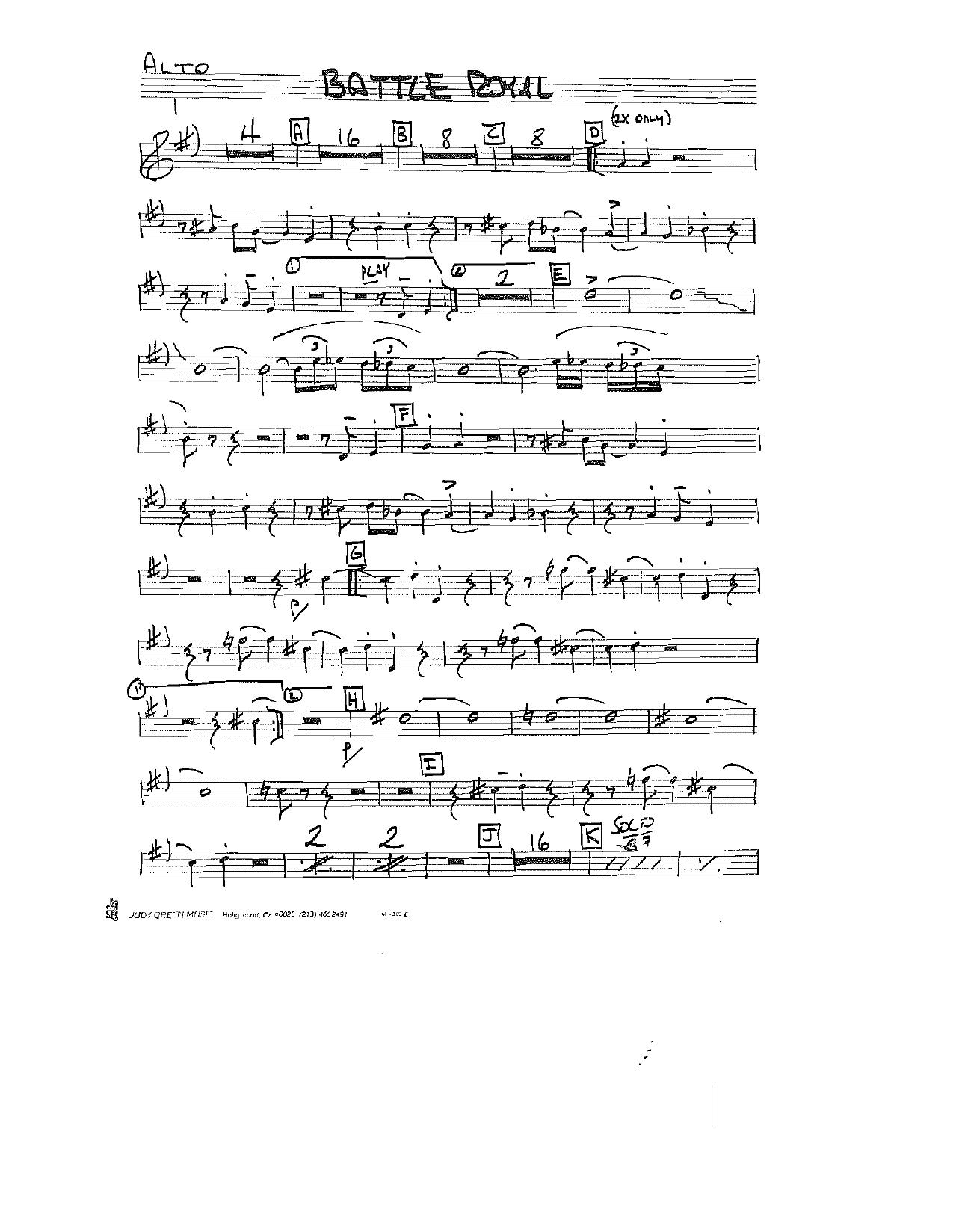
Battle Royal (C.Basie-D.Ellington) sheet music preview

Battle Royal (C.Basie-D.Ellington)

Composed by Duke Ellington

Arranged by Count Basie

  • Ensemble: Big Band
  • Pages: 41
  • Instruments (16): Alto Saxophone I, Alto Saxophone II, Tenor Saxophone I, Tenor Saxophone II, Baritone Saxophone, Trumpet I, Trumpet II, Trumpet III, Trumpet IV, Trombone I, Trombone II, Trombone III, Trombone IV, Piano, Double Bass, Drums
  • Difficulty: medium
  • Content: Individual Parts
  • Format: PDF Download (Instant)
  • Price: $24.99

Duke Ellington and Count Basie first collided on wax for their legendary 1961 collaborative studio album *First Time! The Count Meets the Duke*, a landmark summit that pitted two royalty figures of American big band music against one another in friendly, swinging combat. Among the crown jewels of that historic meeting is "Battle Royal," a high-octane showcase designed to highlight the contrasting yet complementary philosophies of the Ellington and Basie orchestras. This composition represents the pinnacle of post-swing big band arranging, blending the rich, textured color palette and idiosyncratic harmonic palette of Ellington with the driving, blues-drenched, minimalist propulsion of the Basie machine. It stands as a monumental statement of mid-century orchestral jazz, capturing the competitive yet deeply respectful camaraderie between two titans of the genre. Driven by an infectious, hard-driving medium-up swing groove in 4/4 time, "Battle Royal" exudes an electric, competitive energy that builds relentlessly from the first downbeat. The emotional landscape shifts rapidly between playful swagger and explosive, roaring power, evoking a sense of two heavyweights trading blow-for-blow in a musical boxing ring. The harmonic framework balances sophisticated, Ellingtonian dissonances and lush reed voicings with the unmistakable, punchy brass stabs and anchor-like rhythm section syncopation that defined the legendary Basie "Old Testament" and "New Testament" feels. The mood is celebratory, fierce, and undeniably joyous, demanding an ensemble that can swing with authority while navigating intricate thematic interplay. Count Basie’s approach to directing and shaping this arrangement leans heavily into economic phrasing, dynamic contrast, and maximum rhythmic impact. Rather than cluttering the texture, the chart utilizes sparse, perfectly placed piano comping figures, classic Basie-style shout choruses, and brilliantly contrasting block-chord reed solis that trade territory with roaring brass interventions. The melody is tossed dynamically between sections, mimicking a musical conversation or duel across the bandstand. Featured solo space allows room for strong improvisers to step into the spotlight, channeling the competitive spirit of the original recording sessions. Technical challenges lie primarily in maintaining a relaxed yet intense swing micro-timing at faster tempos, executing razor-sharp articulation across disparate sections, and balancing the heavy brass volume against delicate woodwind textures. Advanced college ensembles, top-tier high school jazz bands, and professional repertory orchestras will find this chart an exhilarating centerpiece for a concert program. Because of the sophisticated demands placed on the rhythm section—requiring a deep understanding of Basie-style comping and steady, unhurried time—alongside the stylistic versatility needed to shift between Ellingtonian impressionism and straightforward Kansas City swing, the chart rewards mature bands capable of nuanced phrasing. Performing "Battle Royal" offers a masterclass in big band dynamics, stylistic authenticity, and ensemble listening, making it an unforgettable experience for both performers and audiences alike. Unlocking the authentic drive of "Battle Royal" begins in the rhythm section, where the drummer and bassist must lock into an unhurried, buoyant medium-up swing feel. Avoid rushing the tempo; the power of this arrangement comes from its relaxed intensity and massive forward momentum rather than sheer speed. Brass players should master a wide spectrum of articulations—utilizing aggressive, bluesy falls, controlled doits, and fat, warm plunger mutes where indicated to capture the Ellingtonian growl. Rehearsal should initially isolate the trading sections between the saxophones and brass to ensure seamless transitions and dynamic parity. The rhythm section needs to study the original Basie-Ellington recordings to capture the signature comping style—less is more, leaving ample space for the horns to breathe. Pay meticulous attention to the short, punchy accents in the shout choruses, ensuring every eighth-note is locked in tightly across the entire ensemble. Q: What instruments and parts are included in this arrangement? A: This 41-page arrangement is scored for a standard 16-instrument big band, consisting of 2 alto saxophones, 2 tenor saxophones, baritone saxophone, standard brass instrumentation, and a full rhythm section. Q: What is the difficulty level of this chart? A: This arrangement is graded as advanced, making it best suited for college ensembles, professional big bands, and top-tier high school jazz orchestras with strong, experienced soloists and a tight rhythm section. Q: What is the historical background of this piece? A: Originally recorded for the landmark 1961 album *First Time! The Count Meets the Duke*, this composition captures the historic collaboration and friendly musical rivalry between Duke Ellington and Count Basie. Q: What makes this specific arrangement unique? A: It uniquely bridges Duke Ellington's harmonically rich, texturally diverse writing style with Count Basie's driving, blues-rooted Kansas City swing aesthetic, resulting in a dramatic "duel" format for the big band. Q: What is the performance duration and tempo feel? A: The piece is built around an energetic medium-up swing feel in 4/4 time, typically clocking in at around 3 to 4 minutes depending on the length of the improvised solo choruses.

Questions and answers

What is included in the Battle Royal (C.Basie-D.Ellington) PDF?
The verified current file contains individual parts across 41 pages.
How many instruments or parts are listed for Battle Royal (C.Basie-D.Ellington)?
The verified instrumentation list contains 16 entries for this Big Band arrangement.
Who is credited for Battle Royal (C.Basie-D.Ellington)?
Composer: Duke Ellington. Arranger: Count Basie.
What difficulty is listed for Battle Royal (C.Basie-D.Ellington)?
The verified difficulty level is medium.
Can I preview Battle Royal (C.Basie-D.Ellington) before buying?
Yes. The product page provides a preview generated from the current PDF file.
How is Battle Royal (C.Basie-D.Ellington) delivered?
After successful payment, the digital PDF is made available for download. The displayed price is $24.99.

Musicians Also Search For

Battle Royal Count Basie PDFBattle Royal Count Basie sheet musicBattle Royal arranged by Count BasieCount Basie big band chartsCount Basie jazz arrangements PDFBattle Royal Duke Ellington sheet musicBattle Royal Duke Ellington big band arrangementsDuke Ellington big band chartsBattle Royal big band arrangementsBattle Royal big band PDF downloadBattle Royal jazz sheet musicbig band sheet music downloadBattle Royal individual parts downloadBattle Royal sheet music PDFbuy Battle Royal sheet musicdownload Battle Royal PDFBattle Royal jazz chartsbest Count Basie big band arrangementsDuke Ellington arranged by Count BasieBattle Royal printable sheet musicbig band repertoire PDF

All arrangements by Count Basie All Duke Ellington sheet music