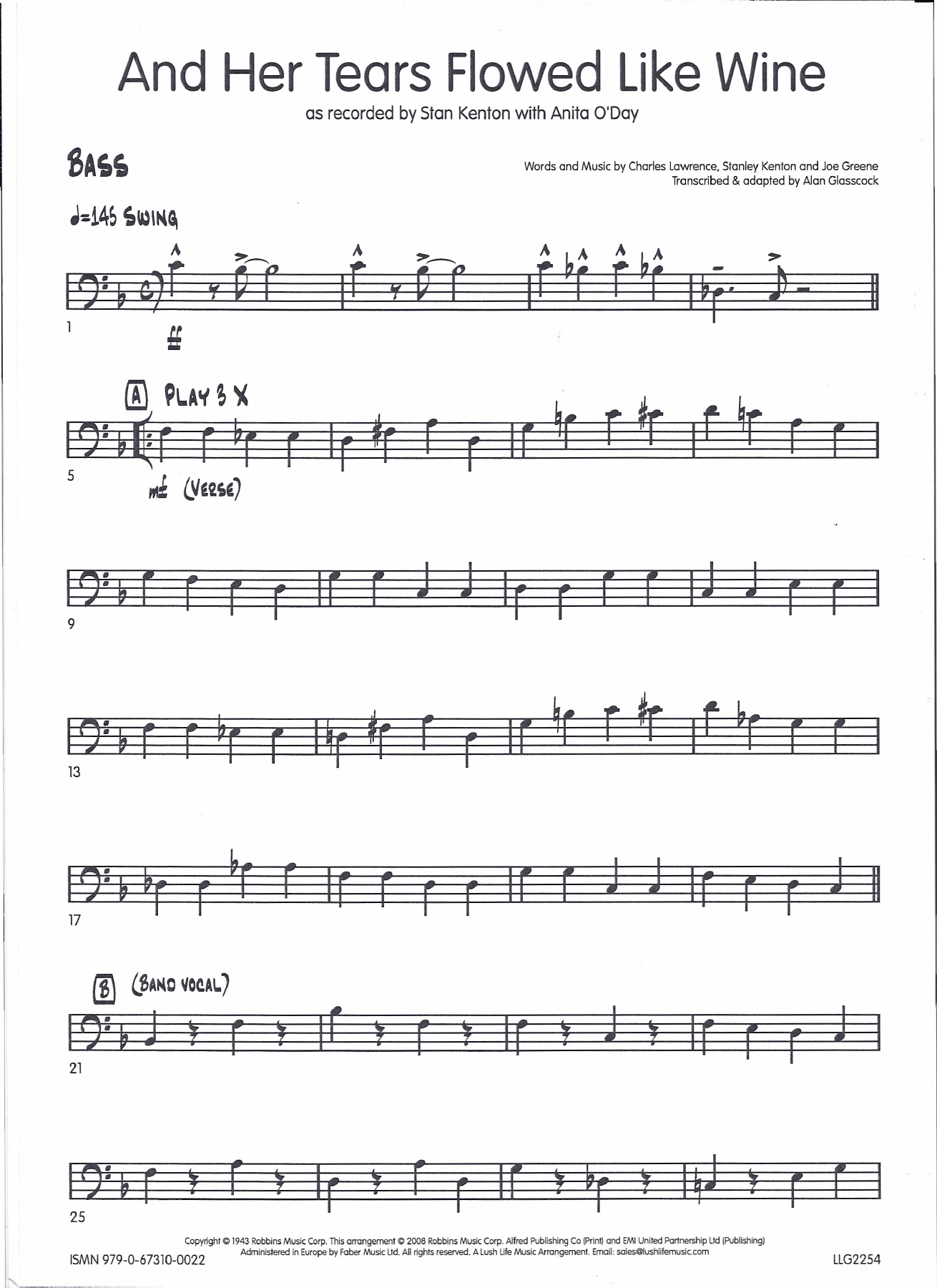
Bass (A.Glasscock)
Composed by Charles Lawrence, Stanley Kenton, Joe Greene
Arranged by Alan Glasscock
- Ensemble: Big Band Vocal
- Style: Jazz Standard
- Pages: 16
- Instruments (14): 1st Alto Sax, 2nd Tenor Sax, 3rd Alto Sax, 4th Tenor Sax, 5th Eb Bar. Sax, 1st Trumpet, 2nd Trumpet, 3rd Trumpet, 1st Trombone, 2nd Trombone, 3rd Trombone, Piano, Bass, Drums
- Difficulty: easy
- Content: Individual Parts
- Format: PDF Download (Instant)
- Price: $12.99
"Bass," as arranged by Alan Glasscock, breathes new life into a foundational jazz standard, a composition deeply rooted in the post-war big band era. While the title "Bass" might evoke its instrumental namesake, the original song, often associated with the vocal stylings of artists like Billy Eckstine and Sarah Vaughan, emerged from the collaborative genius of Charles Lawrence, Stanley Kenton, and Joe Greene. This piece encapsulates the sophisticated vocal jazz of the late 1940s and early 1950s, a period characterized by lush orchestrations, intricate harmonies, and a blend of swing and ballad sensibilities that defined the era's most celebrated vocalists. It's a testament to the enduring appeal of a well-crafted melody and poignant lyrics, establishing itself as a benchmark for vocal interpretation within the jazz canon. Glasscock's treatment of "Bass" is a masterclass in enhancing the original's emotional depth while providing a fresh, contemporary big band canvas. Set at a medium-slow swing tempo in 4/4, the arrangement opens in the key of F major, immediately establishing a warm, introspective mood. The musical character is one of elegant melancholy, evoking a smoky club atmosphere where the vocal narrative takes center stage. Glasscock’s signature approach is evident in the rich, often dense voicings for the horn sections, particularly the saxophones, which provide a velvety bed for the vocalist. Expect carefully crafted counter-melodies and subtle harmonic reharmonizations that add complexity without obscuring the original's melodic integrity. The arrangement unfolds with the vocalist carrying the primary melody, often introduced by a tender, harmonized horn line. Glasscock skillfully employs call-and-response passages between the vocalist and the ensemble, creating a dynamic interplay. While primarily a vocal feature, there are opportunities for instrumental color, including a written-out tenor saxophone soli that provides a brief, lyrical interlude, echoing the vocal line's sentiment. The ensemble's role is to support and enhance, building to a powerful yet controlled shout chorus that provides a climactic moment before receding to a reflective close. Technical challenges include maintaining precise blend and balance within the horn sections, executing nuanced dynamics, and ensuring the rhythm section provides a consistent, supportive swing feel without overpowering the vocalist. This arrangement is particularly rewarding for bands that excel in expressive playing and dynamic control, allowing them to truly craft a narrative alongside the singer. This arrangement is ideally suited for advanced high school, college, community, and professional big bands. Its demands for sophisticated ensemble playing, nuanced interpretation, and a strong, expressive vocalist make it a compelling choice for groups looking to perform a classic standard with a fresh, expertly crafted big band accompaniment. The 16-page score and parts reflect a comprehensive and well-thought-out arrangement, promising a deeply satisfying performance experience for both musicians and audience. Conductors should emphasize a consistent, medium-slow swing feel, ensuring the rhythm section lays down a solid, yet flexible, foundation. The key technical challenge lies in achieving precise intonation and blend within the horn sections, particularly during the lush, harmonized passages that support the vocalist. Encourage brass players to use a warm, rich tone, avoiding harshness, especially in the upper registers. Dynamics are crucial; guide the band to create a nuanced ebb and flow, allowing the vocalist to always be heard clearly. There are no special techniques like plungers or doits required, but expressive phrasing and careful articulation are paramount. Rehearsal time should be dedicated to balancing the ensemble with the vocalist, ensuring the horn lines complement rather than compete. Focus on the lyrical quality of the tenor saxophone soli, treating it as a secondary voice that converses with the main vocal theme. Q: What instruments and parts are included in this arrangement? A: This arrangement includes a full big band instrumentation with parts for 5 saxophones (AATTB), 4 trumpets, 4 trombones, guitar, piano, bass, drums, and a dedicated vocal lead sheet. Q: What is the difficulty level of "Bass (A.Glasscock)"? A: This arrangement is rated as medium-advanced, suitable for advanced high school, college, community, and professional big bands due to its harmonic sophistication, dynamic demands, and the need for a strong, expressive vocalist. Q: What is the musical style and historical context of this arrangement? A: This is a jazz standard arranged for big band vocal, rooted in the sophisticated vocal jazz and lush orchestrations of the late 1940s and early 1950s, embodying the classic big band sound. Q: What makes Alan Glasscock's arrangement of "Bass" unique? A: Glasscock's arrangement is distinguished by its rich, often dense horn voicings, subtle harmonic reharmonizations, and a masterful balance between supporting the vocalist and providing compelling ensemble passages, including a lyrical tenor saxophone soli. Q: What is the typical performance duration and tempo for this piece? A: The arrangement is designed for a medium-slow swing tempo in 4/4, and its performance duration typically ranges from 3:30 to 4:30 minutes, depending on the vocalist's interpretation and any improvised sections.
Questions and answers
- What is included in the Bass (A.Glasscock) PDF?
- The verified current file contains individual parts across 16 pages.
- How many instruments or parts are listed for Bass (A.Glasscock)?
- The verified instrumentation list contains 14 entries for this Big Band Vocal arrangement.
- Who is credited for Bass (A.Glasscock)?
- Composer: Charles Lawrence, Stanley Kenton, Joe Greene. Arranger: Alan Glasscock.
- What difficulty is listed for Bass (A.Glasscock)?
- The verified difficulty level is easy.
- What style is listed for Bass (A.Glasscock)?
- The catalog lists the style as Jazz Standard.
- Can I preview Bass (A.Glasscock) before buying?
- Yes. The product page provides a preview generated from the current PDF file.
- How is Bass (A.Glasscock) delivered?
- After successful payment, the digital PDF is made available for download. The displayed price is $12.99.
Musicians Also Search For
Bass Alan Glasscock PDF • Bass Alan Glasscock sheet music • Bass arranged by Alan Glasscock • Alan Glasscock big band vocal charts • Alan Glasscock jazz arrangements PDF • Bass Charles Lawrence, Stanley Kenton, Joe Greene sheet music • Bass Charles Lawrence, Stanley Kenton, Joe Greene big band vocal arrangements • Charles Lawrence, Stanley Kenton, Joe Greene big band vocal charts • Bass big band vocal arrangements • Bass big band vocal PDF download • Bass jazz sheet music • big band vocal sheet music download • Bass individual parts download • Bass sheet music PDF • Bass Jazz Standard charts • Jazz Standard big band vocal arrangements • buy Bass sheet music • download Bass PDF • Bass jazz charts • best Alan Glasscock big band vocal arrangements • Charles Lawrence, Stanley Kenton, Joe Greene arranged by Alan Glasscock • Bass printable sheet music • big band vocal repertoire PDF