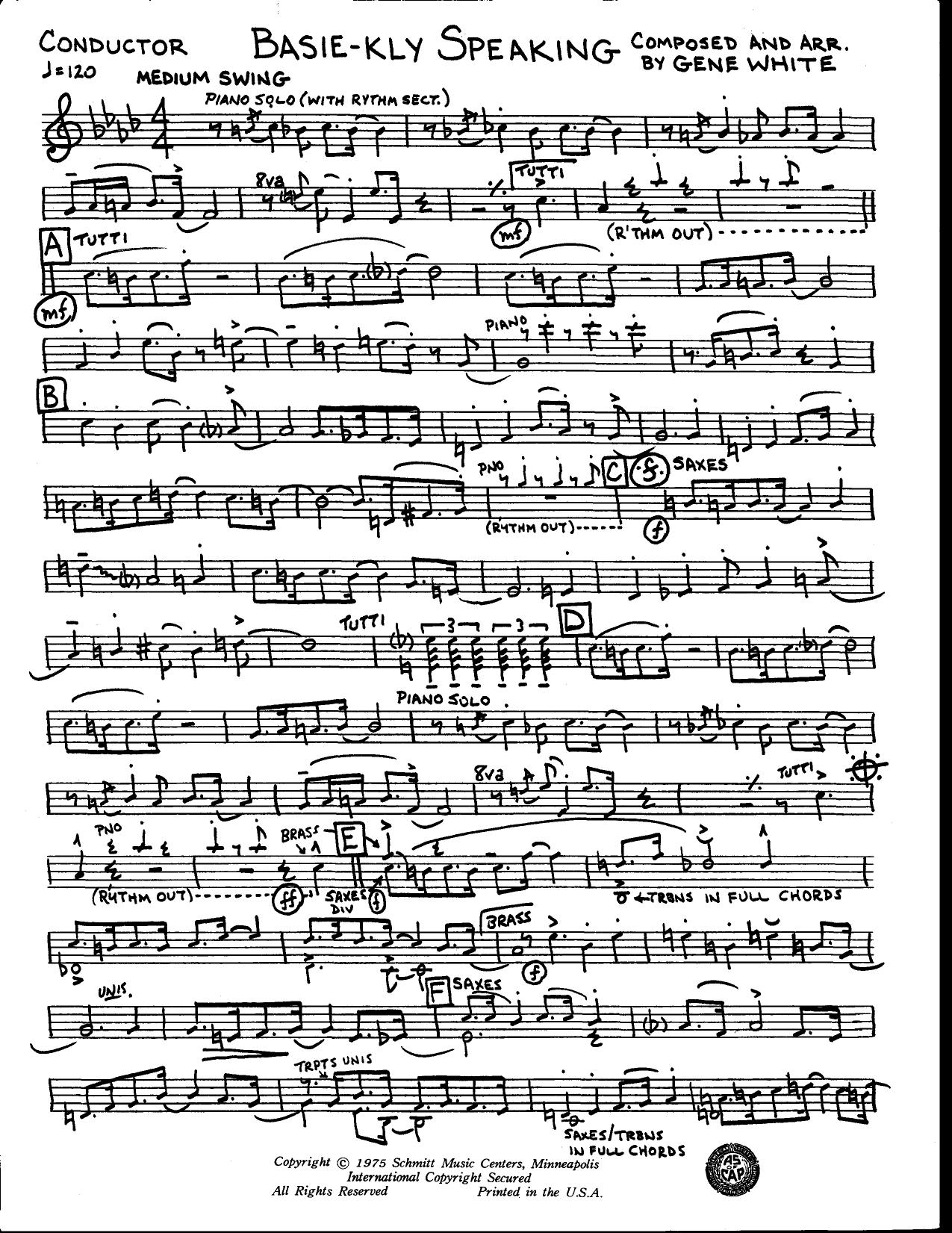
Basie-Kly Speaking (G.White) sheet music preview

Basie-Kly Speaking (G.White)

Composed by George White

Arranged by Count Basie

  • Ensemble: Big Band
  • Pages: 31
  • Instruments (18): Conductor, 1st Alto Sax, 2nd Alto Sax, 1st Tenor Sax, 2nd Tenor Sax, Baritone Sax, 1st Trumpet, 2nd Trumpet, 3rd Trumpet, 4th Trumpet, 1st Trombone, 2nd Trombone, 3rd Trombone, 4th Trombone, Guitar, Piano, Bass, Drums
  • Difficulty: medium
  • Content: Individual Parts
  • Format: PDF Download (Instant)
  • Price: $24.99

Kansas City swing reached its absolute zenith through the collaborative genius of the Count Basie Orchestra, a powerhouse ensemble that defined the heartbeat of classic big band jazz. George White’s composition "Basie-Kly Speaking," captured through the inimitable arranging lens of Count Basie himself, serves as a masterclass in economic phrasing, infectious groove, and dynamic restraint. Rooted in the hard-swinging tradition of the late 1930s and 1940s atomic era of jazz, this chart embodies the legendary "less is more" philosophy. Rather than cluttering the arrangement with dense, modernistic reharmonizations, Basie utilizes the horns and rhythm section like a finely tuned machine, where every riff serves the overarching groove and every silence carries as much weight as a played note. Propelled by an irresistible, medium-tempo swing feel in 4/4 time, "Basie-Kly Speaking" radiates a cool, confident, and blues-infused energy. The mood is sophisticated yet utterly accessible, evoking the sultry, electric atmosphere of a packed mid-century ballroom. The harmonic landscape relies heavily on blues structures and Dorian modal shifts, anchored by iconic, interlocking piano comping figures that mimic the sparse, crystalline style of the Count himself. The arrangement opens with a signature understated vamp before building organic momentum, transitioning smoothly through infectious ensemble riffs that highlight the call-and-response dynamic between the brass and reed sections. Basie’s approach to this arrangement prizes rhythmic precision and textural contrast above all else. The saxophones—led by the alto and tenor voices—deliver buttery, harmonized solis that glide effortlessly over the rhythm section's pulsating walking bassline and crisp ride cymbal patter. Brass statements are punchy and articulate, utilizing classic jazz articulations like short-long accents and subtle doits to give the lines a vocal quality. The tension gradually ratchets upward through a masterfully structured shout chorus, which eschews sheer volume for dynamic contrast, opening up into feature spaces for improvised solos that allow individual players to stretch out within the authentic Kansas City vernacular. Advanced high school ensembles, collegiate jazz bands, and professional repertory groups will find this chart to be an invaluable addition to their library. Because it is scored for an 8-instrument ensemble (comprising Alto Sax, Tenor Sax, Trumpet, Trombone, and a robust rhythm section including Piano), it offers the rich, punchy aesthetic of a full 17-piece big band without requiring a massive horn section. This makes it exceptionally practical for smaller gigging bands while retaining genuine historical weight. The primary technical challenge lies not in blinding velocity or hyper-complex altered scales, but in mastering the microscopic details of ensemble swing eighth-note interpretation, stylistic articulation, and the deep pocket required to make a lean arrangement truly breathe. Nailing the authentic feel of "Basie-Kly Speaking" demands meticulous attention to rhythmic placement and dynamic control. The tempo must remain rock-solid; avoid rushing the medium swing feel, as the groove relies entirely on a relaxed, behind-the-beat eighth-note subdivision. Horn players should carefully observe all written articulations, treating short notes with a crisp, dry staccato and longer notes with a warm, supported breadth. The piano player must channel the sparse, rhythmic comping style of Count Basie—avoiding over-playing in the low register and leaving plenty of space for the horns to speak. Brass players should use subtle cup or straight mutes where indicated to achieve the authentic Kansas City tonal colors, reserving open bell blasts for the dynamic peaks of the shout chorus. Rehearsals should initially focus strictly on the rhythm section's pocket before layering in the horn sections, ensuring that the ensemble breathes and swings as a unified organism. Q: What instruments and parts are included in this arrangement? A: This chart is scored for an 8-instrument ensemble, featuring Alto Saxophone, Tenor Saxophone, Trumpet, Trombone, and a complete rhythm section led by Piano. Q: What is the difficulty level of "Basie-Kly Speaking"? A: This arrangement is graded as intermediate-advanced (suitable for strong high school, college, and professional small big bands), primarily challenging players on stylistic swing phrasing rather than extreme technical dexterity. Q: What is the historical style and musical context of this piece? A: Written by George White and arranged in the signature style of Count Basie, this piece represents the classic Kansas City swing era, emphasizing blues-based harmony, driving rhythm, and economic, powerful arranging. Q: What makes this particular arrangement unique? A: It condenses the massive, hard-driving sound of the full Count Basie Orchestra into an efficient 8-instrument format spanning 31 pages, allowing smaller horn sections to deliver authentic big band power and subtlety. Q: What is the typical performance duration and tempo of the piece? A: The arrangement runs approximately 3 to 4 minutes and is anchored by a steady, medium-tempo swing feel designed to showcase a deep, relaxed groove.

Questions and answers

What is included in the Basie-Kly Speaking (G.White) PDF?
The verified current file contains a conductor score and individual parts across 31 pages.
How many instruments or parts are listed for Basie-Kly Speaking (G.White)?
The verified instrumentation list contains 18 entries for this Big Band arrangement.
Who is credited for Basie-Kly Speaking (G.White)?
Composer: George White. Arranger: Count Basie.
What difficulty is listed for Basie-Kly Speaking (G.White)?
The verified difficulty level is medium.
Can I preview Basie-Kly Speaking (G.White) before buying?
Yes. The product page provides a preview generated from the current PDF file.
How is Basie-Kly Speaking (G.White) delivered?
After successful payment, the digital PDF is made available for download. The displayed price is $24.99.

Musicians Also Search For

Basie-Kly Speaking Count Basie PDFBasie-Kly Speaking Count Basie sheet musicBasie-Kly Speaking arranged by Count BasieCount Basie big band chartsCount Basie jazz arrangements PDFBasie-Kly Speaking George White sheet musicBasie-Kly Speaking George White big band arrangementsGeorge White big band chartsBasie-Kly Speaking big band arrangementsBasie-Kly Speaking big band PDF downloadBasie-Kly Speaking jazz sheet musicbig band sheet music downloadBasie-Kly Speaking conductor score PDFBasie-Kly Speaking individual parts downloadBasie-Kly Speaking sheet music PDFbuy Basie-Kly Speaking sheet musicdownload Basie-Kly Speaking PDFBasie-Kly Speaking jazz chartsbest Count Basie big band arrangementsGeorge White arranged by Count BasieBasie-Kly Speaking printable sheet musicbig band repertoire PDF

All arrangements by Count Basie All George White sheet music