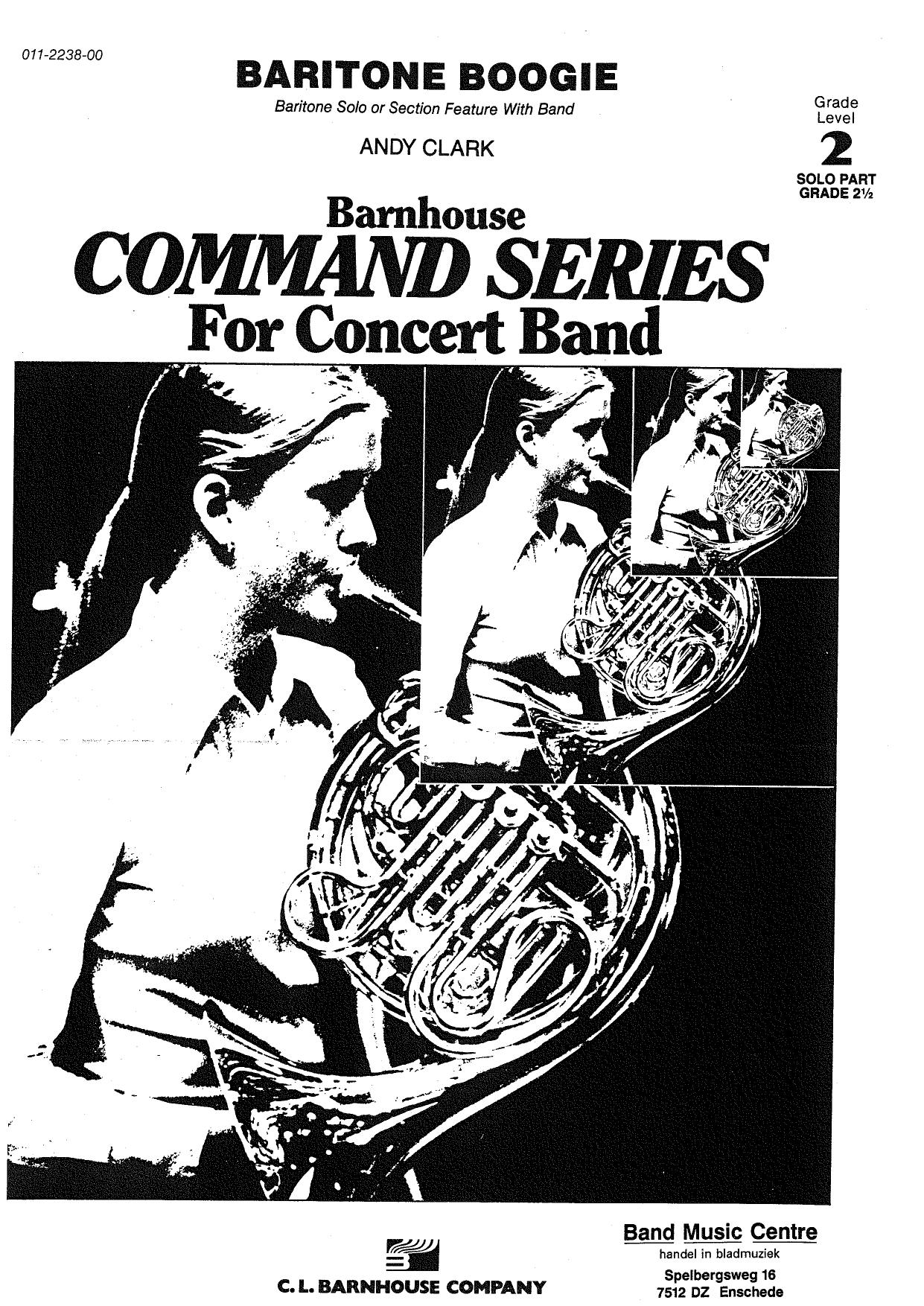
Bariton Boogie (Andy Clark)
Composed by Andy Clark
Arranged by Andy Clark
- Ensemble: Concert Band
- Style: Swing
- Pages: 76
- Instruments (22): Solo Baritone (T.C. & B.C.), Flute, Oboe, Bells, Bb Clarinet 1, Bb Clarinet 2, Bb Bass Clarinet, Eb Alto Saxophone 1, Eb Alto Saxophone 2, Bb Tenor Saxophone, Eb Baritone Saxophone, Eb Alto Clarinet, Bb Trumpet 1, Bb Trumpet 2, F Horn, Eb Horn, Trombone, Bassoon, Tuba, Suspended Cymbals, Snare Drum, Bass Drum
- Difficulty: advanced
- Content: Individual Parts
- Format: PDF Download (Instant)
- Price: $22.99
"Bariton Boogie," composed and arranged by the prolific Andy Clark, is a vibrant concert band arrangement rooted firmly in the classic swing era. While not a historical jazz standard in the traditional sense, Clark's original composition masterfully captures the ebullient spirit and rhythmic drive that defined the big band sound of the 1930s and 40s. It evokes the golden age of swing, reminiscent of the infectious energy found in the works of Count Basie or Glenn Miller, but with a fresh, contemporary concert band voice. This piece is designed to introduce or reinforce the fundamental elements of swing performance to a new generation of musicians, making it a notable contribution to the concert band repertoire. Musically, "Bariton Boogie" is an exhilarating, up-tempo swing piece, typically performed at a brisk ♩ = 160-180 bpm. The primary key of F Major provides a bright, accessible tonal center, while clever harmonic shifts and blues-infused melodic lines add depth and authentic jazz flavor. The mood is unequivocally joyful and energetic, designed to get both performers and audiences tapping their feet. Its driving rhythm section, featuring a walking bass line and swinging drum patterns, lays a solid foundation for the brass and woodwind sections to articulate crisp, syncopated melodies and powerful block chords. The piece's inherent energy builds consistently, creating a sense of exhilaration that is both musically satisfying and engaging. Andy Clark's arrangement of "Bariton Boogie" showcases his signature ability to craft accessible yet authentic jazz-influenced pieces for concert band. He employs clear, idiomatic voicings that allow each section to shine without overburdening individual players. A distinctive feature is the prominent role given to the baritone saxophone and other low brass, often carrying melodic fragments or serving as a powerful rhythmic anchor, hence the "Bariton" in the title. The arrangement features well-constructed soli sections that pass melodic interest between instrument families, fostering ensemble cohesion. While there isn't a dedicated improvised solo section, Clark integrates written-out melodic features that mimic the call-and-response patterns common in swing, providing a rewarding experience for strong lead players. The piece culminates in a powerful shout chorus that brings the entire ensemble together in a climactic, full-bodied statement. Performing "Bariton Boogie" is a rewarding experience, offering numerous opportunities for musicians to develop their swing articulation and rhythmic precision. The primary melody is often shared between the alto saxophones and trumpets, with supportive lines from the trombones and clarinets. Technical challenges include maintaining a consistent, driving swing feel at a fast tempo, executing precise rhythmic figures, and achieving balanced ensemble blend in the full-band sections. The piece is particularly suitable for high school and community concert bands, as it provides an excellent vehicle for teaching swing style, ensemble listening, and rhythmic accuracy in a highly engaging format. Its carefully considered scoring ensures that it sounds full and impressive even with standard instrumentation. "Bariton Boogie" thrives on a robust, driving up-tempo swing feel, ideally around ♩ = 160-180 bpm. Conductors should emphasize a strong, consistent quarter-note pulse in the rhythm section, allowing the melodic lines to float atop with characteristic swing eighth notes. A key technical challenge lies in achieving unified articulation, particularly the short, detached notes typical of swing, and ensuring precise rhythmic alignment in syncopated passages. Encourage brass players to use a bright, focused tone, while woodwinds should aim for clarity and agility. There are no specific extended techniques like plunger mutes or falls required, but stylistic nuances such as subtle scoops into longer notes or controlled vibrato in sustained phrases will enhance authenticity. Rehearsal tips include isolating rhythmic figures in sections, practicing the walking bass line with the rhythm section to establish the groove, and focusing on dynamic contrast to build excitement towards the final shout chorus. Q: What instruments and parts are included in the "Bariton Boogie (Andy Clark)" arrangement? A: This arrangement includes a full conductor score and individual parts for standard concert band instrumentation, typically encompassing flutes, oboes, clarinets, bassoons, alto/tenor/baritone saxophones, trumpets, horns, trombones, euphonium, tuba, and a comprehensive percussion section. Q: What is the difficulty level of "Bariton Boogie (Andy Clark)"? A: "Bariton Boogie" is generally considered to be of medium difficulty, suitable for high school and community concert bands. It presents engaging rhythmic and articulation challenges typical of swing music, but its clear scoring makes it accessible for developing ensembles. Q: What musical style and historical context does "Bariton Boogie (Andy Clark)" represent? A: This piece is an original composition by Andy Clark, written in an up-tempo swing style. It captures the energetic and joyful essence of the big band era from the 1930s and 40s, providing a contemporary concert band interpretation of classic swing characteristics. Q: What makes Andy Clark's arrangement of "Bariton Boogie" unique? A: Andy Clark's arrangement is distinctive for its accessible yet authentic swing voicings, its prominent and engaging role for the baritone saxophone and low brass, and its ability to teach fundamental swing concepts through an original, energetic composition designed specifically for concert band. Q: What is the typical performance duration and tempo for "Bariton Boogie (Andy Clark)"? A: "Bariton Boogie" typically has a performance duration of approximately 2:30 to 3:00 minutes. It is intended to be performed at an up-tempo swing feel, with a recommended tempo range of ♩ = 160-180 bpm.
Questions and answers
- What is included in the Bariton Boogie (Andy Clark) PDF?
- The verified current file contains a conductor score and individual parts across 76 pages.
- How many instruments or parts are listed for Bariton Boogie (Andy Clark)?
- The verified instrumentation list contains 22 entries for this Concert Band arrangement.
- Who is credited for Bariton Boogie (Andy Clark)?
- Composer: Andy Clark. Arranger: Andy Clark.
- What difficulty is listed for Bariton Boogie (Andy Clark)?
- The verified difficulty level is advanced.
- What style is listed for Bariton Boogie (Andy Clark)?
- The catalog lists the style as Swing.
- Can I preview Bariton Boogie (Andy Clark) before buying?
- Yes. The product page provides a preview generated from the current PDF file.
- How is Bariton Boogie (Andy Clark) delivered?
- After successful payment, the digital PDF is made available for download. The displayed price is $22.99.
Musicians Also Search For
Bariton Boogie Andy Clark PDF • Bariton Boogie Andy Clark sheet music • Bariton Boogie arranged by Andy Clark • Andy Clark concert band charts • Andy Clark jazz arrangements PDF • Bariton Boogie Andy Clark concert band arrangements • Bariton Boogie concert band arrangements • Bariton Boogie concert band PDF download • Bariton Boogie jazz sheet music • concert band sheet music download • Bariton Boogie conductor score PDF • Bariton Boogie individual parts download • Bariton Boogie sheet music PDF • Bariton Boogie Swing charts • Swing concert band arrangements • buy Bariton Boogie sheet music • download Bariton Boogie PDF • Bariton Boogie jazz charts • best Andy Clark concert band arrangements • Bariton Boogie printable sheet music • concert band repertoire PDF