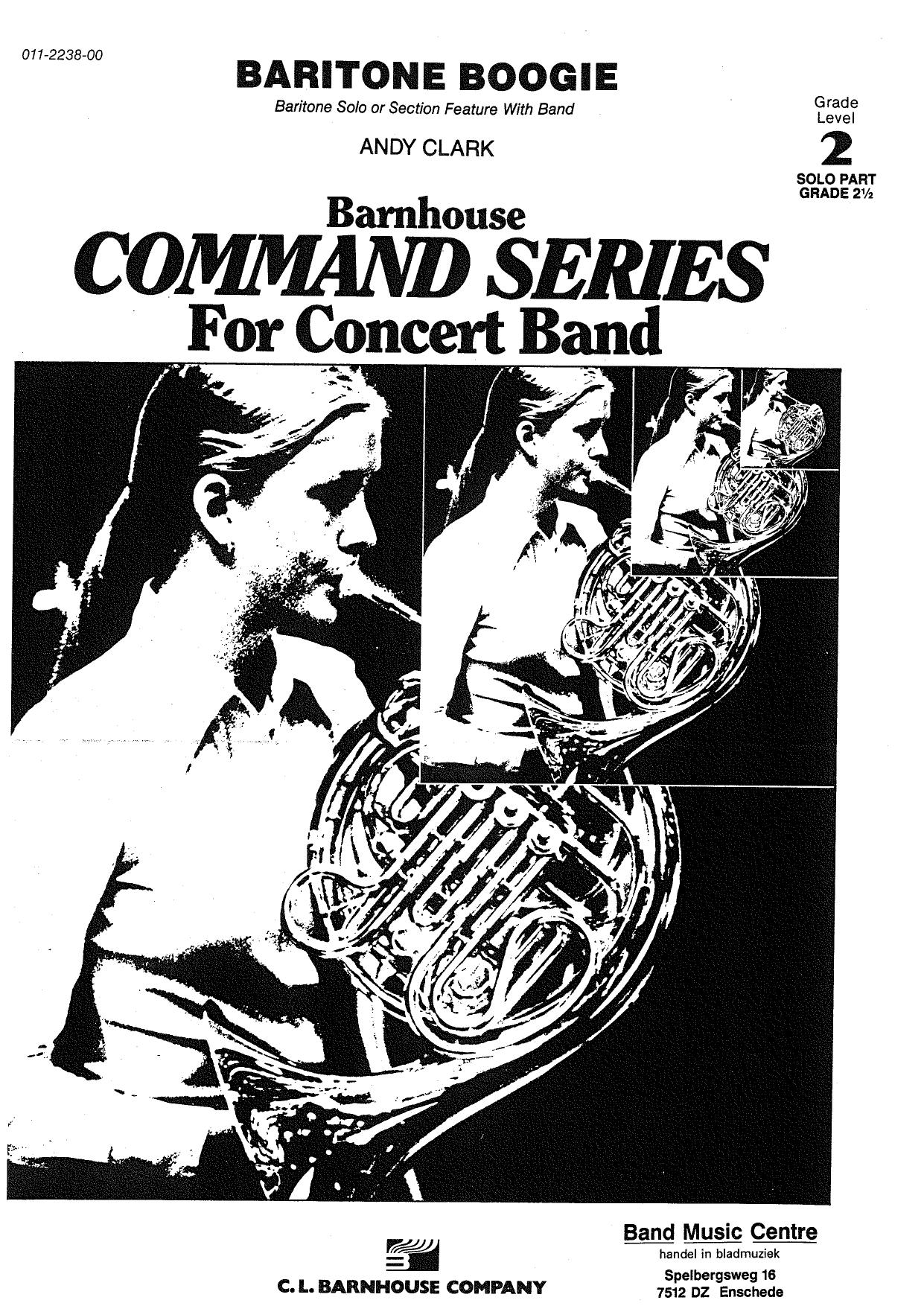
Bariton Boogie (Andy Clark)
Composed by Andy Clark
Arranged by Andy Clark
- Ensemble: Concert Band
- Style: Swing
- Pages: 76
- Instruments (22): Solo Baritone (T.C. & B.C.), Flute, Oboe, Bells, Bb Clarinet 1, Bb Clarinet 2, Bb Bass Clarinet, Eb Alto Saxophone 1, Eb Alto Saxophone 2, Bb Tenor Saxophone, Eb Baritone Saxophone, Eb Alto Clarinet, Bb Trumpet 1, Bb Trumpet 2, F Horn, Eb Horn, Trombone, Bassoon, Tuba, Suspended Cymbals, Snare Drum, Bass Drum
- Difficulty: advanced
- Content: Individual Parts
- Format: PDF Download (Instant)
- Price: $22.99
"Bariton Boogie" by Andy Clark is an original composition and arrangement that masterfully captures the vibrant energy and infectious rhythmic drive of classic swing music, tailored specifically for the concert band idiom. While not a traditional jazz standard, this piece embodies the spirit of the mid-20th century big band era, drawing inspiration from the boogie-woogie piano styles and the full-bodied brass and woodwind voicings characteristic of that period. Clark, a prolific composer and arranger known for his accessible yet musically rich educational works, crafts a piece that feels both historically informed and refreshingly contemporary in its execution for the concert band. It evokes the joyous, foot-tapping atmosphere of a dance hall from the 1940s or 50s, making it an excellent introduction to jazz-influenced styles for developing ensembles. The musical character of "Bariton Boogie" is defined by its medium-up swing tempo, typically around 144-152 beats per minute, creating an irresistible forward momentum. The piece is primarily in a bright, accessible key, likely F or Bb major, allowing for comfortable execution across the concert band's instrumentation. Its mood is unequivocally upbeat and energetic, designed to engage both performers and audience with its catchy melodic lines and driving rhythmic foundation. Clark utilizes a traditional 4/4 swing feel, emphasizing the characteristic off-beat accents and walking bass lines often associated with the genre. The piece features a clear, singable melody that is passed between sections, ensuring all parts contribute to the overall texture and excitement. Andy Clark's arranging approach for "Bariton Boogie" is distinctive for its intelligent scoring that makes a jazz aesthetic achievable for concert bands. He skillfully translates big band voicings into the concert band palette, ensuring that the brass and woodwind sections contribute equally to the swing feel. The melody is initially presented by the upper woodwinds and trumpets, often in unison or octaves, before being developed through various sections. Expect well-crafted soli passages where sections like saxophones or low brass get to shine, contributing to a rich, full sound. Clark's signature clarity in orchestration means that even complex-sounding passages are often built from approachable individual parts. While not featuring extended improvised solos, the arrangement provides ample opportunities for rhythmic precision and stylistic nuance, particularly in articulation and swing eighth-note interpretation. The piece builds to a powerful shout chorus, characteristic of the swing era, where the full ensemble comes together for a climactic, exciting finish. This arrangement is ideally suited for high school and advanced middle school concert bands, as well as community ensembles looking for an engaging and stylistically authentic swing piece. Its technical demands are moderate, focusing more on rhythmic accuracy, articulation, and ensemble blend rather than extreme range or virtuosic finger work. The rewarding aspect of performing "Bariton Boogie" lies in its ability to teach essential jazz concepts—swing feel, syncopation, and stylistic interpretation—within a familiar concert band setting. Specific musical moments that stand out include the infectious main theme, the interplay between different sections during the soli passages, and the exhilarating final shout chorus, all contributing to a highly satisfying and audience-pleasing performance. Conductors should emphasize a consistent medium-up swing feel from the outset, ensuring all eighth notes are interpreted with a relaxed, long-short swing rhythm. A metronome marking of quarter note = 144-152 bpm is a good target. Key technical challenges include precise syncopation in the brass and woodwinds, requiring careful attention to articulation markings (swung eighths, accents, staccatos) to achieve the authentic jazz character. The bass line, often carried by low brass and low reeds, must be steady and propulsive. Rehearsal tips include isolating rhythmic figures to ensure ensemble precision, particularly in the soli sections, and encouraging a light, buoyant approach to the melodic lines. While no special techniques like plunger mutes are explicitly required, encouraging a "jazzier" tone quality in brass (e.g., slightly more edge) and woodwinds (e.g., less classical vibrato) will enhance the stylistic authenticity. Focus on dynamic contrast to build excitement, especially leading into the shout chorus. Q: What instruments and parts are included in the "Bariton Boogie" arrangement? A: This arrangement for concert band typically includes a full set of parts for standard instrumentation: flutes, oboe, bassoon, clarinets (Bb, bass), alto/tenor/baritone saxophones, trumpets, horns, trombones, euphonium, tuba, and percussion (drum set, mallets, auxiliary percussion). Q: What is the difficulty level of "Bariton Boogie"? A: "Bariton Boogie" is generally considered to be of a Grade 2.5 to 3 difficulty level, making it appropriate for intermediate high school concert bands, advanced middle school groups, and community ensembles. Q: What musical style and historical context does "Bariton Boogie" represent? A: This piece is an original composition in the swing style, evoking the energetic and danceable big band music of the mid-20th century, particularly drawing from boogie-woogie influences. Q: What makes Andy Clark's arrangement of "Bariton Boogie" unique? A: Andy Clark's arrangement is unique for its successful translation of big band swing aesthetics into the concert band idiom, offering accessible yet authentic jazz voicings and rhythmic challenges suitable for developing ensembles. Q: What is the typical performance duration or tempo of "Bariton Boogie"? A: "Bariton Boogie" is designed for a medium-up swing tempo, typically around 144-152 beats per minute, resulting in a performance duration of approximately 2 to 3 minutes.
Questions and answers
- What is included in the Bariton Boogie (Andy Clark) PDF?
- The verified current file contains a conductor score and individual parts across 76 pages.
- How many instruments or parts are listed for Bariton Boogie (Andy Clark)?
- The verified instrumentation list contains 22 entries for this Concert Band arrangement.
- Who is credited for Bariton Boogie (Andy Clark)?
- Composer: Andy Clark. Arranger: Andy Clark.
- What difficulty is listed for Bariton Boogie (Andy Clark)?
- The verified difficulty level is advanced.
- What style is listed for Bariton Boogie (Andy Clark)?
- The catalog lists the style as Swing.
- Can I preview Bariton Boogie (Andy Clark) before buying?
- Yes. The product page provides a preview generated from the current PDF file.
- How is Bariton Boogie (Andy Clark) delivered?
- After successful payment, the digital PDF is made available for download. The displayed price is $22.99.
Musicians Also Search For
Bariton Boogie Andy Clark PDF • Bariton Boogie Andy Clark sheet music • Bariton Boogie arranged by Andy Clark • Andy Clark concert band charts • Andy Clark jazz arrangements PDF • Bariton Boogie Andy Clark concert band arrangements • Bariton Boogie concert band arrangements • Bariton Boogie concert band PDF download • Bariton Boogie jazz sheet music • concert band sheet music download • Bariton Boogie conductor score PDF • Bariton Boogie individual parts download • Bariton Boogie sheet music PDF • Bariton Boogie Swing charts • Swing concert band arrangements • buy Bariton Boogie sheet music • download Bariton Boogie PDF • Bariton Boogie jazz charts • best Andy Clark concert band arrangements • Bariton Boogie printable sheet music • concert band repertoire PDF