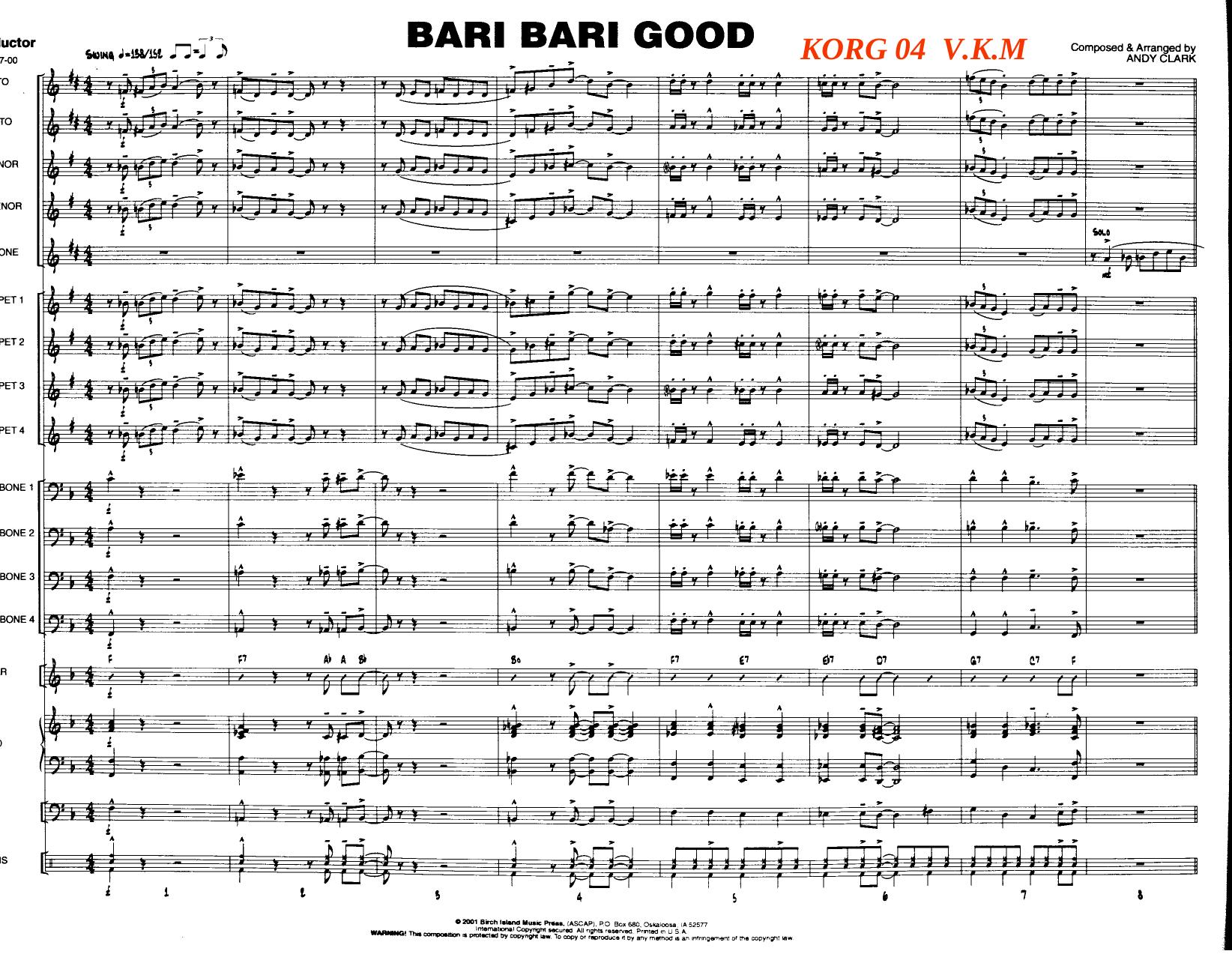
Bari Bari Good (A.Clark)
Composed by Andy Clark
Arranged by Andy Clark
- Ensemble: Big Band
- Pages: 42
- Instruments (16): 1st Eb Alto Saxophone, 2nd Eb Alto Saxophone, 1st Bb Tenor Saxophone, 2nd Bb Tenor Saxophone, Eb Baritone Saxophone, 2nd Trombone, 3rd Trombone, 4th Trombone, 1st Bb Trumpet, 2nd Bb Trumpet, 3rd Bb Trumpet, 4th Bb Trumpet, Drums, Piano, Bass, Guitar
- Difficulty: medium
- Content: Individual Parts
- Format: PDF Download (Instant)
- Price: $24.99
"Bari Bari Good," composed and arranged by the prolific jazz educator and writer Andy Clark, stands as an energetic showcase designed to highlight the often-overlooked low end of the big band saxophone section. Rooted in the rich tradition of mainstream contemporary jazz education writing, the piece embraces a driving, blues-infused groove that bridges the gap between classic swing-era sectional interplay and modern funk-inflected big band vernacular. Andy Clark, renowned for his extensive catalog of accessible yet harmoniously rewarding charts for developing and intermediate ensembles, crafts a composition where the baritone saxophone takes center stage, offering a playful yet swinging vehicle that captures the upbeat, celebratory spirit of mid-century jump blues and modern big band shuffles. Driving with an infectious medium-up swing feel in 4/4 time, the composition radiates an exuberant and infectious energy. The mood is lighthearted, confident, and relentlessly swinging, evoking the smoky atmosphere of a post-war jazz club combined with the polished precision of a modern festival stage. The harmonic language relies on crisp blues changes, punctuated by snappy syncopated brass figures and interwoven woodwind lines. Clark’s arrangement is masterfully paced, opening with a bold, attention-grabbing vamp before handing the primary thematic material over to the saxophones, with the baritone leading the charge on the head and anchoring the lower-register counterpoint throughout the ensemble. Clark’s distinctive approach favors transparent, idiomatic voicings that maximize a band's acoustic resonance without overloading developing players with overly complex alterations. The chart features a robust tutti shout chorus that builds organically through dynamic contrast, utilizing traditional call-and-response dynamics between the brass and saxophones to create immense vertical depth. Solos are thoughtfully open or provided with suggested lines, making it an ideal vehicle for introducing improvisers to standard blues form. The rhythmic foundation relies heavily on a crisp ride cymbal pattern and a walking bass line that keeps the momentum pushing relentlessly forward, ensuring that the ensemble stays locked into a tight pocket from the first downbeat to the final explosive chord. Advanced middle school, high school, and community big bands will find this arrangement to be an exceptional programming choice that balances technical accessibility with high musical payoff. The primary technical challenges lie in maintaining consistent swing articulation at a brisk tempo and executing clean, uniform section dynamics during the punctuated background figures. Horn players will benefit greatly from working on short-long articulation patterns and uniform breath support during the extended unison passages. Ultimately, "Bari Bari Good" rewards performers with a crowd-pleasing, high-energy chart that teaches foundational swing concepts while delivering an undeniably fun experience for both the stage and the audience. Achieving an authentic performance of "Bari Bari Good" requires strict adherence to a relaxed yet driving medium-up swing feel. The rhythm section serves as the engine: the drummer should maintain a steady, feather-light bass drum pulse (four-on-the-floor) while keeping a crisp sizzle on the ride cymbal, avoiding any heavy crashes on downbeats. Bassists must lock in with the drummer's hi-hat on beats two and four, ensuring a smooth, connected walking bass line that supports the horns without rushing. For the wind sections, precision in articulation is paramount. Eighth notes must be swung naturally, avoiding an overly stiff or dotted-eighth-sixteenth interpretation. Ensure that all accented notes—particularly the back-beat punches in the brass—are articulated with a sharp tongue ("dah" or "dit") and cut short according to standard big band style guidelines. Rehearsal should begin by isolating the rhythm section to establish the groove before layering in the baritone sax and low brass to secure the foundational low-end frequencies. When rehearsing the shout chorus, dynamic balance is critical: ensure the background figures under the soloists or melody do not mask the primary voice, allowing Clark’s clever counter-melodies to project clearly across the ensemble. Q: What instruments and parts are included in this arrangement? A: The chart is scored for a standard 16-instrument big band instrumentation, featuring Alto Saxophone 1, Alto Saxophone 2, Tenor Saxophone 1, Tenor Saxophone 2, Baritone Saxophone, plus standard brass and rhythm sections. Q: What is the difficulty level of this arrangement? A: It is graded as medium-easy to medium, making it ideally suited for advanced middle school, high school, and community jazz ensembles looking to develop solid swing concepts. Q: What is the musical style and historical context of the piece? A: Written by Andy Clark, the piece is a contemporary jazz chart styled in the tradition of medium-up swing and jump blues, emphasizing groove, section interplay, and accessibility. Q: What makes this particular arrangement unique? A: As the title suggests, it uniquely spotlights the baritone saxophone section, giving the lower-register instruments prominent thematic material rather than traditional upper-register horn dominance. Q: What is the performance duration and recommended tempo? A: While performance time varies slightly based on improvised solo sections, it typically runs around 3 to 4 minutes at a bright, swinging tempo of approximately 132 to 144 beats per minute.
Questions and answers
- What is included in the Bari Bari Good (A.Clark) PDF?
- The verified current file contains a conductor score and individual parts across 42 pages.
- How many instruments or parts are listed for Bari Bari Good (A.Clark)?
- The verified instrumentation list contains 16 entries for this Big Band arrangement.
- Who is credited for Bari Bari Good (A.Clark)?
- Composer: Andy Clark. Arranger: Andy Clark.
- What difficulty is listed for Bari Bari Good (A.Clark)?
- The verified difficulty level is medium.
- Can I preview Bari Bari Good (A.Clark) before buying?
- Yes. The product page provides a preview generated from the current PDF file.
- How is Bari Bari Good (A.Clark) delivered?
- After successful payment, the digital PDF is made available for download. The displayed price is $24.99.
Musicians Also Search For
Bari Bari Good Andy Clark PDF • Bari Bari Good Andy Clark sheet music • Bari Bari Good arranged by Andy Clark • Andy Clark big band charts • Andy Clark jazz arrangements PDF • Bari Bari Good Andy Clark big band arrangements • Bari Bari Good big band arrangements • Bari Bari Good big band PDF download • Bari Bari Good jazz sheet music • big band sheet music download • Bari Bari Good conductor score PDF • Bari Bari Good individual parts download • Bari Bari Good sheet music PDF • buy Bari Bari Good sheet music • download Bari Bari Good PDF • Bari Bari Good jazz charts • best Andy Clark big band arrangements • Bari Bari Good printable sheet music • big band repertoire PDF