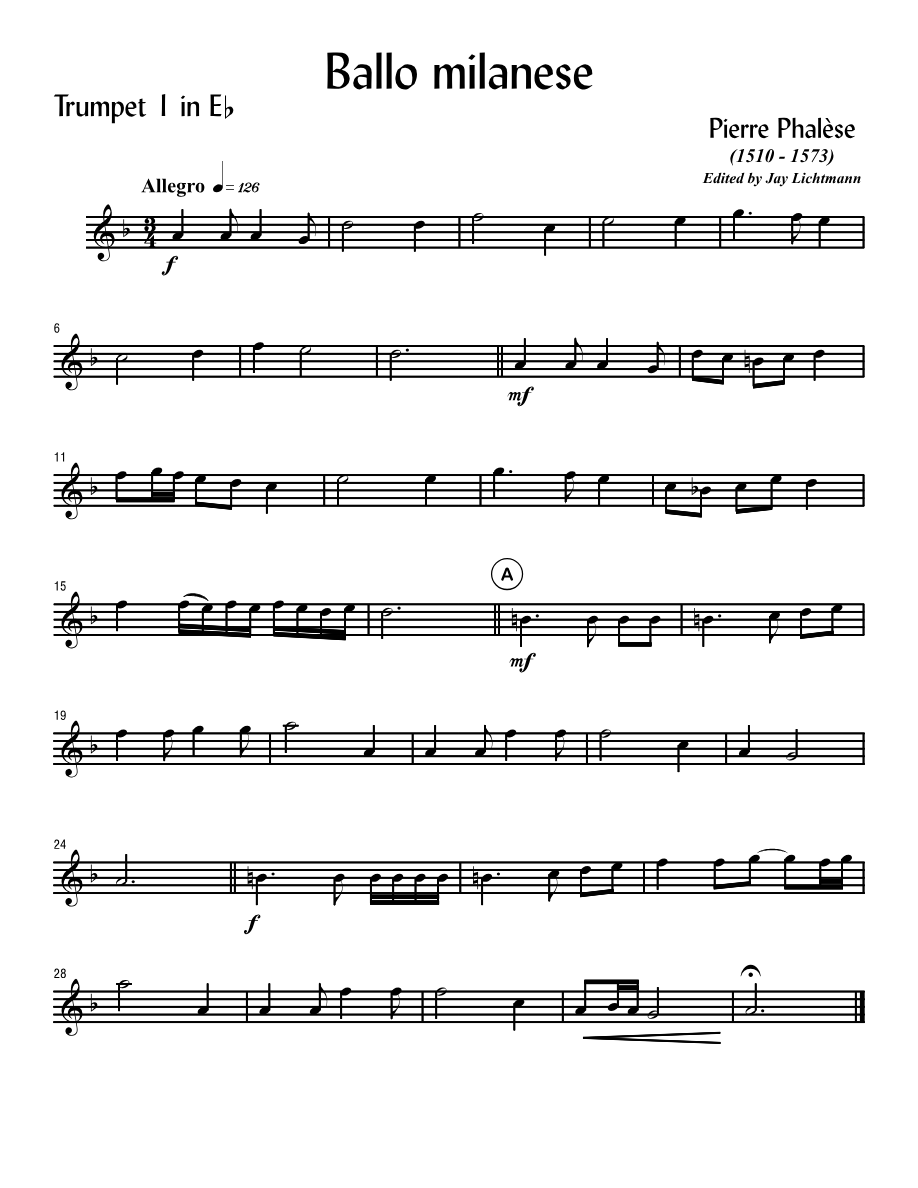
Ballo milanese (J.Lichtmann)
Composed by Pierre Phalèse
Arranged by Jay Lichtmann
- Ensemble: Small Ensemble
- Style: Jazz Standard
- Pages: 4
- Instruments (4): Trumpet 1 in Eb, Trumpet 2 in Bb, Trumpet 3 in Bb, Trumpet 4 in Bb
- Difficulty: easy
- Content: Individual Parts
- Format: PDF Download (Instant)
- Price: $12.99
"Ballo Milanese" by Pierre Phalèse, originally published in the late 16th century, emerges from the rich tapestry of Renaissance dance music. Phalèse, a prominent Flemish printer and publisher, compiled numerous dances in collections such as his "Recueil de danseries" (1583) or "Premier Livre de Danseries" (1571), which included this very "Ballo Milanese" among 69 other dances. These pieces were designed for both voice and instruments, reflecting the period's fluid approach to instrumentation and performance. The term "Ballo" itself, meaning "dance" in Italian, signifies a choreographed piece, often part of court ceremonies or dramatic works of the era. While not a jazz standard in its original form, the melodic and harmonic structures of such Renaissance dances have historically provided fertile ground for reinterpretation across genres, making them notable for their enduring adaptability. Jay Lichtmann's arrangement transforms this Renaissance gem into a vibrant small ensemble jazz standard, showcasing his distinctive ability to reimagine classical repertoire through a contemporary jazz lens. Known for his extensive work in brass music and jazz arranging, Lichtmann brings a refined understanding of both historical context and modern jazz idiom to this piece. His approach typically involves sophisticated voicings, inventive counterpoint, and a keen sense of rhythmic propulsion, often drawing on his background as a principal trumpet with the Hartford Symphony Orchestra. This arrangement is conceived as a medium-swing piece, offering a relaxed yet driving feel that encourages rhythmic interplay and expressive improvisation. The chosen key facilitates comfortable playing across the ensemble, contributing to a bright and engaging mood. The arrangement opens with the melody presented in a clear, lyrical fashion, often featuring a lead voice or a tightly voiced soli section that highlights the original tune's charm. Subsequent sections introduce a contrasting shout chorus, where the ensemble engages in a call-and-response or unified rhythmic statement, building energy and dynamic contrast. Featured solo sections are strategically placed, offering ample opportunity for improvisers to explore the harmonic landscape derived from Phalèse's original work, now recontextualized with extended jazz harmonies. Technical challenges include precise articulation in the swing feel, maintaining blend and balance in the soli passages, and navigating the harmonic shifts during improvisation. The rewarding aspect lies in the ensemble's ability to breathe new life into an ancient melody, creating a cohesive and swinging performance that bridges centuries of musical expression. This arrangement is ideally suited for college-level jazz ensembles, advanced high school groups, or dedicated community jazz combos. Its blend of historical reverence and modern jazz vocabulary provides an excellent educational tool for exploring arranging techniques, improvisation over non-traditional changes, and developing ensemble cohesion. The piece offers a chance to engage with a work that is both historically significant and refreshingly contemporary, making it a compelling addition to any small ensemble's repertoire. Conductors should guide the ensemble towards a relaxed, medium-swing feel, emphasizing a light, buoyant eighth-note interpretation rather than a heavy, straight one. A suggested tempo range of quarter note = 120-132 will allow for comfortable execution of the melodic lines and solo improvisation. Key technical challenges include achieving precise articulation in the swing passages, particularly in the soli sections where clarity and unified phrasing are paramount. Encourage musicians to listen across the ensemble to ensure tight rhythmic alignment and balanced voicings. The improvised solo sections, while harmonically accessible, benefit from a focus on melodic development and storytelling. Rehearsal time should be dedicated to isolating and refining the shout chorus dynamics and attacks, ensuring a powerful and unified statement. No special techniques like plunger mutes or falls are explicitly required, allowing the focus to remain on clean execution and authentic jazz phrasing. Q: What instruments are typically included in this small ensemble arrangement? A: This arrangement is designed for a standard jazz small ensemble, typically including trumpet, alto saxophone, tenor saxophone, trombone, piano, bass, and drums. Specific instrumentation may vary slightly based on the arranger's exact scoring. Q: What is the difficulty level of "Ballo Milanese (J.Lichtmann)"? A: This arrangement is considered intermediate to advanced, suitable for college-level jazz ensembles, advanced high school groups, and proficient community jazz combos. It requires solid instrumental technique, a good understanding of jazz phrasing, and improvisational skills. Q: What is the musical style and historical context of this arrangement? A: This piece is a jazz standard arrangement of "Ballo Milanese," an original Renaissance dance composed by Pierre Phalèse in the late 16th century. Jay Lichtmann has reinterpreted this historical work into a medium-swing jazz style. Q: What makes Jay Lichtmann's arrangement of "Ballo Milanese" unique? A: Lichtmann's arrangement is unique for its successful fusion of a 16th-century Renaissance dance with modern jazz idioms, featuring sophisticated voicings, a driving medium-swing feel, and opportunities for improvised solos, all while maintaining the melodic charm of the original. Q: What is the typical performance duration and tempo for this arrangement? A: The typical performance duration for this arrangement is approximately 3-5 minutes, depending on the length of improvised solos. It is designed to be performed at a medium-swing tempo, generally around quarter note = 120-132 beats per minute.
Questions and answers
- What is included in the Ballo milanese (J.Lichtmann) PDF?
- The verified current file contains individual parts across 4 pages.
- How many instruments or parts are listed for Ballo milanese (J.Lichtmann)?
- The verified instrumentation list contains 4 entries for this Small Ensemble arrangement.
- Who is credited for Ballo milanese (J.Lichtmann)?
- Composer: Pierre Phalèse. Arranger: Jay Lichtmann.
- What difficulty is listed for Ballo milanese (J.Lichtmann)?
- The verified difficulty level is easy.
- What style is listed for Ballo milanese (J.Lichtmann)?
- The catalog lists the style as Jazz Standard.
- Can I preview Ballo milanese (J.Lichtmann) before buying?
- Yes. The product page provides a preview generated from the current PDF file.
- How is Ballo milanese (J.Lichtmann) delivered?
- After successful payment, the digital PDF is made available for download. The displayed price is $12.99.
Musicians Also Search For
Ballo milanese Jay Lichtmann PDF • Ballo milanese Jay Lichtmann sheet music • Ballo milanese arranged by Jay Lichtmann • Jay Lichtmann small ensemble charts • Jay Lichtmann jazz arrangements PDF • Ballo milanese Pierre Phalèse sheet music • Ballo milanese Pierre Phalèse small ensemble arrangements • Pierre Phalèse small ensemble charts • Ballo milanese small ensemble arrangements • Ballo milanese small ensemble PDF download • Ballo milanese jazz sheet music • small ensemble sheet music download • Ballo milanese individual parts download • Ballo milanese sheet music PDF • Ballo milanese Jazz Standard charts • Jazz Standard small ensemble arrangements • buy Ballo milanese sheet music • download Ballo milanese PDF • Ballo milanese jazz charts • best Jay Lichtmann small ensemble arrangements • Pierre Phalèse arranged by Jay Lichtmann • Ballo milanese printable sheet music • small ensemble repertoire PDF