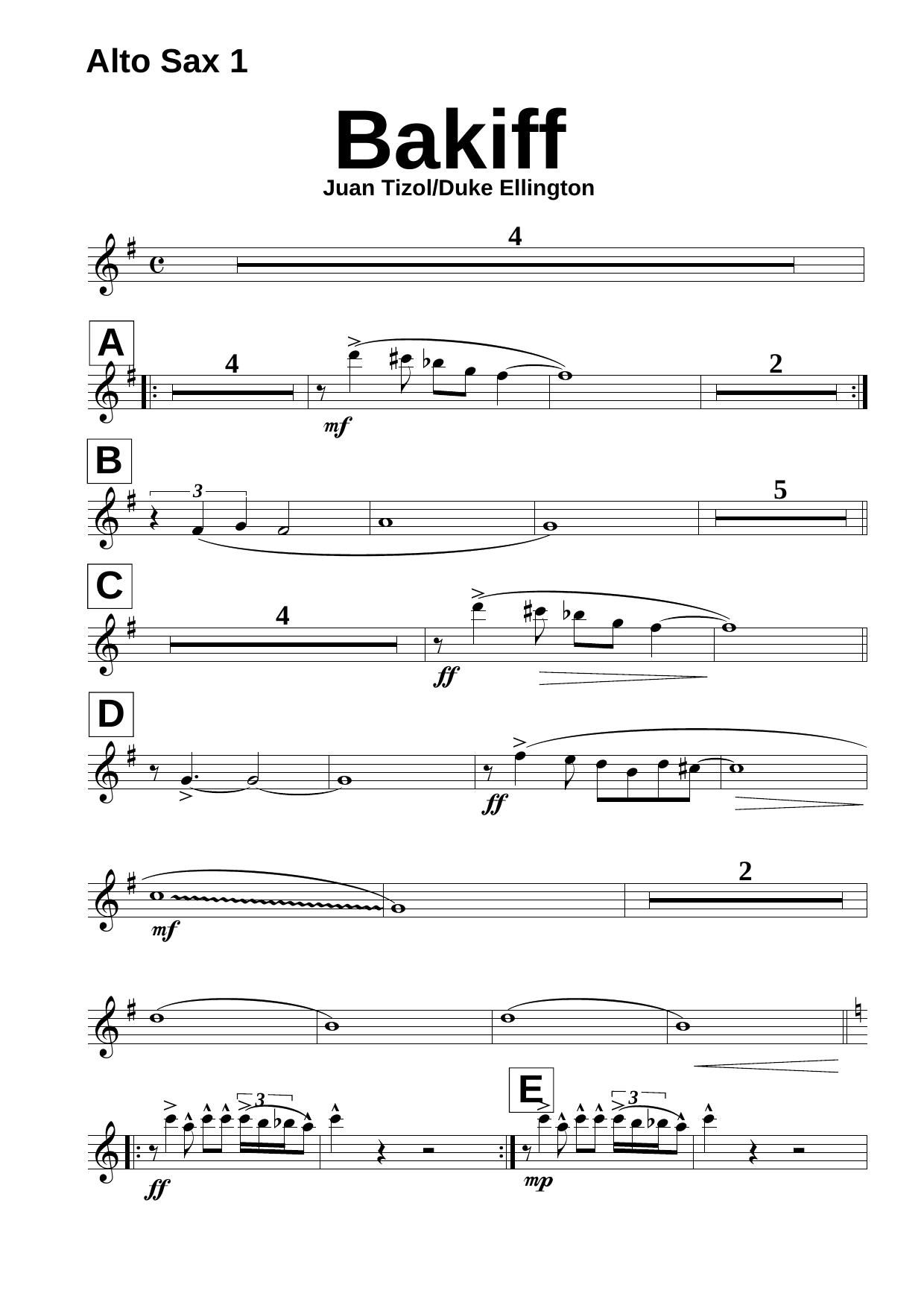
Bakiff (J.Tizol-D.Ellington)
Composed by Juan Tizol
Arranged by Duke Ellington & B.Strayhorn.D.Berger
- Ensemble: Big Band
- Pages: 42
- Instruments (18): Alto Sax 1, Alto Sax 2, Clarinet, Tenor Sax, Baritone Sax, Trumpet 1, Trumpet 2, Trumpet 3, Trumpet 4, Trumpet 5, Trombone 1, Trombone 2, Trombone 3, Violin, Guitar, Piano, Bass, Drums
- Difficulty: medium
- Content: Individual Parts
- Format: PDF Download (Instant)
- Price: $24.99
Juan Tizol’s exotic, Spanish-tinged masterpiece "Bakiff" stands as one of the most intriguing contributions to the Duke Ellington Orchestra’s legendary Victor-era book of the early 1940s. Originally recorded in 1941, this composition showcases Tizol's unique ability to merge traditional Latin-American rhythmic pulses with the sophisticated harmonic palette of Harlem big band jazz. Situated between the tropical allure of "Caravan" and the mysterious depths of "Perdole," "Bakiff" captures the height of the Ellington-Strayhorn collaboration, reflecting an era when the orchestra operated as an unrivaled laboratory for tone color, exotic texture, and advanced sectional writing. Brimming with atmospheric tension, "Bakiff" unfolds over a hypnotic, undulating groove that blends a sultry habanera-esque pulse with a driving medium-tempo swing feel. The composition is anchored in a minor key framework, evoking an evocative, nocturnal mood characterized by shifting shadows and lush, impressionistic harmonies. The opening vamp immediately establishes an intoxicating sonic landscape, driven by low-register woodwinds and biting brass accents that create a palpable sense of theatrical drama. Rather than relying on standard blues forms, the structure guides listeners through a cinematic journey marked by modal exploration and rich, multi-layered counterpoint. This definitive adaptation benefits from the master craft of Duke Ellington and Billy Strayhorn, with additional transcription and editorial brilliance by David Berger, tailored specifically for an 8-instrument flexible big band lineup (featuring Alto Saxophone, Tenor Saxophone, Baritone Saxophone, Trumpet, Trombone, and rhythm section support). The arrangers utilize Ellington’s signature voicing techniques—cross-section scoring, where instruments from different families are blended to invent entirely new composite timbres. The arrangement avoids predictable shout choruses in favor of undulating textures and intricate horn interleavings that mimic the exotic wind instruments of Tizol's original vision. Strayhorn’s sophisticated harmonic thumbprint is evident in the altered dominants and extended tertian chords that give the inner voices a striking, modern edge. Performers will find that success in "Bakiff" hinges on immaculate rhythmic precision, subtle dynamic control, and a deep appreciation for ensemble blend. The melody is shared fluidly across the horn section, requiring seamless passing of phrases between the saxophone and brass voices. Soloists are provided ample space to stretch out over modal vamps, demanding a lyrical approach that complements the moody, nocturnal ambiance rather than simply playing changes. Technical demands are moderate to advanced, particularly regarding intonation in tight voicings and maintaining a steady, hypnotic groove without rushing the tempo. Advanced high school ensembles, collegiate jazz orchestras, and professional chamber jazz groups will find this chart an exceptional vehicle for developing sectional cohesion and stylistic versatility. Because of its unique 8-instrument configuration, it provides a full, authentic Ellingtonian sound without requiring a massive 17-piece modern big band, making it an ideal showcase for specialized stylistic units seeking to master the subtleties of the classic swing era. Conductors approaching "Bakiff" must prioritize a sultry, unhurried groove where the underlying Latin-tinged pulse feels deep and grounded rather than stiff. The tempo should remain steady, avoiding any tendency to rush during the energetic brass interludes. Balance is paramount: because the arrangement relies heavily on dense, non-standard voicings across its 8 instruments, inner voices must project without masking the primary melodic line carried by the saxophones or muted brass. Special attention should be given to articulation and color. Brass players should master a palette of expressive tonal shading, utilizing cup or straight mutes where indicated to replicate the signature Ellingtonian growl and warmth without sacrificing intonation. Rehearsals should begin by isolating the rhythmic vamp between the rhythm section and low horns to lock in the hypnotic habanera feel before layering the upper horns on top. Pay meticulous attention to dynamic swells, ensuring that crescendos and decrescendos are executed uniformly across the ensemble to capture the piece's cinematic scope. Q: What instruments and parts are included in this arrangement of "Bakiff"? A: This arrangement is scored for an 8-instrument ensemble comprising Alto Saxophone, Tenor Saxophone, Baritone Saxophone, Trumpet, Trombone, and a standard rhythm section framework across a comprehensive 42-page score and parts set. Q: What is the difficulty level of this chart? A: It is ideally suited for advanced high school, collegiate, and professional jazz ensembles due to its dense harmonies, required sectional blend, and demands for mature stylistic interpretation. Q: What is the historical style and background of "Bakiff"? A: Composed by Juan Tizol and famously recorded by the Duke Ellington Orchestra in 1941, the piece represents the Golden Age of big band jazz, fusing exotic Latin-American rhythms with sophisticated Harlem swing. Q: What makes this specific arrangement by Ellington, Strayhorn, and Berger unique? A: It features Ellington and Strayhorn's trademark cross-section voicing and impressionistic harmonies, meticulously transcribed and edited by David Berger to capture the authentic, exotic tone colors of the original Victor recording in a compact 8-player format. Q: What is the performance duration and tempo feel of this piece? A: The arrangement runs approximately 4 to 5 minutes and features a hypnotic, medium-tempo blend of a sultry habanera groove and a driving swing feel.
Questions and answers
- What is included in the Bakiff (J.Tizol-D.Ellington) PDF?
- The verified current file contains a conductor score and individual parts across 42 pages.
- How many instruments or parts are listed for Bakiff (J.Tizol-D.Ellington)?
- The verified instrumentation list contains 18 entries for this Big Band arrangement.
- Who is credited for Bakiff (J.Tizol-D.Ellington)?
- Composer: Juan Tizol. Arranger: Duke Ellington & B.Strayhorn.D.Berger.
- What difficulty is listed for Bakiff (J.Tizol-D.Ellington)?
- The verified difficulty level is medium.
- Can I preview Bakiff (J.Tizol-D.Ellington) before buying?
- Yes. The product page provides a preview generated from the current PDF file.
- How is Bakiff (J.Tizol-D.Ellington) delivered?
- After successful payment, the digital PDF is made available for download. The displayed price is $24.99.
Musicians Also Search For
Bakiff Duke Ellington & B.Strayhorn.D.Berger PDF • Bakiff Duke Ellington & B.Strayhorn.D.Berger sheet music • Bakiff arranged by Duke Ellington & B.Strayhorn.D.Berger • Duke Ellington & B.Strayhorn.D.Berger big band charts • Duke Ellington & B.Strayhorn.D.Berger jazz arrangements PDF • Bakiff Juan Tizol sheet music • Bakiff Juan Tizol big band arrangements • Juan Tizol big band charts • Bakiff big band arrangements • Bakiff big band PDF download • Bakiff jazz sheet music • big band sheet music download • Bakiff conductor score PDF • Bakiff individual parts download • Bakiff sheet music PDF • buy Bakiff sheet music • download Bakiff PDF • Bakiff jazz charts • best Duke Ellington & B.Strayhorn.D.Berger big band arrangements • Juan Tizol arranged by Duke Ellington & B.Strayhorn.D.Berger • Bakiff printable sheet music • big band repertoire PDF