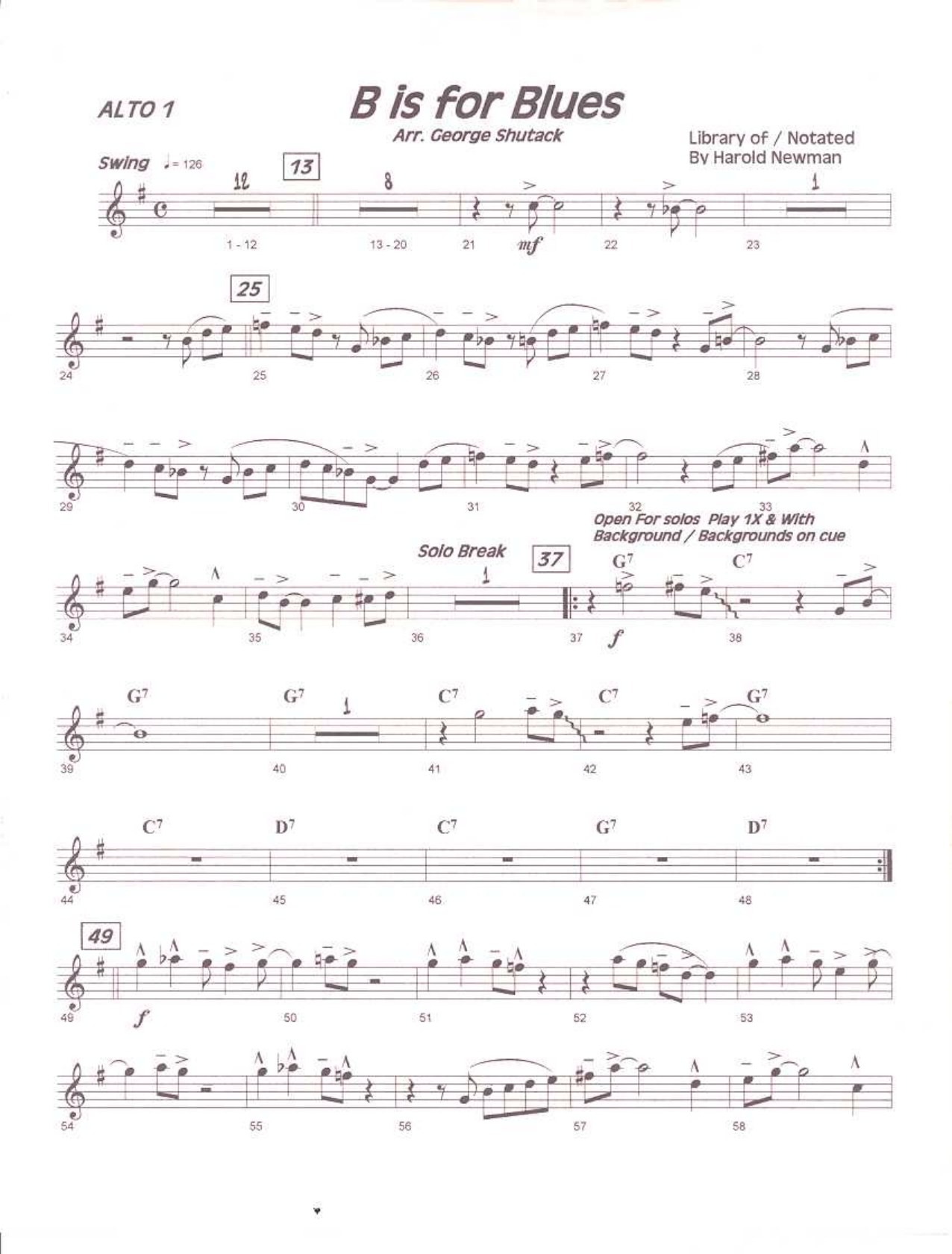
B Is For Blues (G.Shutack)
Composed by G. Shutack
Arranged by G.Shutack
- Ensemble: Big Band
- Pages: 35
- Instruments (17): Alto Saxophone 1, Alto Saxophone 2, Tenor Saxophone 1, Tenor Saxophone 2, Baritone Saxophone, Trumpet 1, Trumpet 2, Trumpet 3, Trumpet 4, Trombone 1, Trombone 2, Trombone 3, Trombone 4, Piano, Bass, Drums, Guitar
- Difficulty: medium
- Content: Individual Parts
- Format: PDF Download (Instant)
- Price: $24.99
G. Shutack’s "B Is For Blues" stands as a quintessential modern contribution to the educational and professional big band repertoire, capturing the timeless appeal of the traditional blues form while infusing it with contemporary harmonic sensibilities. Rooted in the rich heritage of mid-century American jazz—drawing stylistic lineage from Kansas City shuffles and post-bop modal explorations—this composition honors the foundational 12-bar blues structure that served as the vehicle for icons like Count Basie, Duke Ellington, and Sonny Rollins. Shutack crafts a composition that bridges historical jazz idioms with modern ensemble writing, making it an invaluable study in how classic forms continue to evolve in contemporary big band literature. Driven by an infectious, energetic medium-swing groove in 4/4 time, "B Is For Blues" radiates a confident, sophisticated mood that balances earthy blues grit with polished ensemble precision. The harmonic landscape features accessible yet colorful extensions—utilizing minor pentatonic frameworks peppered with sharp chromatic passing tones, blues-scale inflections, and subtle tritone substitutions. The arrangement opens with a provocative, rhythmically taut motif in the horns that immediately establishes the swinging momentum. As the chart unfolds, the mood shifts fluidly from sultry, laid-back ensemble grooving to high-octane celebratory climaxes, eliciting a strong visceral and emotional response from both performers and listeners alike. In this specific 8-instrument configuration, G. Shutack demonstrates a masterful economy of writing, packing the punch and textural variety of a full seventeen-piece big band into a tightly knit horn section comprising Alto Saxophone, Tenor Saxophone, Baritone Saxophone, Trumpet, Trombone, and a robust rhythm support framework across 35 meticulously edited pages. Shutack avoids clutter by employing clever counterpoint and transparent voicing techniques where every single part carries immense weight. The melody is shared democratically across the frontline—frequently anchored by the saxophones with punchy brass interjections—while tight, interlocking horn solis showcase the ensemble's internal cohesion. The arrangement builds toward a rewarding shout chorus that utilizes dynamic contrast and rhythmic displacement rather than sheer volume to achieve maximum impact, culminating in a memorable, hard-swinging coda. Advanced high school ensembles, collegiate jazz groups, and professional community big bands will find "B Is For Blues" to be an ideal vehicle for developing stylistic authenticity, ensemble articulation, and improvisational confidence. Because the scoring is tailored for an 8-instrument lineup, individual players cannot hide behind a massed section; every musician must possess strong internal time, stylistic awareness of swing eighth notes, and good intonation. Solo opportunities are strategically mapped out with flexible chord changes provided, allowing developing improvisers to stretch out over standard blues changes while giving experienced players enough harmonic latitude to craft compelling, modern linear solos. Achieving an authentic performance of "B Is For Blues" requires strict adherence to stylistic articulation and a well-maintained medium-swing groove. The rhythm section serves as the heartbeat of the chart; the drummer must lock in a steady, unhurried ride cymbal pattern (the classic "ding-da-ding, da-ding-da") with crisp hi-hat chicks on beats two and four, avoiding any tendency to rush the tempo. Horn players should focus on executing traditional jazz articulations—tonguing off-beats and ensuring that eighth notes are swung naturally rather than interpreted as rigid triplets, particularly in faster scalar passages. Pay close attention to dynamic markings; the contrast between the hushed, driving background figures behind the soloists and the explosive ensemble shout choruses is what gives the chart its dramatic arc. No specialized mutes are strictly mandatory, though subtle plunger work or cup mutes on the brass can be utilized creatively to add textural variation during softer ensemble interludes. Rehearsals should initially isolate the rhythm section to cement the groove before layering in the saxophones and brass section-by-section to balance internal blend and articulation uniformity. Q: What specific instruments and parts are included in this arrangement? A: This arrangement is scored for an 8-instrument ensemble comprising Alto Saxophone, Tenor Saxophone, Baritone Saxophone, Trumpet, Trombone, and a complete rhythm section framework spanning 35 comprehensive pages of tightly edited score and parts. Q: What is the difficulty level of "B Is For Blues"? A: This chart is best suited for advanced high school, collegiate, and professional community jazz ensembles capable of handling reduced-instrument scoring where individual part independence and strong internal time are essential. Q: What is the musical style and historical context of the piece? A: Written in the key and style of a classic 12-bar medium swing tune, the piece draws heavily from the Kansas City jazz and post-bop traditions, celebrating the foundational blues framework popularized by mid-century big band icons. Q: What makes G. Shutack’s arrangement unique for an 8-instrument band? A: Shutack successfully distills the dynamic power, harmonic depth, and texture of a full 17-piece big band into a compact 8-instrument configuration through transparent voicings, clever counterpoint, and democratic distribution of melodic material. Q: What is the performance tempo and expected duration of the arrangement? A: The piece is set at a comfortable, driving medium-swing tempo (approximately quarter note = 120-126 BPM) and typically runs for about 4 to 5 minutes depending on the number of improvised solo choruses taken.
Questions and answers
- What is included in the B Is For Blues (G.Shutack) PDF?
- The verified current file contains individual parts across 35 pages.
- How many instruments or parts are listed for B Is For Blues (G.Shutack)?
- The verified instrumentation list contains 17 entries for this Big Band arrangement.
- Who is credited for B Is For Blues (G.Shutack)?
- Composer: G. Shutack. Arranger: G.Shutack.
- What difficulty is listed for B Is For Blues (G.Shutack)?
- The verified difficulty level is medium.
- Can I preview B Is For Blues (G.Shutack) before buying?
- Yes. The product page provides a preview generated from the current PDF file.
- How is B Is For Blues (G.Shutack) delivered?
- After successful payment, the digital PDF is made available for download. The displayed price is $24.99.
Musicians Also Search For
B Is For Blues G.Shutack PDF • B Is For Blues G.Shutack sheet music • B Is For Blues arranged by G.Shutack • G.Shutack big band charts • G.Shutack jazz arrangements PDF • B Is For Blues G. Shutack sheet music • B Is For Blues G. Shutack big band arrangements • G. Shutack big band charts • B Is For Blues big band arrangements • B Is For Blues big band PDF download • B Is For Blues jazz sheet music • big band sheet music download • B Is For Blues individual parts download • B Is For Blues sheet music PDF • buy B Is For Blues sheet music • download B Is For Blues PDF • B Is For Blues jazz charts • best G.Shutack big band arrangements • G. Shutack arranged by G.Shutack • B Is For Blues printable sheet music • big band repertoire PDF