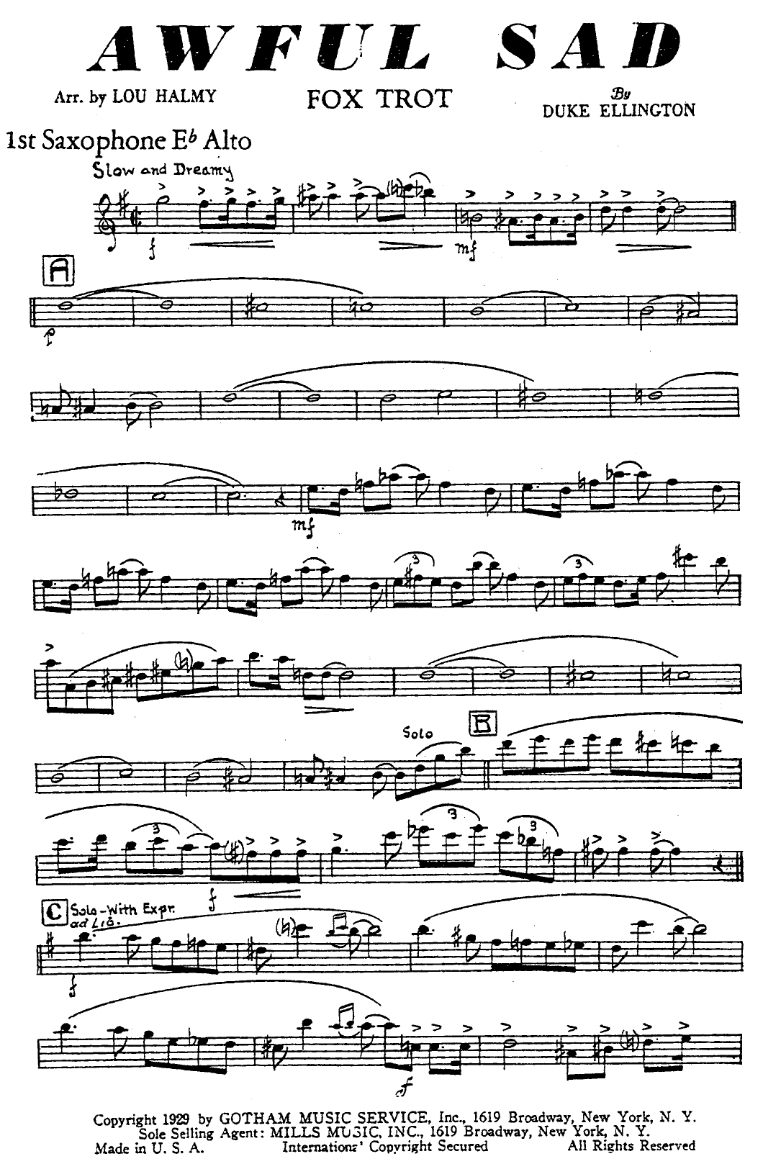
Awful Sad (D.Ellington)
Composed by Duke Ellington
Arranged by D.Ellington
- Ensemble: Big Band
- Style: Jazz Standard
- Pages: 18
- Instruments (11): 1st Saxophone Eb Alto, 3rd Saxophone Eb Alto, 2nd Saxophone Bb Tenor, 1st Trumpet in Bb, 2nd Trumpet in Bb, 1st Trombone, Bass, Drums, Piano, Guitar, Violin
- Difficulty: easy
- Content: Individual Parts
- Format: PDF Download (Instant)
- Price: $24.99
Duke Ellington's "Awful Sad" emerges from the rich tapestry of early 20th-century jazz, a poignant ballad that first captivated audiences in the late 1920s. Composed and recorded by Ellington himself during a period of immense creative output, this piece embodies the sophisticated melancholy and innovative harmonic language that defined his burgeoning genius. It quickly became a staple of the Ellington orchestra's repertoire, showcasing their unparalleled ability to blend individual instrumental voices into a cohesive, expressive whole. While perhaps not as overtly famous as some of his later, more sprawling works, "Awful Sad" stands as a testament to Ellington's mastery of the jazz ballad form, offering a glimpse into the emotional depth and subtle complexities that would characterize his enduring legacy. Its enduring appeal lies in its evocative melody and the profound emotional resonance it carries, making it a cherished, if understated, jazz standard. This particular arrangement of "Awful Sad" by D. Ellington masterfully captures the original's introspective and slightly melancholic character, presenting it as a slow, expressive ballad in 4/4 time. The primary key of C minor sets a somber yet beautiful tone, allowing for rich harmonic exploration. The mood is one of tender reflection, imbued with a subtle blues sensibility that underpins the entire composition. Ellington’s genius for orchestral color is immediately apparent, with carefully crafted voicings that highlight the unique timbres of each section. The arrangement maintains a delicate balance between individual expression and ensemble cohesion, demanding a nuanced approach from all performers to truly convey its emotional depth. D. Ellington's treatment of "Awful Sad" is a masterclass in big band arranging, showcasing his signature ability to create intricate textures within a seemingly simple form. The melody is initially carried by the Alto Saxophone 1, often doubled or harmonized with the 3rd Saxophone Eb Alto, creating a warm, reedy blend that is instantly recognizable as Ellingtonian. Throughout the piece, Ellington employs his characteristic "jungle sound" voicings and extended harmonies, particularly in the brass and saxophone soli sections, which are meticulously crafted to evoke a sense of yearning and introspection. While there isn't a traditional open solo section, the arrangement features beautifully written obbligatos and counter-melodies that allow individual voices to shine within the ensemble context. The technical challenges lie not in blistering tempos or complex rhythmic figures, but in achieving a unified, expressive tone, precise intonation, and a profound understanding of the ballad style. The rewarding aspect of performing this arrangement comes from the opportunity to delve into the emotional core of Ellington's music, bringing to life its subtle beauty and profound sentiment. This arrangement is ideally suited for college-level jazz ensembles, advanced community bands, and professional big bands. Its demands for sophisticated musicianship, nuanced interpretation, and a deep appreciation for the jazz ballad tradition make it an excellent vehicle for developing expressive playing and ensemble blend. While technically accessible to many, its true depth unfolds with mature musicality, making it a challenging yet incredibly fulfilling piece for bands aiming to explore the finer points of Ellington's unparalleled compositional and arranging style. "Awful Sad" requires a deliberate, unhurried approach to its slow ballad tempo in 4/4. The conductor should emphasize a sustained, legato feel throughout, avoiding any tendency to rush or fragment phrases. Key technical challenges include achieving precise intonation in the close voicings, particularly within the saxophone section, and maintaining a consistent, warm tone across all instruments. Brass players should focus on controlled dynamics and smooth attacks, utilizing plunger mutes where indicated to achieve the authentic "growl" effects characteristic of Ellington's sound. Rehearsal time should be dedicated to shaping melodic lines, ensuring that the primary melody, often carried by Alto Saxophone 1 and the 3rd Saxophone Eb Alto, always sings above the accompaniment. Pay close attention to dynamic contrasts and subtle rubato to enhance the expressive quality of the piece, allowing the inherent melancholy and beauty of Ellington's harmonies to truly resonate. Q: What instruments and parts are included in this arrangement of "Awful Sad"? A: This arrangement includes parts for 11 instruments: Alto Saxophone 1, 3rd Saxophone Eb Alto, Bass, Drum Set, Piano, and additional standard big band instrumentation. Q: What is the difficulty level of this arrangement? A: This arrangement is best suited for college-level jazz ensembles, advanced community bands, and professional big bands due to its demands for sophisticated musicianship and nuanced interpretation. Q: What is the musical style and historical context of "Awful Sad"? A: "Awful Sad" is a jazz standard, a poignant ballad composed and recorded by Duke Ellington in the late 1920s, embodying the sophisticated melancholy of that era. Q: What makes D. Ellington's arrangement of "Awful Sad" unique? A: D. Ellington's arrangement is unique for its authentic capture of the original's introspective character, employing his signature "jungle sound" voicings, extended harmonies, and intricate textures that highlight individual voices within the ensemble. Q: What is the typical performance duration or tempo for this piece? A: "Awful Sad" is a slow, expressive ballad in 4/4 time, and its performance duration will typically be around 3-5 minutes depending on interpretation and any improvised sections.
Questions and answers
- What is included in the Awful Sad (D.Ellington) PDF?
- The verified current file contains individual parts across 18 pages.
- How many instruments or parts are listed for Awful Sad (D.Ellington)?
- The verified instrumentation list contains 11 entries for this Big Band arrangement.
- Who is credited for Awful Sad (D.Ellington)?
- Composer: Duke Ellington. Arranger: D.Ellington.
- What difficulty is listed for Awful Sad (D.Ellington)?
- The verified difficulty level is easy.
- What style is listed for Awful Sad (D.Ellington)?
- The catalog lists the style as Jazz Standard.
- Can I preview Awful Sad (D.Ellington) before buying?
- Yes. The product page provides a preview generated from the current PDF file.
- How is Awful Sad (D.Ellington) delivered?
- After successful payment, the digital PDF is made available for download. The displayed price is $24.99.
Musicians Also Search For
Awful Sad D.Ellington PDF • Awful Sad D.Ellington sheet music • Awful Sad arranged by D.Ellington • D.Ellington big band charts • D.Ellington jazz arrangements PDF • Awful Sad Duke Ellington sheet music • Awful Sad Duke Ellington big band arrangements • Duke Ellington big band charts • Awful Sad big band arrangements • Awful Sad big band PDF download • Awful Sad jazz sheet music • big band sheet music download • Awful Sad individual parts download • Awful Sad sheet music PDF • Awful Sad Jazz Standard charts • Jazz Standard big band arrangements • buy Awful Sad sheet music • download Awful Sad PDF • Awful Sad jazz charts • best D.Ellington big band arrangements • Duke Ellington arranged by D.Ellington • Awful Sad printable sheet music • big band repertoire PDF