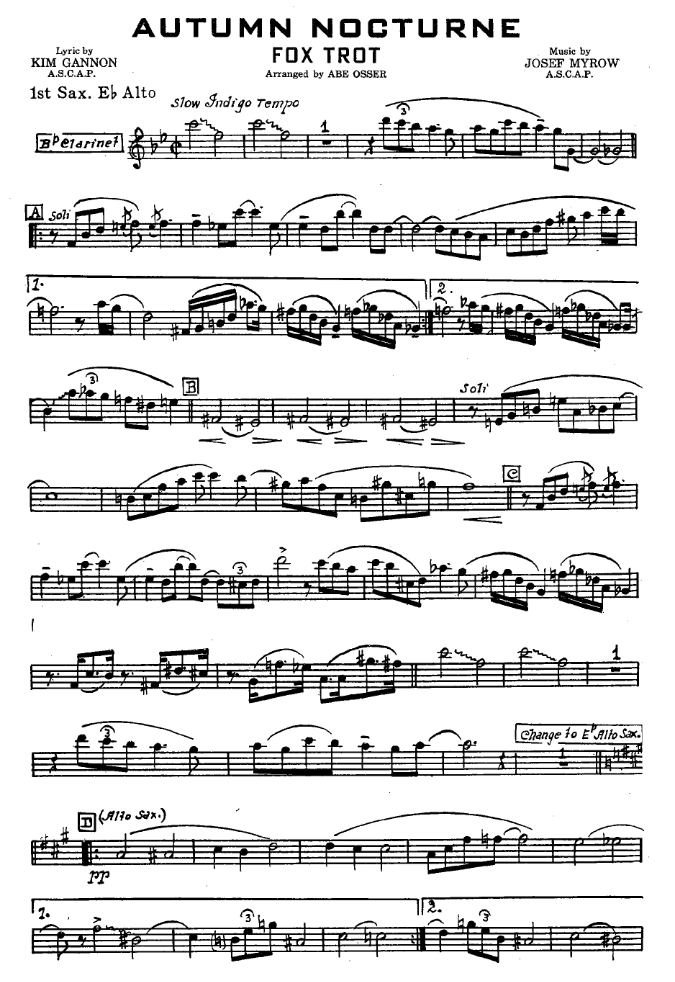
Autumn Nocturne (A.Osser)
Composed by Josef Myrow
Arranged by A. Osser
- Ensemble: Big Band
- Style: Foxtrot
- Pages: 23
- Instruments (17): Alto Saxophone 1, Alto Saxophone 2, Tenor Saxophone 1, Tenor Saxophone 2, Baritone Saxophone, Trumpet 1, Trumpet 2, Trumpet 3, Trumpet 4, Trombone 1, Trombone 2, Trombone 3, Bass Trombone, Piano, Bass, Drums, Guitar
- Difficulty: medium
- Content: Individual Parts
- Format: PDF Download (Instant)
- Price: $24.99
Josef Myrow's "Autumn Nocturne," originally penned in 1941, emerged during the golden age of the American Songbook, a period defined by lush melodies and sophisticated harmonies. While not as overtly famous as some of its contemporaries, its evocative title and melancholic yet romantic character quickly made it a favorite among instrumentalists and vocalists alike. The piece gained particular traction through instrumental interpretations, embodying the smooth, reflective mood often associated with late-night radio broadcasts and the burgeoning big band ballad tradition. It captures a timeless sentiment, a wistful reflection on the changing seasons, making it a perennial choice for its emotional depth and melodic beauty. A. Osser's arrangement of "Autumn Nocturne" for big band masterfully transforms Myrow's poignant melody into a classic foxtrot, imbued with the characteristic elegance and swing of the early 1940s. The musical character is defined by a medium-slow, relaxed foxtrot tempo, typically around 90-100 BPM, fostering a smooth, flowing feel rather than a driving swing. Osser maintains the original's melancholic mood, often in a minor key (likely D minor or G minor, common for this era's ballads), but infuses it with a gentle, danceable pulse. The arrangement prioritizes rich, warm harmonies, utilizing close voicings in the saxophone section and sustained brass pads to create a lush sonic landscape. The overall energy is refined and understated, building through subtle dynamic shifts rather than explosive power. Osser's distinctive approach is evident in the arrangement's sophisticated texture and careful melodic distribution. The primary melody is initially presented by the lead alto saxophone, often doubled or harmonized by the other saxophones, showcasing the section's blend. Later, the melody may transfer to the trumpet section, offering a brighter, more focused timbre. Osser frequently employs layered counter-melodies and obbligatos, particularly in the trombone section, adding depth without cluttering the main theme. There are no extended improvised solo sections in the modern sense; instead, Osser features short, written-out melodic statements or fills for various instruments, maintaining the arranged integrity of the piece. The technical challenges lie in achieving a unified ensemble sound, precise articulation for the foxtrot feel, and maintaining sustained breath control for the long melodic lines and rich chords. It is particularly rewarding for bands that appreciate classic big band voicings and a focus on blend and musicality over raw power. This arrangement is ideally suited for college, community, and advanced high school jazz ensembles seeking to explore the authentic sounds of the big band era. Its 17-instrument scoring (5 saxes, 4 trumpets, 4 trombones, piano, bass, drums, guitar) provides a full, traditional big band sound. The emphasis on ensemble blend, controlled dynamics, and expressive phrasing makes it an excellent teaching tool for developing musical maturity and an appreciation for foundational big band styles. This foxtrot arrangement of "Autumn Nocturne" requires a relaxed, medium-slow tempo, approximately 90-100 BPM, emphasizing a smooth, legato feel rather than a hard swing. Conductors should guide the rhythm section to lay down a steady, unhurried pulse, with the bass providing a walking line that is felt more than heard, and the drums utilizing brushes or light sticks for a soft, understated groove. Key technical challenges include achieving precise blend and intonation within the saxophone and brass sections, particularly on sustained chords and close voicings. Articulation should be predominantly legato, with careful attention to dynamic shaping to highlight the piece's melancholic mood. Trumpets and trombones should focus on warm, controlled tones, avoiding harshness. There are no specific mute requirements beyond standard cup or straight mutes for color if desired, though the arrangement generally thrives on open brass. Rehearsal time should be dedicated to balancing the layered melodic lines and ensuring the ensemble breathes together, allowing the rich harmonies to resonate fully. Q: What instruments are included in this arrangement? A: This arrangement is scored for a standard 17-piece big band: Alto Saxophone 1, Alto Saxophone 2, Tenor Saxophone 1, Tenor Saxophone 2, Baritone Saxophone, Trumpet 1, Trumpet 2, Trumpet 3, Trumpet 4, Trombone 1, Trombone 2, Trombone 3, Trombone 4, Piano, Bass, Drums, and Guitar. Q: What is the difficulty level of this arrangement? A: This arrangement is rated as Medium. It is suitable for college, community, and advanced high school jazz ensembles, requiring good ensemble blend, intonation, and a nuanced understanding of big band foxtrot style. Q: What is the musical style and historical context of "Autumn Nocturne"? A: "Autumn Nocturne" is a classic foxtrot from the American Songbook era, originally composed by Josef Myrow in 1941. This A. Osser arrangement captures the lush, melancholic, and sophisticated big band sound prevalent in the early 1940s. Q: What makes A. Osser's arrangement of "Autumn Nocturne" unique? A: Osser's arrangement is distinctive for its elegant foxtrot interpretation, rich close voicings, and sophisticated layering of melodic lines across sections. It prioritizes ensemble blend and musicality, offering a refined, authentic big band sound without extended improvised solos. Q: What is the recommended performance duration and tempo for this piece? A: The recommended tempo for this foxtrot is a medium-slow 90-100 BPM. The typical performance duration for this arrangement is approximately 3 to 4 minutes, depending on the chosen tempo and any optional repeats.
Musicians Also Search For
Autumn Nocturne A. Osser PDF • Autumn Nocturne A. Osser sheet music • Autumn Nocturne arranged by A. Osser • A. Osser big band charts • A. Osser jazz arrangements PDF • Autumn Nocturne Josef Myrow sheet music • Autumn Nocturne Josef Myrow big band arrangement • Josef Myrow big band charts • Autumn Nocturne big band arrangement • Autumn Nocturne big band PDF download • Autumn Nocturne jazz ensemble sheet music • big band sheet music instant download • Autumn Nocturne individual parts download • Autumn Nocturne sheet music with parts • Autumn Nocturne Foxtrot chart • Foxtrot big band arrangements • buy Autumn Nocturne sheet music online • download Autumn Nocturne PDF • Autumn Nocturne jazz chart • best A. Osser big band arrangements • Josef Myrow songs arranged by A. Osser • Autumn Nocturne printable sheet music • big band repertoire PDF