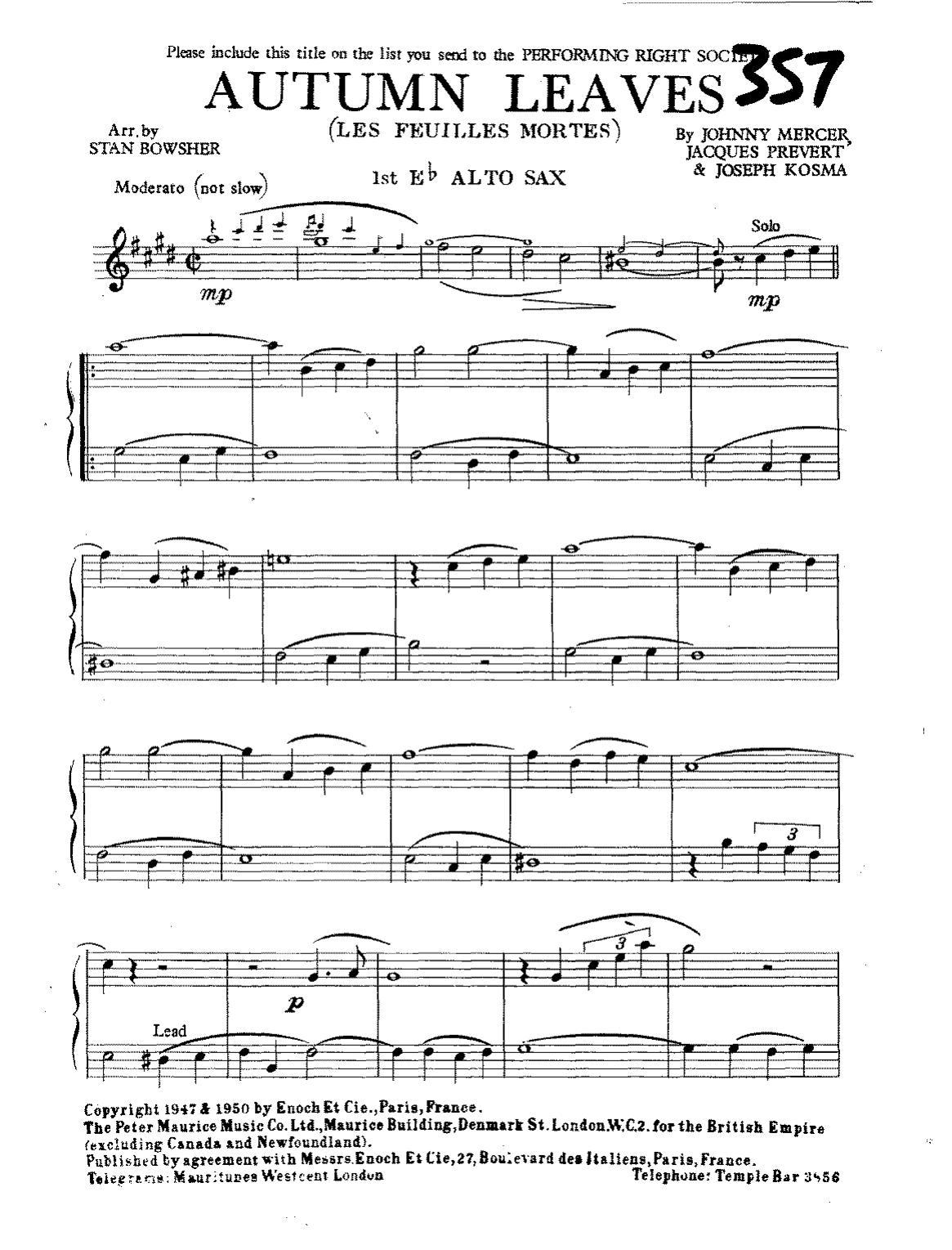
Autumn Leaves (S.Bowsher)
Composed by Joseph Kosma, Johnny Mercer
Arranged by S.Bowsher
- Ensemble: Big Band
- Style: Jazz Standard
- Pages: 25
- Instruments (18): 1st Alto Saxophone, 2nd Alto Saxophone, 1st Tenor Saxophone, 2nd Tenor Saxophone, Baritone Saxophone, 1st Trumpet, 2nd Trumpet, 3rd Trumpet, 4th Trumpet, 5th Trumpet, 1st Trombone, 2nd Trombone, 3rd Trombone, 4th Trombone, Piano, Bass, Drums, Guitar
- Difficulty: easy
- Content: Individual Parts
- Format: PDF Download (Instant)
- Price: $24.99
Composed originally in 1945 by Joseph Kosma with French lyrics by Jacques Prévert—and later immortalized in the Anglophone jazz canon with English lyrics by Johnny Mercer—"Autumn Leaves" stands as one of the most performed and recorded jazz standards in history. Emerging from post-war Paris and quickly becoming a cornerstone of the American jazz repertoire, its haunting, descending circle-of-fifths progression has provided a definitive vehicle for generations of improvisers, from Cannonball Adderley and Miles Davis to Bill Evans. This timeless framework anchors a rich tradition of harmonic exploration, where melancholic lyricism meets sophisticated jazz counterpoint. Conceived as a sweeping modern big band chart, S.Bowsher’s arrangement breathes fresh vitality into the canonical standard through a sophisticated medium-swing feel laced with lush, contemporary harmonic extensions. The mood balances introspective nostalgia with driving, modern energy, opening with a rubato, atmospheric introduction before settling into an infectious, buoyant pocket. Bowsher utilizes rich, chromatic chord voicings across the saxophone and brass sections, creating dense, shimmering textures that evoke the shifting colors of autumn. Subtle reharmonizations throughout the form elevate the sophistication of the chart, steering clear of tired clichés while honoring the bittersweet emotional core of Kosma’s original melody. The arrangement features dynamic interplay across the entire ensemble, beginning with a delicate woodwind-led statement of the melody before expanding into robust brass solis. A high-energy shout chorus serves as the structural climax, characterized by punchy syncopated figures, dynamic contrast, and brilliant upper-structure triad voicings for the trumpets. Solo opportunities are provided for tenor saxophone and piano, allowing featured improvisers to stretch out over standard changes made vibrant by Bowsher’s reimagined background figures. The rhythm section is treated as an active compositional voice, featuring written piano comping guides and a crisp, interactive drum chart that drives the medium-swing pulse with authentic stylistic authority. Advanced high school ensembles with strong section playing, as well as collegiate and professional big bands, will find this chart an immensely rewarding addition to their repertoire. While the technical demands are well within reach of capable student groups—particularly regarding rhythm section coordination and stylistic articulation—the arrangement offers enough harmonic depth and sophisticated nuance to satisfy professional audiences. Weighing in at a comprehensive 31 pages including a full conductor score, this publication provides all the necessary detail for a polished, professional-grade performance that will stand out in any festival or concert program. Achieving the ideal interpretation of S.Bowsher’s "Autumn Leaves" requires careful attention to articulation, balance, and the subtle nuances of a contemporary medium-swing feel. The tempo should remain locked in a comfortable, driving pocket around quarter note = 120 BPM, ensuring that eighth notes maintain a natural, relaxed triplet feel without becoming overly heavy or squared off. The primary technical challenge lies in the execution of the rich, extended harmonic voicings during the ensemble passages; brass players must prioritize blend and intonation to let the complex upper structures bloom without forcing the sound. Pay close attention to dynamic markings, particularly the sudden subtones in the saxophones and muted trumpet contrasts, which create the signature textural shifts inherent in Bowsher’s writing. Rehearsals should begin with section-only work on the dynamic balance of the inner-voice harmony before integrating the rhythm section. Ensure the bassist anchors the descending circle-of-fifths progression with a warm, acoustic-style walking line that locks tightly with the ride cymbal. Saxophones should focus on a lightweight, linear approach to the counter-melodies, while the brass must treat the shout chorus with razor-sharp articulation and controlled power. Q: What instruments and parts are included in this publication? A: The 31-page package includes a comprehensive full conductor score alongside individual parts for standard big band instrumentation: 5 saxophones (with double woodwind options where applicable), 4 trumpets, 4 trombones, and a full rhythm section comprising piano, guitar, bass, and drums. Q: What is the designated difficulty level for this arrangement? A: This chart is graded as advanced intermediate to advanced, making it exceptionally well-suited for top-tier high school jazz ensembles, university bands, and professional community big bands seeking a sophisticated repertoire piece. Q: What is the musical style and historical context of this chart? A: This arrangement is a modern big band interpretation of the classic jazz standard composed by Joseph Kosma and popularized by Johnny Mercer, reimagining the traditional 1945 European-American masterpiece through a contemporary medium-swing aesthetic. Q: What makes S.Bowsher’s arrangement unique compared to standard stock charts? A: Bowsher elevates the familiar form through inventive reharmonizations, lush chromatic voicings, a striking structural contrast between rubato intro and driving swing, and meticulously crafted background figures that support featured soloists without cluttering the texture. Q: What is the approximate performance duration and tempo of the piece? A: The arrangement plays out over approximately 4 to 5 minutes at a comfortable, driving medium-swing tempo of around 120 beats per minute, allowing ample space for improvised solos and dynamic development.
Questions and answers
- What is included in the Autumn Leaves (S.Bowsher) PDF?
- The verified current file contains individual parts across 25 pages.
- How many instruments or parts are listed for Autumn Leaves (S.Bowsher)?
- The verified instrumentation list contains 18 entries for this Big Band arrangement.
- Who is credited for Autumn Leaves (S.Bowsher)?
- Composer: Joseph Kosma, Johnny Mercer. Arranger: S.Bowsher.
- What difficulty is listed for Autumn Leaves (S.Bowsher)?
- The verified difficulty level is easy.
- What style is listed for Autumn Leaves (S.Bowsher)?
- The catalog lists the style as Jazz Standard.
- Can I preview Autumn Leaves (S.Bowsher) before buying?
- Yes. The product page provides a preview generated from the current PDF file.
- How is Autumn Leaves (S.Bowsher) delivered?
- After successful payment, the digital PDF is made available for download. The displayed price is $24.99.
Musicians Also Search For
Autumn Leaves S.Bowsher PDF • Autumn Leaves S.Bowsher sheet music • Autumn Leaves arranged by S.Bowsher • S.Bowsher big band charts • S.Bowsher jazz arrangements PDF • Autumn Leaves Joseph Kosma, Johnny Mercer sheet music • Autumn Leaves Joseph Kosma, Johnny Mercer big band arrangements • Joseph Kosma, Johnny Mercer big band charts • Autumn Leaves big band arrangements • Autumn Leaves big band PDF download • Autumn Leaves jazz sheet music • big band sheet music download • Autumn Leaves individual parts download • Autumn Leaves sheet music PDF • Autumn Leaves Jazz Standard charts • Jazz Standard big band arrangements • buy Autumn Leaves sheet music • download Autumn Leaves PDF • Autumn Leaves jazz charts • best S.Bowsher big band arrangements • Joseph Kosma, Johnny Mercer arranged by S.Bowsher • Autumn Leaves printable sheet music • big band repertoire PDF