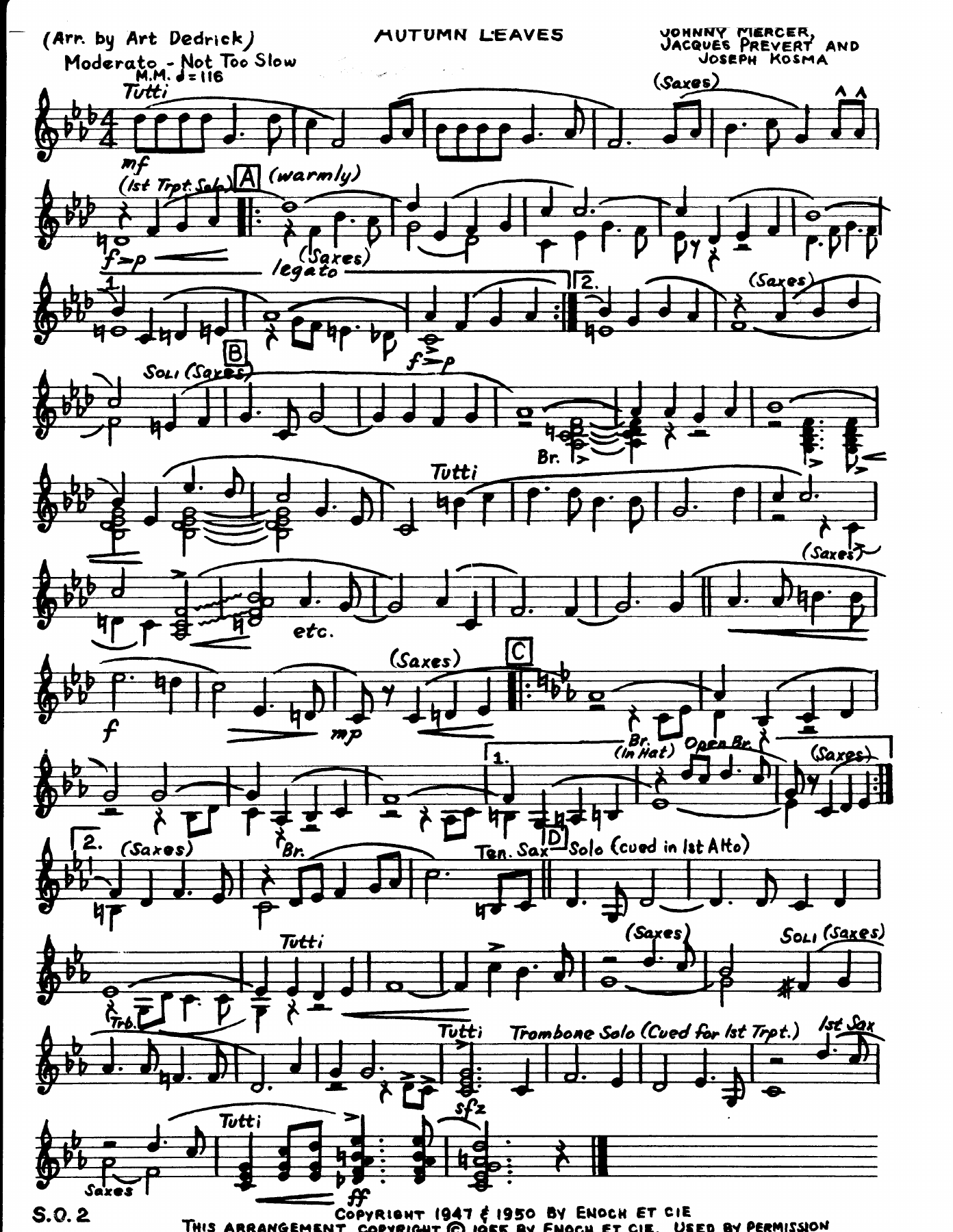
Autumn Leaves (A.Dedrick)
Composed by Joseph Kosma
Arranged by Art Dedrick
- Ensemble: Big Band
- Style: Jazz Standard
- Pages: 18
- Instruments (18): Vocal (Male Voice/Soprano), Vocal (Female Voice/Alto), 1st Eb Alto Sax, 3rd Eb Alto Sax, 2nd Bb Tenor Sax, 4th Bb Tenor Sax, 5th Eb Baritone Sax, 1st Bb Trumpet, 2nd Bb Trumpet, 3rd Bb Trumpet, 1st Trombone, 2nd Trombone, 3rd Trombone, Piano, Guitar, String Bass, Tuba, Drums
- Difficulty: easy
- Content: Individual Parts
- Format: PDF Download (Instant)
- Price: $24.99
Joseph Kosma's timeless melody, "Autumn Leaves" ("Les Feuilles mortes"), first captivated audiences in 1945 as a French song with lyrics by Jacques Prévert. Its melancholic yet beautiful theme quickly transcended language barriers, becoming a global phenomenon and one of the most frequently recorded jazz standards of all time. The English lyrics, penned by Johnny Mercer in 1947, further cemented its place in the American Songbook. This poignant ballad, often associated with the cool jazz era and artists like Cannonball Adderley, Miles Davis, and Erroll Garner, encapsulates the bittersweet beauty of change and memory. Its enduring popularity stems from its elegantly constructed AABA form, sophisticated harmonic progression (often featuring minor ii-V-I progressions), and instantly recognizable, lyrical melody, making it a cornerstone of the jazz repertoire. Art Dedrick's arrangement of "Autumn Leaves" for big band presents this beloved standard with a sophisticated, medium-swing feel, typically set in the key of G minor. The overall mood is one of refined elegance and warmth, avoiding overt sentimentality in favor of a smooth, grooving interpretation. Dedrick, known for his accessible yet musically rich charts, employs his signature clear voicings and logical sectional writing to highlight the tune's inherent beauty. The arrangement maintains a consistent 4/4 time signature, allowing the band to settle into a comfortable, flowing rhythm that supports the melodic lines without overpowering them. The energy level is consistent and engaging, building subtly through dynamic contrasts rather than abrupt changes. Dedrick's distinctive approach is evident from the outset. The melody is initially presented by the alto saxophone, often doubled or harmonized with other woodwinds, establishing a classic big band texture. Throughout the arrangement, Dedrick skillfully orchestrates the melodic duties, passing the theme between sections – from the saxophones to the brass, and occasionally featuring the full ensemble. A standout feature is a beautifully crafted saxophone soli section, where the entire sax section plays a harmonized melodic line, showcasing their blend and precision. The arrangement typically features an open solo section over the standard chord changes, providing ample opportunity for improvisation, often for alto saxophone or trumpet, allowing soloists to stretch out over the familiar progression. A well-placed shout chorus builds excitement towards the end, utilizing strong brass figures and driving saxophone lines before returning to a final, elegant statement of the theme. This arrangement is particularly suitable for high school and college jazz ensembles, as well as community bands seeking a rewarding and educational piece. While it offers rich musicality, Dedrick's writing is generally idiomatic for each instrument, making the technical demands manageable for developing musicians. The clear articulation markings, dynamic contrasts, and well-voiced harmonies provide excellent teaching opportunities for balance, blend, and stylistic interpretation. Performing this chart is rewarding due to its familiar melody, satisfying harmonic movement, and the chance to explore classic big band textures within a well-structured framework. Conductors should aim for a relaxed, medium-swing tempo around 120-130 BPM, emphasizing a smooth, flowing eighth-note feel rather than a rushed or choppy one. Articulation is key: encourage legato phrasing in the melody lines and crisp, precise attacks in the brass figures, especially during the shout chorus. The saxophone soli requires careful attention to blend and intonation across the section, ensuring a unified sound. Balance between sections is crucial; brass should support the saxophones without overpowering them, particularly during melodic statements. Dynamic contrasts, from subtle piano sections to robust fortissimos, should be carefully observed to build musical tension and release. Soloists should be encouraged to explore the harmonic landscape of the tune, using the provided chord changes as a springboard for creative improvisation. No special techniques like plunger mutes or falls are explicitly required, allowing the focus to remain on fundamental big band execution and musicality. Q: What instruments and parts are included in the "Autumn Leaves (A.Dedrick)" arrangement? A: This big band arrangement includes parts for 17 instruments: Alto Saxophone 1, Alto Saxophone 2, Tenor Saxophone 1, Tenor Saxophone 2, Baritone Saxophone, Trumpet 1, Trumpet 2, Trumpet 3, Trumpet 4, Trombone 1, Trombone 2, Trombone 3, Trombone 4, Piano, Bass, Drums, and Guitar. Q: What is the difficulty level of this arrangement by Art Dedrick? A: This arrangement is generally considered to be of medium difficulty, suitable for high school, college, and community jazz ensembles. It offers rich musicality without presenting overly complex technical challenges, focusing instead on solid ensemble playing and stylistic interpretation. Q: What is the musical style and historical context of "Autumn Leaves"? A: "Autumn Leaves" is a quintessential jazz standard, originating as a French song in 1945. This arrangement presents it in a classic big band medium-swing style, reflecting the traditional jazz orchestra sound that became popular in the mid-20th century. Q: What makes Art Dedrick's arrangement of "Autumn Leaves" unique compared to other versions? A: Dedrick's arrangement is characterized by its clear, accessible voicings, a well-crafted saxophone soli section, and a balanced approach to melodic presentation across the ensemble. It provides an excellent framework for developing bands to perform a beloved standard with authenticity and musicality. Q: What is the typical performance duration and tempo for this arrangement? A: The typical performance duration for this arrangement is approximately 3-4 minutes, depending on the length of the improvised solos. It is designed to be played at a medium-swing tempo, usually around 120-130 beats per minute.
Questions and answers
- What is included in the Autumn Leaves (A.Dedrick) PDF?
- The verified current file contains individual parts across 18 pages.
- How many instruments or parts are listed for Autumn Leaves (A.Dedrick)?
- The verified instrumentation list contains 18 entries for this Big Band arrangement.
- Who is credited for Autumn Leaves (A.Dedrick)?
- Composer: Joseph Kosma. Arranger: Art Dedrick.
- What difficulty is listed for Autumn Leaves (A.Dedrick)?
- The verified difficulty level is easy.
- What style is listed for Autumn Leaves (A.Dedrick)?
- The catalog lists the style as Jazz Standard.
- Can I preview Autumn Leaves (A.Dedrick) before buying?
- Yes. The product page provides a preview generated from the current PDF file.
- How is Autumn Leaves (A.Dedrick) delivered?
- After successful payment, the digital PDF is made available for download. The displayed price is $24.99.
Musicians Also Search For
Autumn Leaves Art Dedrick PDF • Autumn Leaves Art Dedrick sheet music • Autumn Leaves arranged by Art Dedrick • Art Dedrick big band charts • Art Dedrick jazz arrangements PDF • Autumn Leaves Joseph Kosma sheet music • Autumn Leaves Joseph Kosma big band arrangements • Joseph Kosma big band charts • Autumn Leaves big band arrangements • Autumn Leaves big band PDF download • Autumn Leaves jazz sheet music • big band sheet music download • Autumn Leaves individual parts download • Autumn Leaves sheet music PDF • Autumn Leaves Jazz Standard charts • Jazz Standard big band arrangements • buy Autumn Leaves sheet music • download Autumn Leaves PDF • Autumn Leaves jazz charts • best Art Dedrick big band arrangements • Joseph Kosma arranged by Art Dedrick • Autumn Leaves printable sheet music • big band repertoire PDF