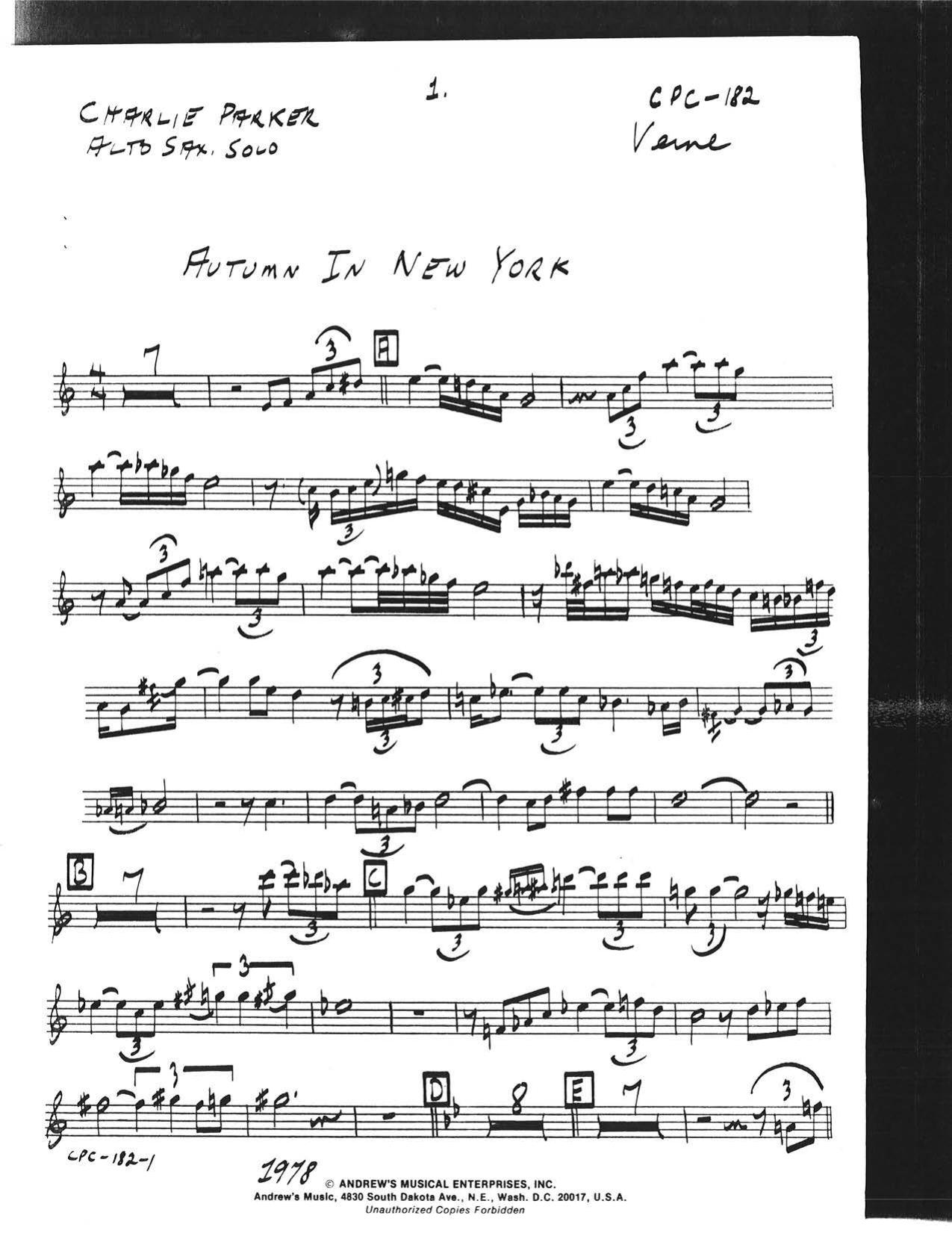
Autumn In New York (C.Parker with Strings)
Composed by Vernon Duke
Arranged by Ch.Parker-String
- Ensemble: Big Band
- Pages: 68
- Instruments (21): Alto Sax Solo, 1st Reed (Flute, Clarinet), 2nd Reed (Flute, Clarinet, Bass Clarinet), 3rd Reed (Clarinet, Bass Clarinet), Reed 4 (Clarinet, Bass Clarinet), 5th Reed (Oboe, Clarinet), 1st Trumpet, 2nd Trumpet, 3rd Trumpet, 1st Trombone, 2nd Trombone, Piano, Guitar, Bass, Drums, A Violin, B Violin, C Violin, Viola, Cello, Harp
- Difficulty: advanced
- Content: Individual Parts
- Format: PDF Download (Instant)
- Price: $24.99
Vernon Duke’s timeless 1934 ballad "Autumn in New York" achieved immortal status in the jazz canon largely due to Charlie Parker’s legendary 1950 Verve recording, *Charlie Parker with Strings*. This masterwork captured the bebop pioneer operating in a lush, highly emotive orchestral environment, marrying the harmonic sophistication of modern jazz with romantic cinematic scoring. The composition itself evokes the bittersweet nostalgia, crisp air, and architectural grandeur of Manhattan during the autumn transition, blending melancholy harmonic minor shifts with sweeping, sophisticated major-seventh cadences. Bridging the gap between intimate bebop expression and rich orchestral writing, this 11-instrument arrangement balances a shimmering horn backdrop with the poignant voice of the lead alto saxophone. The tempo unfolds as a spacious, rubato-inflected ballad feel that settles into a gentle, flowing 4/4 walking groove. Texturally, the chart utilizes sophisticated extended harmonies, lush chromatic voice-leading, and subtle countermelodies that mirror the original recorded string lines adapted specifically for a jazz ensemble. The mood oscillates between introspective quietude and soaring, bittersweet release, demanding absolute control over tone color, intonation, and dynamic shading from every section. The lead alto saxophone commands the spotlight throughout, capturing Parker’s iconic phrasing, vocalistic vibrato, and graceful embellishments while leaving ample room for personal improvisational expression. The accompanying horns—featuring tenor saxophone, trumpet, trombone, and a rhythm section anchored by piano—operate as a cohesive harmonic cushion, utilizing tight, beautiful voicings reminiscent of Neal Hefti or Jimmy Mundy’s classic string-orchestra charts. Technical challenges reside primarily in maintaining pristine intonation during exposed chord clusters, executing seamless transitions between rubato and strict time, and sustaining long, lyrical lines without losing intensity. Advanced collegiate, professional, and elite community jazz ensembles will find this arrangement an exceptional vehicle for showcasing a mature guest soloist. Because the charts rely heavily on linear independence and dynamic sensitivity rather than sheer volume, it offers a refreshing departure from standard high-energy shout-chorus literature. Performing this arrangement provides audiences with a deeply moving, sophisticated jazz-history experience that highlights the undeniable intersection of bebop genius and classic American songbook elegance. Navigating this arrangement successfully requires a refined approach to ballad playing, where time feels elastic yet fundamentally grounded. The conductor must guide the ensemble through subtle rubato sections before settling into a relaxed, pulsing 4/4 swing feel around quarter note equals 64–72. Balance is the primary technical hurdle; because the 11-instrument scoring is transparent, inner voices must constantly listen down and across to support the lead alto saxophone without masking its delicate phrasing. Horn players should prioritize a warm, dark timbre, minimizing excessive vibrato except where specified to emulate the original string-section warmth. Pay close attention to dynamic markings, treating crescendos and decrescendos as collective breaths rather than abrupt volume shifts. Rehearsals should initially focus on unaccompanied sectional intonation, locking in the complex tertian and quartal voicings before integrating the rhythm section's harmonic foundation. Q: What instruments and parts are included in this 11-instrument arrangement? A: The instrumentation features parts for Alto Saxophone (featured solo role), Tenor Saxophone, Trumpet, Trombone, Piano, and a standard rhythm/string reduction footprint spanning 68 total pages of comprehensive score and parts. Q: What is the overall difficulty level of this chart? A: This arrangement is rated advanced, primarily due to the demand for sophisticated intonation, mature ballad phrasing, delicate dynamic control, and the stylistic sensitivity required to interpret Parker-esque string adaptations. Q: How does this arrangement connect to historical jazz recordings? A: It directly mirrors the aesthetic and harmonic framework of Charlie Parker’s celebrated 1950 Verve recording sessions with strings, translating lush orchestral textures into an accessible 11-piece jazz ensemble format. Q: What makes this specific arrangement unique compared to standard big band charts? A: Instead of relying on traditional powerhouse shout choruses and heavy brass payloads, it emphasizes rich, cinematic counterpoint, transparent harmonic voicings, and an intimate soloist-accompaniment dynamic. Q: What is the suggested performance tempo and duration? A: The piece is performed at a slow, expressive ballad tempo (approximately quarter note = 64–72) with an estimated duration of roughly 3 to 4 minutes depending on the length of the improvised soloist cadenzas.
Questions and answers
- What is included in the Autumn In New York (C.Parker with Strings) PDF?
- The verified current file contains a conductor score and individual parts across 68 pages.
- How many instruments or parts are listed for Autumn In New York (C.Parker with Strings)?
- The verified instrumentation list contains 21 entries for this Big Band arrangement.
- Who is credited for Autumn In New York (C.Parker with Strings)?
- Composer: Vernon Duke. Arranger: Ch.Parker-String.
- What difficulty is listed for Autumn In New York (C.Parker with Strings)?
- The verified difficulty level is advanced.
- Can I preview Autumn In New York (C.Parker with Strings) before buying?
- Yes. The product page provides a preview generated from the current PDF file.
- How is Autumn In New York (C.Parker with Strings) delivered?
- After successful payment, the digital PDF is made available for download. The displayed price is $24.99.
Musicians Also Search For
Autumn In New York Ch.Parker-String PDF • Autumn In New York Ch.Parker-String sheet music • Autumn In New York arranged by Ch.Parker-String • Ch.Parker-String big band charts • Ch.Parker-String jazz arrangements PDF • Autumn In New York Vernon Duke sheet music • Autumn In New York Vernon Duke big band arrangements • Vernon Duke big band charts • Autumn In New York big band arrangements • Autumn In New York big band PDF download • Autumn In New York jazz sheet music • big band sheet music download • Autumn In New York conductor score PDF • Autumn In New York individual parts download • Autumn In New York sheet music PDF • buy Autumn In New York sheet music • download Autumn In New York PDF • Autumn In New York jazz charts • best Ch.Parker-String big band arrangements • Vernon Duke arranged by Ch.Parker-String • Autumn In New York printable sheet music • big band repertoire PDF