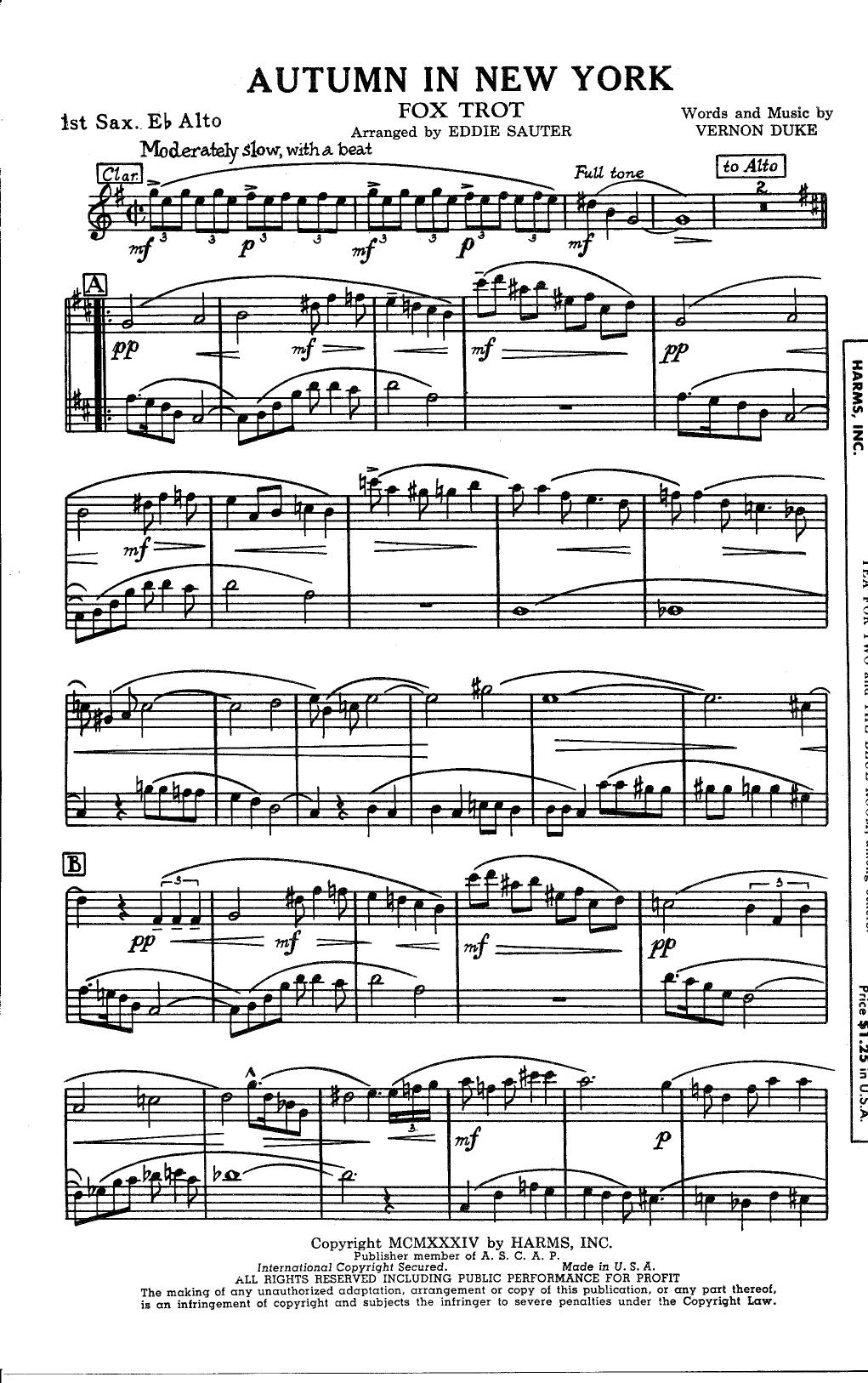
Autum In New York (E.Sauter)
Composed by Vernon Duke
Arranged by Eddie Sauter
- Ensemble: Big Band
- Pages: 35
- Instruments (18): 1st Sax. Eb Alto (doubles Clarinet), 2nd Sax. Bb Tenor, 3rd Sax. Eb Alto, 4th Sax. Bb Tenor, 5th Sax. Eb Baritone, 1st Trumpet in Bb, 2nd Trumpet in Bb, 3rd Trumpet in Bb, 1st Trombone, 2nd Trombone, 3rd Trombone, Guitar, Bass, Drums (doubles Bells), Piano, 1st Sax. Bb Tenor (Tenor Band), 3rd Sax. Bb Tenor (Tenor Band), Violins
- Difficulty: medium
- Content: Individual Parts
- Format: PDF Download (Instant)
- Price: $24.99
Vernon Duke’s timeless 1934 ballad "Autumn in New York" occupies a revered position in the Great American Songbook, capturing the bittersweet, melancholic elegance of Manhattan during the crisp autumn transition. Originally penned for the Broadway revue *Thumbs Up!*, the composition quickly transcended its theatrical origins to become a definitive jazz standard, interpreted by vocal and instrumental icons alike, including Billie Holiday, Charlie Parker, and Frank Sinatra. Its sophisticated harmonic progression and evocative melody make it a natural canvas for master orchestrators who seek to mine its rich emotional depths. Eddie Sauter, one of the most visionary and idiosyncratic arrangers in jazz history—renowned for his work with the Benny Goodman Orchestra and the groundbreaking Sauter-Finegan Orchestra—approaches this standard with his signature impressionistic palette. Eschewing standard big band clichés, Sauter utilizes an intimate 9-instrument ensemble (featuring a dynamic horn section of Alto Saxophone, Tenor Saxophone, Baritone Saxophone, Trumpet, and Trombone alongside rhythm) to create a transparent, chamber-jazz texture. The arrangement unfolds at a languid, rubato-leaning ballad tempo in 4/4 time, prioritizing lush, modernistic chord voicings, subtle counterpoint, and shifting tonal colors over sheer volume. The mood is deeply nostalgic, sophisticated, and at times hauntingly sparse, evoking the misty, amber-lit streets of mid-century New York through ingenious harmonic suspensions and delicate dynamic gradients. Throughout the 35-page score, the melodic weight is distributed artfully across the compact horn ensemble, allowing individual timbres to pierce through the texture before dissolving back into the rich harmonic cushion. Sauter’s distinctive writing incorporates intricate woodwind doublings, highly sophisticated extended harmonies, and carefully calibrated chordal density that demands immaculate intonation and blending. Featured solo spaces allow expressive players to stretch out over lush, sophisticated changes, while the ensemble sections require a high degree of rhythmic independence and lyrical sensitivity. There are no heavy-handed shout choruses here; instead, the climax is achieved through sheer harmonic expansion and emotional intensity, making the arrangement a masterclass in subtlety and restraint. Because of its demanding requirements in balance, intonation, and stylistic nuance, this 9-instrument configuration is best suited for advanced college ensembles, professional chamber-jazz groups, and elite high school jazz bands capable of mature ensemble listening. Directors will find that working on this chart drastically improves a section's collective ear, breath control, and command of subtle rubato phrasing. Performing Eddie Sauter's "Autumn in New York" offers audiences and musicians alike a rare glimpse into the higher art of jazz composition, where every note serves an atmospheric and emotional purpose. Conductors approaching Eddie Sauter’s arrangement of "Autumn in New York" must prioritize transparency, dynamic control, and horizontal linear phrasing over vertical chord-bashing. The tempo should remain flexible and conversational, avoiding a rigid metronomic pulse; allow the soloists and melody carriers to breathe with the phrasing. Intonation is the primary technical challenge, as Sauter’s dense, impressionistic voicings rely on pristine tuning of altered dominants and extended major-minor sonorities to achieve their characteristic shimmer. Players must obsess over balance, ensuring that inner-voice countermelodies do not inadvertently obscure the primary melodic line. Rhythm section members should approach their roles with utmost economy—the piano and guitar must voice chords cleanly without cluttering the harmonic space, while the bass provides a warm, foundational pulse. Rehearsals should begin by isolating the horn sections to lock in blend and dynamic tapering before integrating the full 9-piece ensemble. Q: What instruments and parts are included in this 9-instrument arrangement? A: The instrumentation features a 9-instrument lineup comprising Alto Saxophone, Tenor Saxophone, Baritone Saxophone, Trumpet, Trombone, and a standard rhythm section, spanning a comprehensive 35-page score and parts set. Q: What is the difficulty level of this chart? A: This arrangement is graded as advanced, making it ideal for elite college ensembles, professional chamber-jazz groups, and advanced high school jazz bands with strong maturity in intonation and balance. Q: What style and historical era does this arrangement represent? A: It represents the sophisticated cool and impressionistic modernism of the mid-20th-century jazz tradition, filtered through the unmistakable, avant-garde arranging genius of Eddie Sauter. Q: What makes this specific Eddie Sauter arrangement unique? A: Unlike traditional big band charts that rely on heavy shout choruses and block-chord walls, Sauter utilizes a transparent 9-instrument chamber-jazz approach focused on shifting harmonic colors, linear counterpoint, and subtle emotional depth. Q: What is the performance duration and tempo feel of the piece? A: The piece is performed at a relaxed, atmospheric ballad tempo with a fluid, expressive 4/4 swing-ballad feel, typically lasting around 4 to 5 minutes depending on the length of the improvised solos.
Questions and answers
- What is included in the Autum In New York (E.Sauter) PDF?
- The verified current file contains individual parts across 35 pages.
- How many instruments or parts are listed for Autum In New York (E.Sauter)?
- The verified instrumentation list contains 18 entries for this Big Band arrangement.
- Who is credited for Autum In New York (E.Sauter)?
- Composer: Vernon Duke. Arranger: Eddie Sauter.
- What difficulty is listed for Autum In New York (E.Sauter)?
- The verified difficulty level is medium.
- Can I preview Autum In New York (E.Sauter) before buying?
- Yes. The product page provides a preview generated from the current PDF file.
- How is Autum In New York (E.Sauter) delivered?
- After successful payment, the digital PDF is made available for download. The displayed price is $24.99.
Musicians Also Search For
Autum In New York Eddie Sauter PDF • Autum In New York Eddie Sauter sheet music • Autum In New York arranged by Eddie Sauter • Eddie Sauter big band charts • Eddie Sauter jazz arrangements PDF • Autum In New York Vernon Duke sheet music • Autum In New York Vernon Duke big band arrangements • Vernon Duke big band charts • Autum In New York big band arrangements • Autum In New York big band PDF download • Autum In New York jazz sheet music • big band sheet music download • Autum In New York individual parts download • Autum In New York sheet music PDF • buy Autum In New York sheet music • download Autum In New York PDF • Autum In New York jazz charts • best Eddie Sauter big band arrangements • Vernon Duke arranged by Eddie Sauter • Autum In New York printable sheet music • big band repertoire PDF