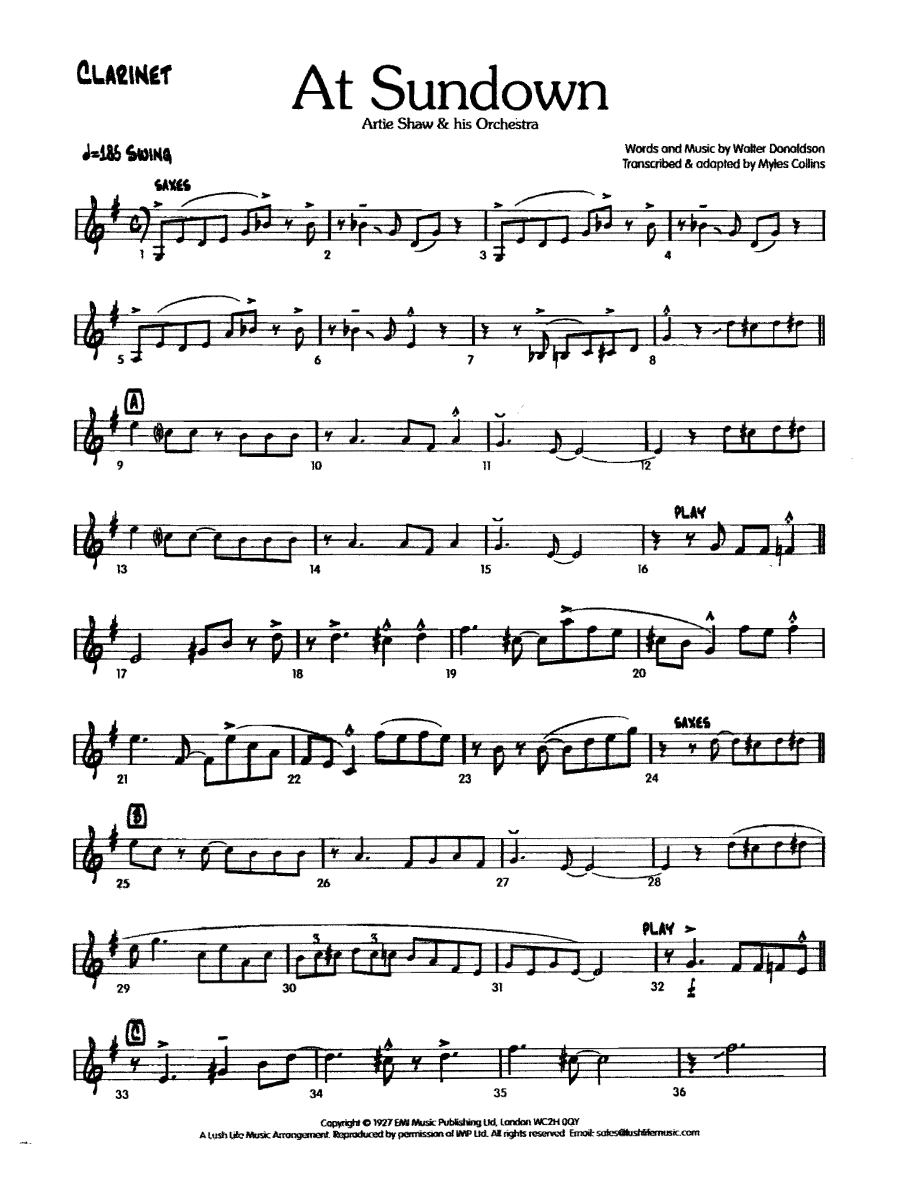
At Sundown (W.Donaldson) sheet music preview

At Sundown (W.Donaldson)

Composed by Walter Donaldson

Arranged by Artie Shaw

  • Ensemble: Big Band
  • Style: Jazz Standard
  • Pages: 64
  • Instruments (17): Clarinet, Alto 1, Alto 2, Tenor 1, Tenor 2, Trumpet 1, Trumpet 2, Trumpet 3, Trumpet 4, Trombone 1, Trombone 2, Trombone 3, Trombone 4, Piano, Guitar, Bass, Drums
  • Difficulty: advanced
  • Content: Individual Parts
  • Format: PDF Download (Instant)
  • Price: $24.99

Walter Donaldson's "At Sundown," a timeless jazz standard, emerged from the heart of the Tin Pan Alley era, first published in 1927. This period, characterized by a proliferation of popular songs that formed the bedrock of early jazz and swing, saw Donaldson penning numerous hits, many of which became staples for dance bands and vocalists. While not as immediately ubiquitous as some of his other compositions, "At Sundown" found its enduring place in the jazz lexicon through its elegant melody and harmonic sophistication, making it a favorite for instrumental interpretations and vocalists alike, including notable recordings by Mildred Bailey and, of course, Artie Shaw himself. Its lyrical narrative of twilight reflection and romantic longing is perfectly matched by its wistful, yet ultimately hopeful, musical contour. Artie Shaw's arrangement of "At Sundown" for big band captures the quintessential mid-tempo swing feel that defined his orchestra's golden age. Set primarily in the key of F major, the piece maintains a relaxed, flowing groove, evoking a sophisticated, slightly melancholic, yet undeniably swinging mood. Shaw's signature approach to big band arranging is immediately evident: a masterful blend of rich, often clarinet-led, voicings with impeccably tight ensemble work. The arrangement opens with a warm, inviting saxophone soli, establishing the melodic theme with his characteristic smooth legato and precise articulation. Throughout the piece, Shaw skillfully alternates between full ensemble passages and more intimate sections, often featuring his own clarinet as a prominent solo voice, weaving through the orchestral texture with unparalleled grace and technical brilliance. The arrangement features the melody carried initially by the saxophone section, then often transitioning to the brass or a combination thereof, showcasing Shaw's adeptness at orchestrating melody. While a specific improvised solo section is not explicitly marked in the traditional sense, the arrangement provides ample opportunity for a featured clarinetist (presumably Shaw himself) to embellish and interpret the melodic lines, particularly in the bridge sections, adding a layer of virtuosic improvisation that is integral to the piece's character. The technical challenges lie in maintaining Shaw's demanding precision in articulation and blend, particularly within the saxophone and brass sections, and achieving the seamless transitions between dynamic contrasts. The rewarding aspect of performing this arrangement is the opportunity to recreate the sophisticated, polished sound of one of the most iconic big bands in jazz history, delivering a piece that is both musically engaging and historically significant. This arrangement is ideally suited for advanced high school, collegiate, community, and professional big bands. Its intricate voicings and requirement for precise ensemble playing demand a mature understanding of swing articulation and dynamics. Bands capable of achieving a cohesive, polished sound will find this piece an excellent vehicle for showcasing their musicality and historical appreciation, offering a deep dive into the arranging genius of Artie Shaw and the enduring charm of a classic jazz standard. Conductors should emphasize a relaxed, medium swing feel throughout, ensuring a consistent pulse without rushing. The primary technical challenge lies in achieving Artie Shaw's characteristic legato phrasing and precise articulation, especially in the saxophone solis. Encourage players to listen across sections for balance and blend, particularly when the melody shifts between brass and reeds. Pay close attention to dynamic markings; Shaw's arrangements often feature subtle swells and diminuendos that contribute significantly to the overall mood. There are no specific extended techniques like plunger mutes or falls indicated, but standard jazz inflections (scoops, slight bends) should be encouraged tastefully. Rehearsal time should focus on clean entrances and releases, and developing a unified ensemble sound that captures the elegance and sophistication inherent in Shaw's writing. Q: What instruments and parts are included in this arrangement? A: This big band arrangement includes parts for 17 instruments: Alto Saxophone 1, Alto Saxophone 2, Tenor Saxophone 1, Tenor Saxophone 2, Baritone Saxophone, Trumpet 1, Trumpet 2, Trumpet 3, Trumpet 4, Trombone 1, Trombone 2, Trombone 3, Trombone 4, Piano, Bass, Drums, and Guitar. Q: What is the difficulty level of Artie Shaw's "At Sundown" arrangement? A: This arrangement is considered advanced, suitable for collegiate, community, or professional big bands. It demands precise ensemble playing, sophisticated blend, and a strong understanding of swing articulation and dynamics. Q: What is the musical style and historical context of this arrangement? A: This is a classic jazz standard from the Tin Pan Alley era (1927), arranged in the iconic mid-tempo swing style of Artie Shaw's big band. It embodies the sophisticated dance band sound of the late 1930s and early 1940s. Q: What makes Artie Shaw's treatment of "At Sundown" unique? A: Shaw's arrangement is distinguished by its elegant, clarinet-led voicings, tight ensemble precision, and the sophisticated interplay between sections. It showcases his signature smooth legato phrasing and masterful orchestration, often featuring a prominent clarinet voice. Q: What is the approximate performance duration and tempo of this piece? A: "At Sundown" is typically performed at a medium swing tempo, around 120-140 BPM. The approximate performance duration is 3-4 minutes, depending on interpretation and any optional solo embellishments.

Questions and answers

What is included in the At Sundown (W.Donaldson) PDF?
The verified current file contains individual parts across 64 pages.
How many instruments or parts are listed for At Sundown (W.Donaldson)?
The verified instrumentation list contains 17 entries for this Big Band arrangement.
Who is credited for At Sundown (W.Donaldson)?
Composer: Walter Donaldson. Arranger: Artie Shaw.
What difficulty is listed for At Sundown (W.Donaldson)?
The verified difficulty level is advanced.
What style is listed for At Sundown (W.Donaldson)?
The catalog lists the style as Jazz Standard.
Can I preview At Sundown (W.Donaldson) before buying?
Yes. The product page provides a preview generated from the current PDF file.
How is At Sundown (W.Donaldson) delivered?
After successful payment, the digital PDF is made available for download. The displayed price is $24.99.

Musicians Also Search For

At Sundown Artie Shaw PDFAt Sundown Artie Shaw sheet musicAt Sundown arranged by Artie ShawArtie Shaw big band chartsArtie Shaw jazz arrangements PDFAt Sundown Walter Donaldson sheet musicAt Sundown Walter Donaldson big band arrangementsWalter Donaldson big band chartsAt Sundown big band arrangementsAt Sundown big band PDF downloadAt Sundown jazz sheet musicbig band sheet music downloadAt Sundown individual parts downloadAt Sundown sheet music PDFAt Sundown Jazz Standard chartsJazz Standard big band arrangementsbuy At Sundown sheet musicdownload At Sundown PDFAt Sundown jazz chartsbest Artie Shaw big band arrangementsWalter Donaldson arranged by Artie ShawAt Sundown printable sheet musicbig band repertoire PDF

All arrangements by Artie Shaw All Walter Donaldson sheet music