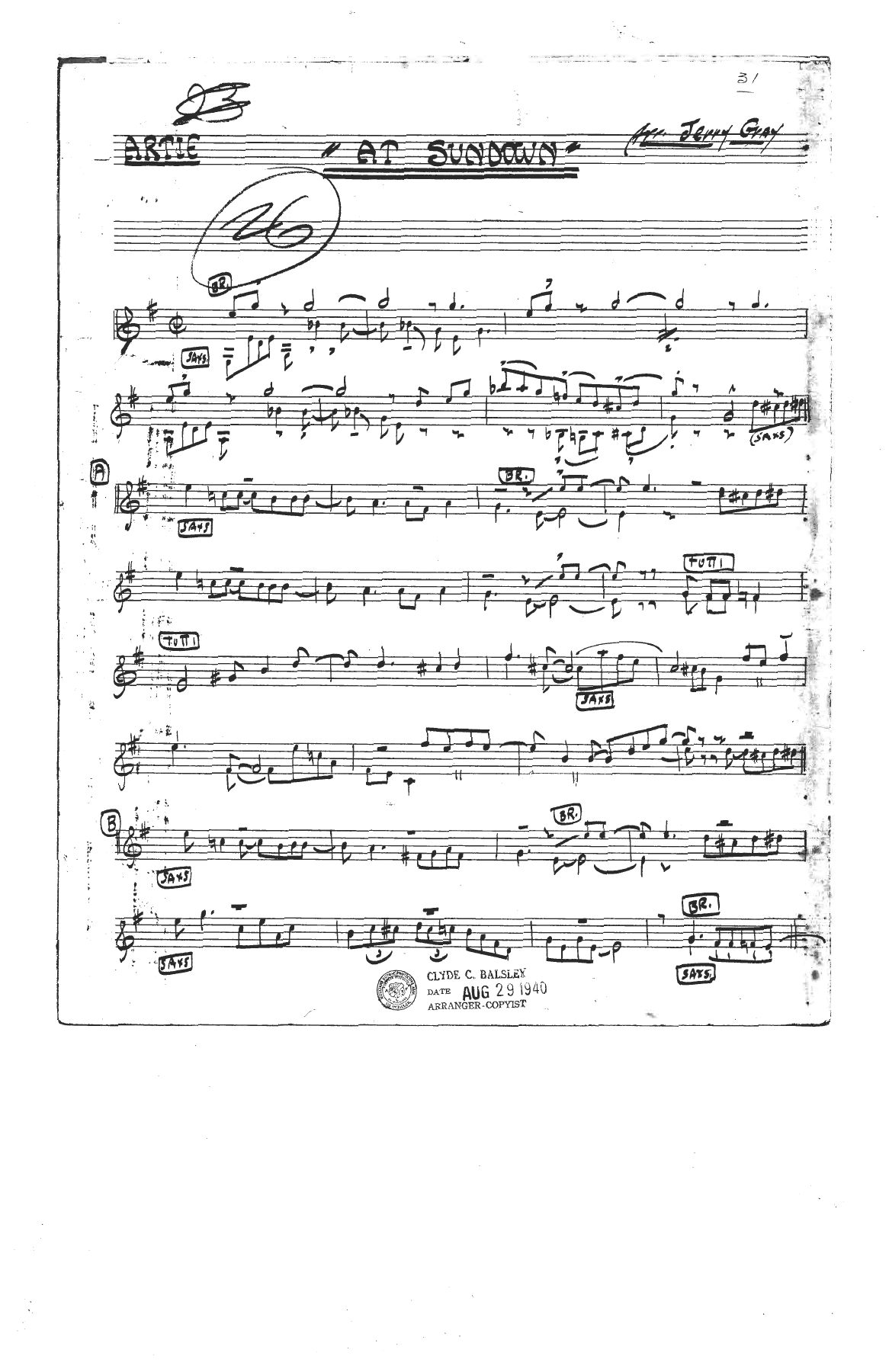
At Sundown (J.Gray) sheet music preview

At Sundown (J.Gray)

Composed by Walter Donaldson

Arranged by Artie Shaw

  • Ensemble: Big Band
  • Style: Jazz Standard
  • Pages: 53
  • Instruments (17): Alto Saxophone 1, Alto Saxophone 2, Tenor Saxophone 1, Tenor Saxophone 2, Baritone Saxophone, Trumpet 1, Trumpet 2, Trumpet 3, Trumpet 4, Trombone 1, Trombone 2, Trombone 3, Bass Trombone, Guitar, Piano, Bass, Drums
  • Difficulty: advanced
  • Content: Individual Parts
  • Format: PDF Download (Instant)
  • Price: $24.99

"At Sundown," a timeless composition by Walter Donaldson, emerged from the vibrant Tin Pan Alley era, first published in 1927. This period, nestled between the Roaring Twenties and the Great Depression, was a golden age for popular song, laying much of the foundational repertoire for what would become the jazz standard canon. While Donaldson was a prolific songwriter known for hits like "My Blue Heaven" and "Yes Sir, That's My Baby," "At Sundown" gained significant traction through various dance band recordings and, crucially, its adoption by jazz luminaries. Its enduring appeal lies in its elegant melody, sophisticated harmonic progression, and a lyrical quality that evokes a sense of wistful romance or tranquil reflection, making it a natural fit for both vocalists and instrumentalists seeking expressive depth. This particular arrangement of "At Sundown" is a masterful interpretation by the legendary clarinetist and bandleader Artie Shaw. Shaw, renowned for his sophisticated musicality and innovative orchestral approach, imbues this standard with his signature blend of swing era elegance and precise, often challenging, ensemble writing. The piece settles into a comfortable medium swing feel, typically around 120-130 BPM, allowing for both melodic clarity and rhythmic propulsion. While the original key is not specified, Shaw often favored keys that showcased the clarinet and brass, contributing to a bright yet warm sonic palette. The overall mood is one of refined charm and understated energy, characteristic of Shaw's more melodic and less overtly virtuosic big band charts. Shaw's distinctive arranging style is immediately apparent. The arrangement opens with a beautifully voiced saxophone soli, presenting the main theme with a rich, blended timbre that is a hallmark of his band's sound. This is often followed by a brass response or counter-melody, creating a dynamic interplay between sections. Expect meticulously crafted voicings throughout, particularly in the saxophone and brass sections, which demand excellent intonation and balance. While "At Sundown" is not primarily a feature for extended improvisation, there are typically designated solo sections, often for tenor saxophone or clarinet, providing opportunities for individual expression within the ensemble context. The chart builds subtly, avoiding abrupt shifts in dynamics, culminating in a full ensemble shout chorus that is powerful yet controlled, showcasing Shaw's command of orchestral color without resorting to bombast. Performing this arrangement is a rewarding experience for college, community, and professional big bands. While not overtly technically demanding in terms of blistering tempos or extreme ranges, its challenges lie in precision, blend, and capturing the nuanced swing feel. The intricate voicings require careful attention to balance and intonation, particularly in the saxophone section's soli passages and the brass's sustained chords. The rhythmic precision necessary for the medium swing groove, coupled with the dynamic control required for Shaw's sophisticated ensemble writing, makes this an excellent piece for developing musicality and ensemble cohesion. The satisfaction comes from bringing to life a classic standard through the lens of one of jazz's most influential arrangers, delivering a performance that is both historically authentic and musically engaging. Conductors should emphasize a relaxed, yet precise medium swing feel, aiming for a tempo around 120-130 BPM. The primary technical challenge lies in achieving seamless blend and accurate intonation within the intricate saxophone solis and brass voicings. Encourage musicians to listen across sections, particularly during sustained chords, to ensure a rich, unified sound. Dynamic contrast should be subtle and controlled, reflecting Artie Shaw's sophisticated style rather than exaggerated swells. Rehearsal time should be dedicated to balancing the inner voices of the saxophone soli, ensuring the melody (often lead alto) is present but supported. Articulation should be light and consistent, with particular attention to short, precise releases on swing eighth notes. No special techniques like plungers or doits are explicitly required, but a collective understanding of swing era phrasing is paramount. Q: What instruments and parts are included in this arrangement? A: This arrangement is scored for a standard 17-piece big band, including Alto Saxophone 1, Alto Saxophone 2, Tenor Saxophone 1, Tenor Saxophone 2, Baritone Saxophone, Trumpet 1, Trumpet 2, Trumpet 3, Trumpet 4, Trombone 1, Trombone 2, Trombone 3, Bass Trombone, Piano, Bass, Drums, and Guitar. Q: What is the difficulty level of Artie Shaw's arrangement of "At Sundown"? A: This arrangement is considered intermediate to advanced. While not featuring extreme technical demands, it requires strong ensemble playing, precise intonation, and a nuanced understanding of swing phrasing, making it suitable for college, advanced community, or professional big bands. Q: What is the musical style and historical context of "At Sundown"? A: "At Sundown" is a jazz standard from the Tin Pan Alley era, originally composed by Walter Donaldson in 1927. Artie Shaw's arrangement interprets it in a classic medium swing big band style, characteristic of the late 1930s and early 1940s. Q: What makes Artie Shaw's arrangement of "At Sundown" unique? A: Shaw's arrangement is distinguished by its sophisticated saxophone solis, meticulously crafted voicings, and a refined medium swing feel. It showcases his signature blend of melodic elegance and precise ensemble writing, offering a classic big band sound without relying on overt virtuosic displays. Q: What is the typical performance duration and tempo for this arrangement? A: The performance duration for this arrangement typically ranges from 3 to 4 minutes, depending on the inclusion of improvised solos. It is designed to be performed at a comfortable medium swing tempo, generally between 120 and 130 beats per minute.

Musicians Also Search For

At Sundown Artie Shaw PDFAt Sundown Artie Shaw sheet musicAt Sundown arranged by Artie ShawArtie Shaw big band chartsArtie Shaw jazz arrangements PDFAt Sundown Walter Donaldson sheet musicAt Sundown Walter Donaldson big band arrangementWalter Donaldson big band chartsAt Sundown big band arrangementAt Sundown big band PDF downloadAt Sundown jazz ensemble sheet musicbig band sheet music instant downloadAt Sundown individual parts downloadAt Sundown sheet music with partsAt Sundown Jazz Standard chartJazz Standard big band arrangementsbuy At Sundown sheet music onlinedownload At Sundown PDFAt Sundown jazz chartbest Artie Shaw big band arrangementsWalter Donaldson songs arranged by Artie ShawAt Sundown printable sheet musicbig band repertoire PDF

All arrangements by Artie Shaw All Walter Donaldson sheet music