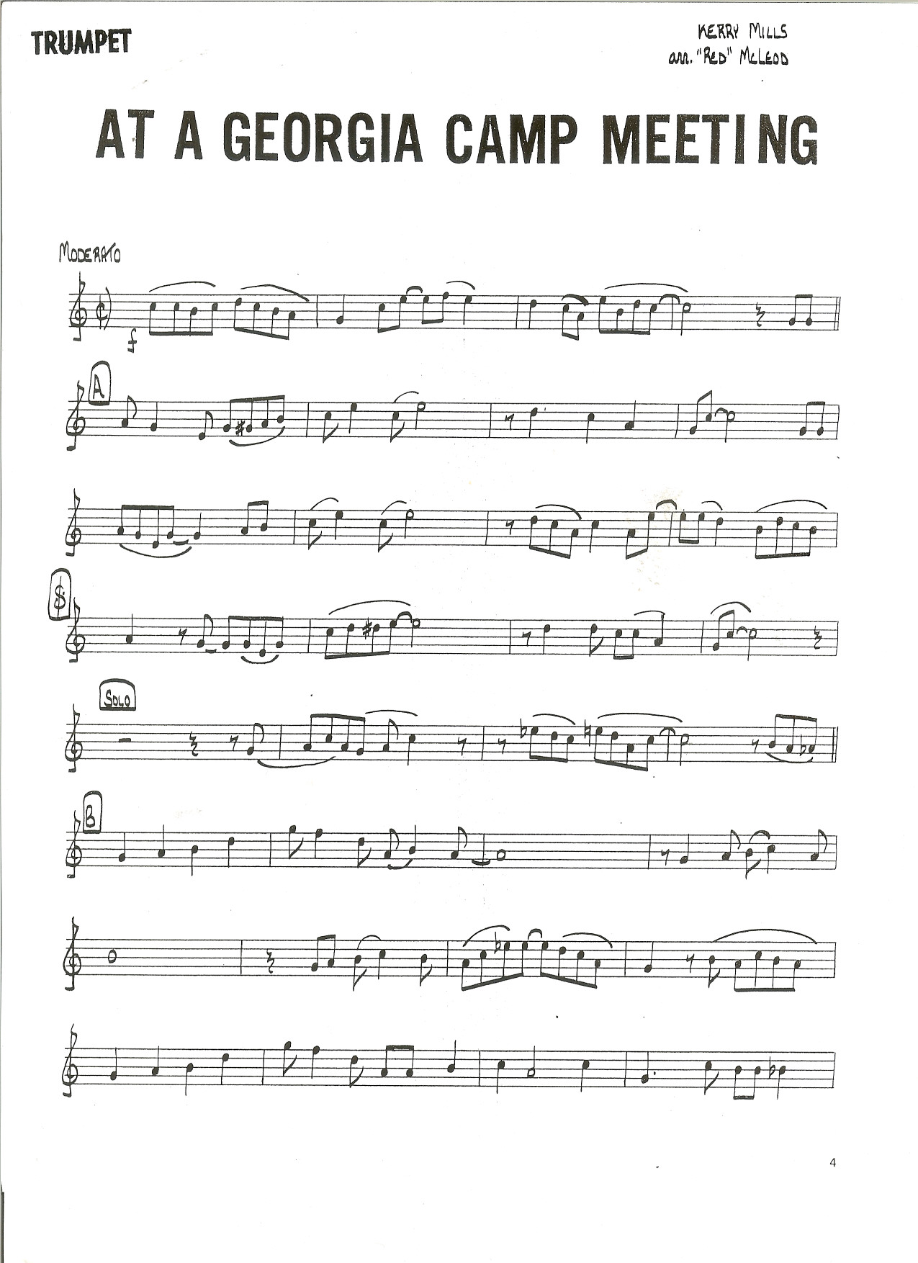
At A Georgia Camp Meeting (J.R.McLeod)
Composed by Kerry Mills
Arranged by J.R.McLeod
- Ensemble: Dixieland Band
- Style: Ragtime
- Pages: 17
- Difficulty: easy
- Content: Sheet Music
- Format: PDF Download (Instant)
- Price: $18.99
"At A Georgia Camp Meeting," composed by Frederick Allen "Kerry" Mills in 1897, stands as a seminal work from the vibrant Tin Pan Alley era, capturing the essence of the popular cakewalk dance craze that swept America at the turn of the 20th century. Originally subtitled "A Characteristic March which can be used effectively as a Two-Step, Polka or Cake Walk," this piece quickly became one of Mills' biggest hits, alongside other notable compositions like "Whistling Rufus" and "Red Wing." It represents a crucial bridge between the structured marches of the late 19th century and the emerging syncopated rhythms that would define ragtime and, subsequently, early jazz. The piece gained widespread fame through vaudeville performances and early recordings, including one by Sousa's Band in 1899, solidifying its place as a celebrated example of early American popular music. Its infectious melody and rhythmic vitality made it an instant favorite, embodying the joyous and often theatrical spirit of the era's social gatherings and camp meetings. This arrangement by J.R. McLeod breathes new life into Mills' classic, reimagining it for the spirited contours of a Dixieland band. McLeod's approach typically honors the traditional stylistic elements while introducing thoughtful harmonic and melodic embellishments that enhance the ensemble's texture and dynamic range. Expect a bright, up-tempo feel, firmly rooted in a driving 2/4 Dixieland march groove, often alternating with a lively 4/4 swing feel in later sections, maintaining the original's exuberant character. The key signature will likely remain accessible, facilitating energetic improvisation and ensemble interplay characteristic of the style. The mood is unequivocally celebratory and energetic, evoking images of bustling dance halls and lively parades, making it a perfect opener or an invigorating feature in any concert program. J.R. McLeod's distinctive arranging signature for Dixieland often involves clever interplay between the front-line instruments (trumpet, clarinet, trombone), utilizing both unison melodic statements and harmonized soli sections that highlight the unique timbres of each voice. Expect a clear melodic presentation, initially carried by the full ensemble or lead trumpet, before transitioning into featured solo opportunities for various instruments, allowing for individual expression within the established ragtime framework. Technical challenges will primarily revolve around maintaining crisp articulation at a brisk tempo, navigating syncopated rhythms precisely, and executing dynamic contrasts effectively. The true reward of performing this arrangement lies in its ability to transport both musicians and audience to the foundational era of jazz, celebrating its historical roots with an arrangement that is both authentic and fresh. This arrangement is ideally suited for college and community Dixieland bands, as well as advanced high school ensembles seeking to explore the rich history of ragtime and early jazz. Its blend of historical authenticity and engaging arrangement techniques provides an excellent educational opportunity to delve into the stylistic nuances of the genre, while offering a highly rewarding and entertaining performance experience. The detailed scoring ensures that each instrument has a meaningful and challenging part, fostering ensemble cohesion and individual musical growth. To achieve the authentic spirit of "At A Georgia Camp Meeting," conductors should emphasize a consistent, driving tempo with a buoyant, forward momentum. Aim for a brisk march feel, approximately quarter note = 120-130 BPM, allowing for rhythmic precision without sacrificing the inherent swing. Technical challenges include maintaining clean articulation on syncopated figures, particularly in the brass, and ensuring a balanced blend during the often-dense soli sections. Encourage musicians to exaggerate dynamic contrasts and utilize stylistic inflections such as short, crisp notes and subtle scoops or falls (where appropriate for the Dixieland idiom) to enhance the ragtime character. The clarinet should strive for a bright, soaring tone, while the trombone should provide a robust, often glissando-infused counterpoint. Rehearsal focus should be placed on rhythmic alignment between the rhythm section and the front line, as well as precise entrances and cutoffs to maintain the piece's energetic flow. Q: What instruments/parts are included in this arrangement? A: This 17-page arrangement is scored for a standard Dixieland band instrumentation, typically including Trumpet, Clarinet, Trombone, Piano, Bass (or Tuba), and Drums. Specific parts for each of these instruments are provided. Q: What is the difficulty level of this arrangement? A: This arrangement is rated as intermediate to advanced, suitable for college and community Dixieland bands, as well as advanced high school ensembles. It requires solid technical proficiency and an understanding of ragtime and Dixieland stylistic conventions. Q: What is the musical style and historical context of "At A Georgia Camp Meeting"? A: The piece is a classic ragtime composition by Kerry Mills, originally published in 1897. It's a prime example of the cakewalk, a popular dance and musical form from the late 19th and early 20th centuries, representing a foundational era in American popular music that predates and influenced early jazz. Q: What makes J.R. McLeod's arrangement unique? A: J.R. McLeod's arrangement maintains the historical integrity of Mills' original while skillfully adapting it for a Dixieland band. It features engaging soli sections, clear melodic lines, and opportunities for improvisation, all crafted with a deep understanding of the genre's authentic voicings and energetic feel. Q: What is the typical performance duration or tempo for this piece? A: Performed at a lively, up-tempo march/swing feel (approximately quarter note = 120-130 BPM), this arrangement typically runs between 2:30 and 3:30 minutes, depending on the number and length of improvised solos.
Musicians Also Search For
At A Georgia Camp Meeting J.R.McLeod PDF • At A Georgia Camp Meeting J.R.McLeod sheet music • At A Georgia Camp Meeting arranged by J.R.McLeod • J.R.McLeod dixieland band charts • J.R.McLeod jazz arrangements PDF • At A Georgia Camp Meeting Kerry Mills sheet music • At A Georgia Camp Meeting Kerry Mills dixieland band arrangement • Kerry Mills dixieland band charts • At A Georgia Camp Meeting dixieland band arrangement • At A Georgia Camp Meeting dixieland band PDF download • At A Georgia Camp Meeting jazz ensemble sheet music • dixieland band sheet music instant download • At A Georgia Camp Meeting sheet music with parts • At A Georgia Camp Meeting Ragtime chart • Ragtime dixieland band arrangements • buy At A Georgia Camp Meeting sheet music online • download At A Georgia Camp Meeting PDF • At A Georgia Camp Meeting jazz chart • best J.R.McLeod dixieland band arrangements • Kerry Mills songs arranged by J.R.McLeod • At A Georgia Camp Meeting printable sheet music • dixieland band repertoire PDF