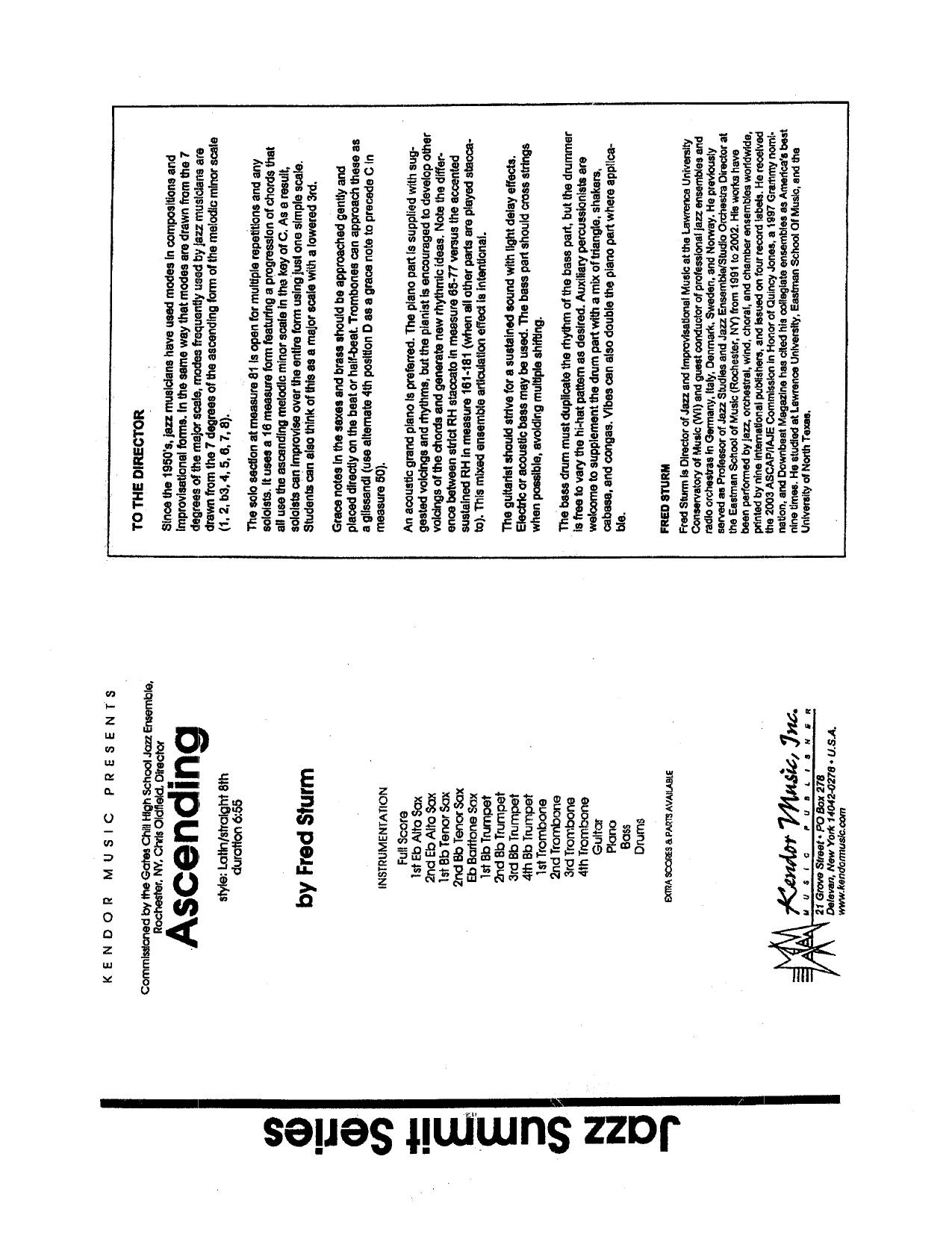
Ascending (F.Sturm) sheet music preview

Ascending (F.Sturm)

Composed by Fred Sturm

Arranged by Fred Sturm

  • Ensemble: Big Band
  • Pages: 98
  • Instruments (17): 1st Eb Alto Saxophone, 2nd Eb Alto Saxophone, 1st Bb Tenor Saxophone, 2nd Bb Tenor Saxophone, Eb Baritone Saxophone, 1st Bb Trumpet, 2nd Bb Trumpet, 3rd Bb Trumpet, 4th Bb Trumpet, 1st Trombone, 2nd Trombone, 3rd Trombone, 4th Trombone, Guitar, Piano, Bass, Drums
  • Difficulty: advanced
  • Content: Individual Parts
  • Format: PDF Download (Instant)
  • Price: $24.99

Fred Sturm’s "Ascending" stands as a monumental work within contemporary large jazz ensemble literature, showcasing the brilliant compositional and arranging mind of one of modern jazz education and composition's most revered figures. Written during Sturm's prolific tenure as a leading voice in progressive big band writing, the piece bridges the gap between traditional post-bop idioms and modern orchestral jazz composition. It represents an era where contemporary big bands pushed beyond standard swing-era constraints, embracing complex rhythmic metric modulations, dense harmonic structures, and intricate textural developments while maintaining an undeniable visceral groove. Driven by an energetic, forward-momentum contemporary groove, "Ascending" operates in a shifting tempo landscape that demands absolute precision and rhythmic agility from the entire ensemble. The mood is triumphant, intellectual, and relentlessly driving, evoking a sense of architectural elevation through its soaring melodic lines and cascading harmonic cycles. The piece opens with an atmospheric, tension-building intro before locking into a vibrant feel that tests the ensemble's collective internal clock. The emotional trajectory shifts seamlessly from introspective, harmonically suspended interludes to explosive, high-octane ensemble unisons that command the listener's complete attention. Sturm’s arranging approach is masterclass-level, utilizing advanced upper-structure triads, fourth-interval voicings, and polyrhythmic layering that bear his signature pedagogical and artistic depth. Rather than relying on standard block-voicing formulas, Sturm treats the 17-piece big band as a unified chamber orchestra where individual sections weave independent countermelodies. The woodwind doublings and brass colorations are meticulously calculated, featuring gorgeous sax solis that demand pristine intonation and fluid articulation. The climax builds toward a sophisticated, multi-layered shout chorus that avoids predictable resolutions, instead resolving through unexpected harmonic portals that keep both performers and audiences thoroughly engaged. Melodic duties are distributed fluidly across the ensemble, with prominent thematic statements shared between the trumpet and saxophone sections, underpinned by an interactive, modern rhythm section framework. The arrangement features open solo sections tailored for advanced improvisers—typically designated for tenor saxophone and piano—over sophisticated harmonic changes that challenge soloists to expand beyond diatonic thinking. Technical hurdles include rapid-fire unison lines, wide dynamic ranges, and complex metric shifts. However, the reward lies in the sheer architectural brilliance of the chart; every section gets a moment in the spotlight, and the comprehensive 98-page conductor score provides total transparency into Sturm's intricate scoring decisions. Advanced collegiate ensembles, top-tier youth jazz orchestras, and professional big bands will find "Ascending" to be an ideal centerpiece for ambitious concert programs and festival performances. Because of its sophisticated demands in balance, blend, and contemporary stylistic interpretation, it serves as an exceptional vehicle for groups looking to stretch their technical boundaries and explore the upper echelons of modern big band repertoire. Conductors tackling "Ascending" must first address the intricate rhythmic unisons that pepper the arrangement; absolute precision in articulation between the brass and saxophones is non-negotiable. Establish a rock-solid internal subdivision within the rhythm section before introducing the horn lines, as the tempo fluctuations and shifting metric feels require a unified collective pulse. The drummer should approach the groove with a modern, interactive sensibility—balancing crisp, driving ride cymbal work with dynamic snare and tom accents that mirror the ensemble's angular figures without overplaying. Saxophone players must ensure that internal balance within the soli sections highlights the lead alto voice while maintaining a dark, cohesive ensemble blend. Brass players should practice their high-register entrances with careful attention to dynamic control, avoiding forced tones during the soaring climactic passages. Rehearsal time is best spent isolating the complex transitional interludes, ensuring that the ensemble breathes together and transitions smoothly between the aggressive, rhythmic peaks and the spacious, atmospheric valleys. Q: What instruments and parts are included in this arrangement? A: The chart is scored for a standard 17-instrument big band lineup comprising 5 saxophones (Alto 1, Alto 2, Tenor 1, Tenor 2, Baritone), 4 trumpets, 4 trombones, piano, guitar, bass, and drums, alongside a comprehensive conductor score. Q: What is the difficulty level of Fred Sturm's "Ascending"? A: This arrangement is designated for advanced ensembles, making it best suited for elite university jazz bands, professional orchestras, and top-tier high school groups with strong technical proficiency. Q: What is the musical style and historical background of this piece? A: Composed in the contemporary post-bop and progressive big band idiom, the piece reflects Fred Sturm's signature style of combining complex modern harmony with high-energy, driving orchestral jazz. Q: What makes this specific big band arrangement unique? A: Its uniqueness lies in Sturm's sophisticated orchestration, which utilizes advanced fourth-interval voicings, intricate metric interplay, and an expansive 98-page score that treats the big band like a modern chamber orchestra. Q: What is the performance duration and tempo feel of the arrangement? A: While performance time can vary based on individual solo stretch lengths, the piece averages around 6 to 7 minutes and features an energetic, fast-moving contemporary groove with dynamic tempo flexibility.

Questions and answers

What is included in the Ascending (F.Sturm) PDF?
The verified current file contains a conductor score and individual parts across 98 pages.
How many instruments or parts are listed for Ascending (F.Sturm)?
The verified instrumentation list contains 17 entries for this Big Band arrangement.
Who is credited for Ascending (F.Sturm)?
Composer: Fred Sturm. Arranger: Fred Sturm.
What difficulty is listed for Ascending (F.Sturm)?
The verified difficulty level is advanced.
Can I preview Ascending (F.Sturm) before buying?
Yes. The product page provides a preview generated from the current PDF file.
How is Ascending (F.Sturm) delivered?
After successful payment, the digital PDF is made available for download. The displayed price is $24.99.

Musicians Also Search For

Ascending Fred Sturm PDFAscending Fred Sturm sheet musicAscending arranged by Fred SturmFred Sturm big band chartsFred Sturm jazz arrangements PDFAscending Fred Sturm big band arrangementsAscending big band arrangementsAscending big band PDF downloadAscending jazz sheet musicbig band sheet music downloadAscending conductor score PDFAscending individual parts downloadAscending sheet music PDFbuy Ascending sheet musicdownload Ascending PDFAscending jazz chartsbest Fred Sturm big band arrangementsAscending printable sheet musicbig band repertoire PDF

All arrangements by Fred Sturm All Fred Sturm sheet music