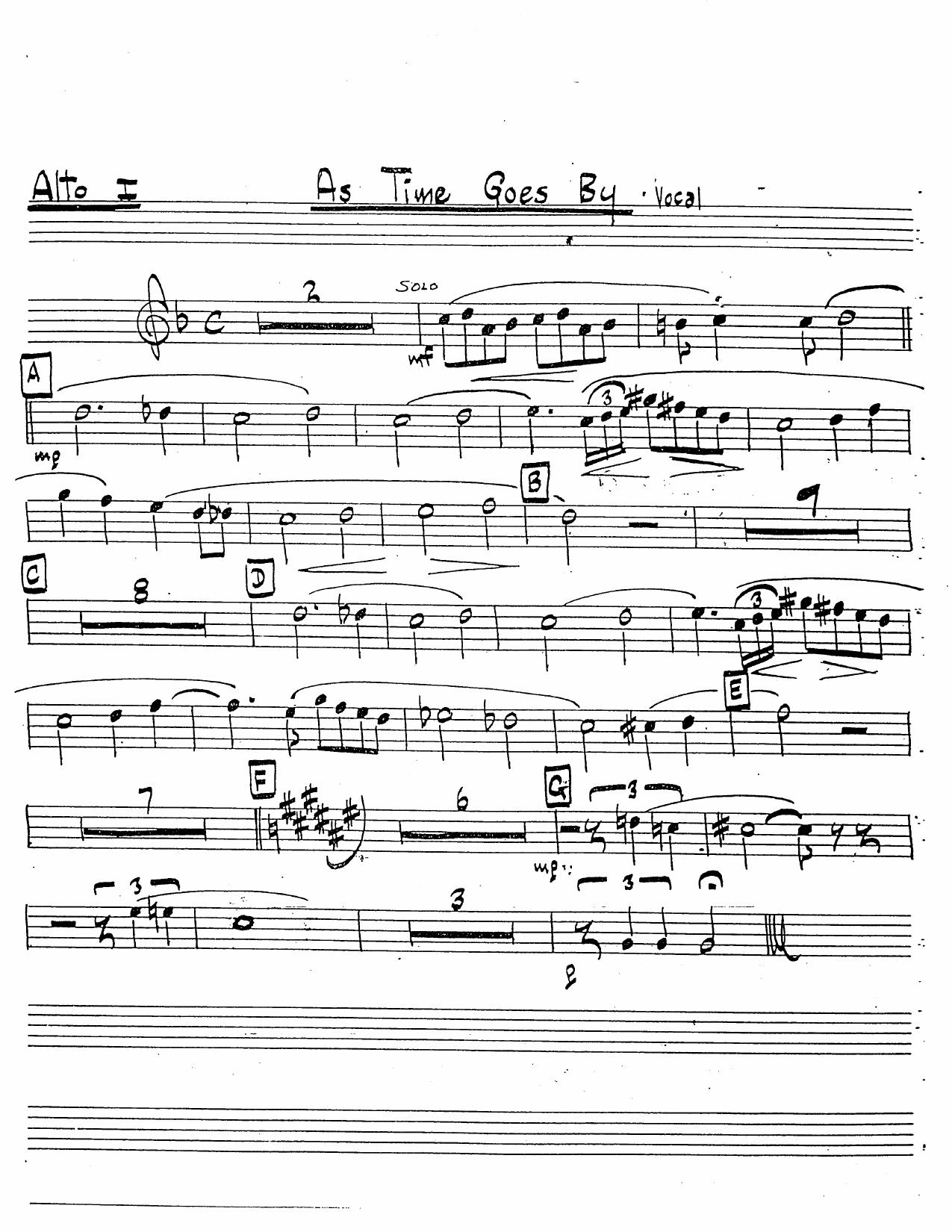
As Time Goes By (J.Farley)
Composed by Herman Hupfeld
Arranged by John Farley
- Ensemble: Big Band
- Pages: 22
- Instruments (18): Alto Saxophone I, Alto Saxophone II, Tenor Saxophone I, Tenor Saxophone II, Baritone Saxophone, Trumpet I, Trumpet II, Trumpet III, Trumpet IV, Trombone I, Trombone II, Trombone III, Trombone IV, Piano, Bass, Drums, Guitar, Vocal
- Difficulty: medium
- Content: Individual Parts
- Format: PDF Download (Instant)
- Price: $24.99
Herman Hupfeld penned "As Time Goes By" in 1931 for the Broadway musical *Everybody's Welcome*, but immortalized forever by its inclusion in the 1942 cinematic masterpiece *Casablanca*, the tune stands as one of the quintessential pillars of the American Songbook. Originally interpreted as a poignant ballad, the composition transitioned effortlessly into the jazz idiom, embraced by vocalists and instrumentalists alike who found rich harmonic terrain within its romantic framework. Its enduring appeal lies in a deceptively simple AABA form coupled with sophisticated chord progressions that invite both intimate rubato styling and deeply expressive, lyrical swing interpretations. John Farley’s sophisticated big band adaptation reframes Hupfeld’s timeless melody as a lush, expressive ballad with a pulsing, subtle underlying swing feel that gives the chart forward momentum without sacrificing its inherent nostalgia. Opening with a atmospheric, rubato chordal intro featuring shimmering upper-structure voicings in the saxophones, the arrangement quickly establishes a warm, velvety mood anchored by rich brass countermelodies. Farley employs dense, modern extended harmonies reminiscent of the Thad Jones or Bill Holman schools of writing, utilizing stacked ninths and elevenths to color the familiar changes. The harmonic language breathes new life into the standard without alienating traditionalists, offering a masterclass in chord-voicing economy and dynamic contrast. Throughout the chart, melodic responsibility is shared fluidly across the ensemble, transitioning from a sultry muted trumpet statement to a full-ensemble sax soli that highlights the rich textures of the 17-piece instrumentation. A soaring, expressive solo space is provided for tenor saxophone or flugelhorn, allowing a featured soloist to navigate sweeping lyrical lines over a supportive, harmonically rich background pad. The climax builds organically into a restrained, emotionally resonant shout chorus that prioritizes warmth and blend over sheer volume, before tapering down to a delicate, lingering final chord that leaves a profound impression on the listener. Advanced high school, collegiate, and professional jazz ensembles will find this chart an exceptional vehicle for developing ensemble intonation, dynamic control, and stylistic maturity. Because the arrangement relies heavily on subtle rubato pacing, sectional balance, and sophisticated phrasing rather than sheer velocity, it serves as an ideal program centerpiece for showcasing a band's refined musicality and interpretive depth. Achieving success with this arrangement requires meticulous attention to dynamic shading and a unified concept of time, even during rubato passages. The conductor should treat the tempo as fluid yet grounded, ensuring that the transition from free-form introductory sections into the core pulse feels organic and unforced. Intonation is a primary technical challenge, particularly in the sax soli and dense brass block voicings; players must lock in their tuning on altered dominants and extended maj9 chords. Balance is critical—the rhythm section, especially the piano and guitar, should voice chords sparsely, leaving ample sonic space for the horns. No specialized mute effects like plungers are required, but standard cup and straight mutes should be utilized in the trumpet section to achieve the desired vintage warmth during the head. Rehearsal should begin by isolating the harmonized saxophone lines separately from the rhythm section to lock in blend, followed by careful balancing of the background figures underneath the featured soloist. Q: What instruments and parts are included in this big band arrangement? A: The 17-instrument orchestration includes a standard big band lineup: Alto Saxophone 1 & 2, Tenor Saxophone 1 & 2, Baritone Saxophone, 4 Trumpets (with doubling options), 4 Trombones, Piano, Guitar, Bass, and Drums, spread across a comprehensive 22-page score and parts set. Q: What is the difficulty level of this chart? A: This arrangement is rated as medium-advanced (Grade 4), making it well-suited for proficient high school jazz ensembles, university bands, and professional community big bands seeking a sophisticated ballad challenge. Q: Does this arrangement stay true to the traditional jazz standard style? A: While rooted in the classic 1931 Herman Hupfeld composition made famous during the swing era, John Farley infuses the chart with modern harmonic extensions and lush, contemporary big band arranging techniques. Q: What makes John Farley’s arrangement unique compared to other versions? A: This chart stands out through its masterclass use of upper-structure voicings, a flowing transition between rubato expression and subtle swing momentum, and a richly textured sax soli that reinterprets the familiar melody. Q: What is the recommended performance tempo and duration? A: The piece is performed at a relaxed, expressive ballad tempo (around 68-72 BPM) with a flowing feel, resulting in a total performance duration of approximately 4 to 5 minutes depending on solo extensions.
Questions and answers
- What is included in the As Time Goes By (J.Farley) PDF?
- The verified current file contains individual parts across 22 pages.
- How many instruments or parts are listed for As Time Goes By (J.Farley)?
- The verified instrumentation list contains 18 entries for this Big Band arrangement.
- Who is credited for As Time Goes By (J.Farley)?
- Composer: Herman Hupfeld. Arranger: John Farley.
- What difficulty is listed for As Time Goes By (J.Farley)?
- The verified difficulty level is medium.
- Can I preview As Time Goes By (J.Farley) before buying?
- Yes. The product page provides a preview generated from the current PDF file.
- How is As Time Goes By (J.Farley) delivered?
- After successful payment, the digital PDF is made available for download. The displayed price is $24.99.
Musicians Also Search For
As Time Goes By John Farley PDF • As Time Goes By John Farley sheet music • As Time Goes By arranged by John Farley • John Farley big band charts • John Farley jazz arrangements PDF • As Time Goes By Herman Hupfeld sheet music • As Time Goes By Herman Hupfeld big band arrangements • Herman Hupfeld big band charts • As Time Goes By big band arrangements • As Time Goes By big band PDF download • As Time Goes By jazz sheet music • big band sheet music download • As Time Goes By individual parts download • As Time Goes By sheet music PDF • buy As Time Goes By sheet music • download As Time Goes By PDF • As Time Goes By jazz charts • best John Farley big band arrangements • Herman Hupfeld arranged by John Farley • As Time Goes By printable sheet music • big band repertoire PDF