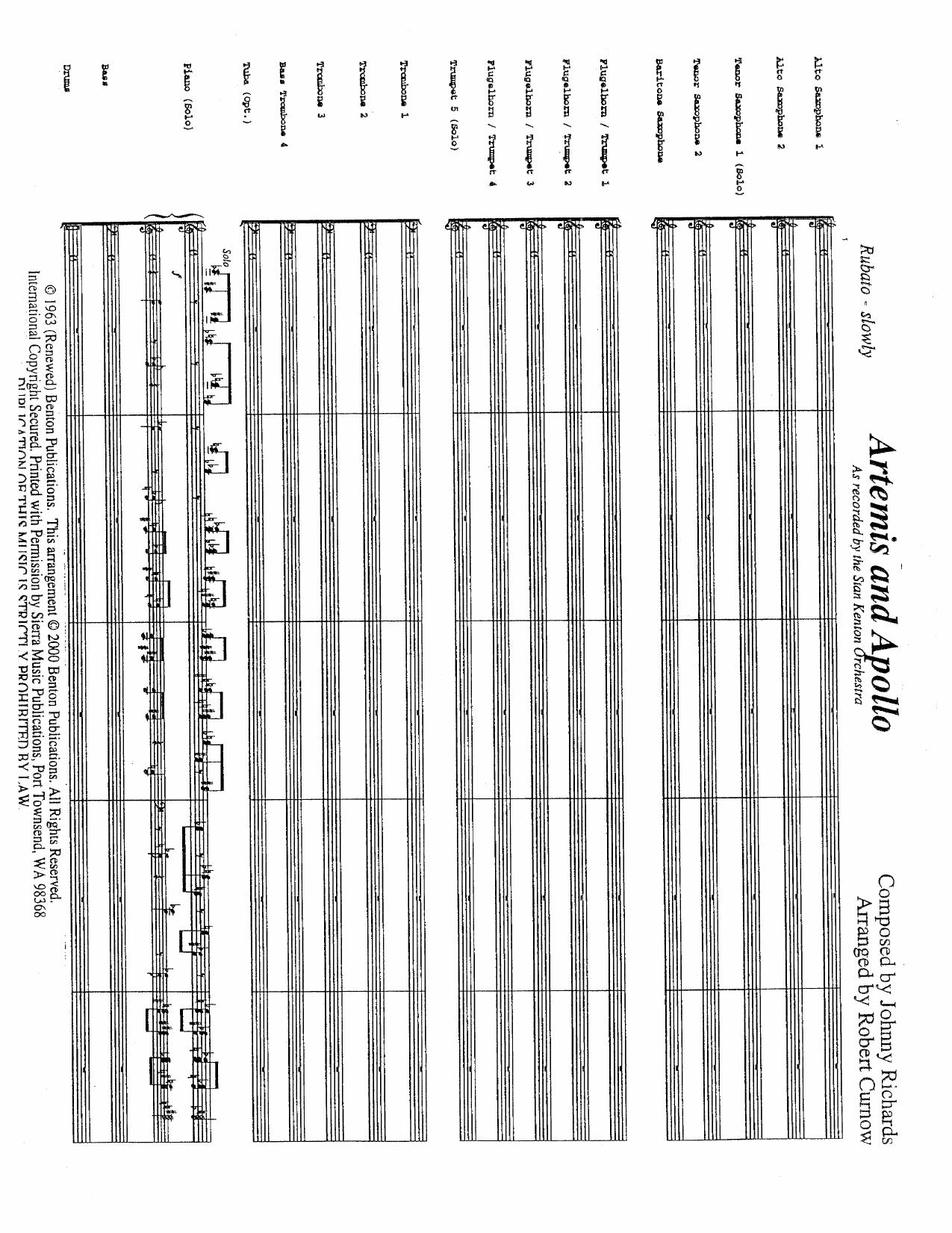
Artemis And Apollo (B.Curnow)
Composed by Bob Curnow
Arranged by Bob Curnow
- Ensemble: Big Band
- Pages: 49
- Instruments (18): Alto Saxophone 1, Alto Saxophone 2, Tenor Saxophone 1 (Solo), Tenor Saxophone 2, Baritone Saxophone, Flugelhorn / Trumpet 1, Flugelhorn / Trumpet 2, Flugelhorn / Trumpet 3, Flugelhorn / Trumpet 4, Trumpet 5 (Solo), Trombone 1, Trombone 2, Trombone 3, Bass Trombone 4, Tuba (Opt.), Piano (Solo), Bass, Drums
- Difficulty: medium
- Content: Individual Parts
- Format: PDF Download (Instant)
- Price: $24.99
Composed and structured within the rich tradition of progressive modern big band jazz, Bob Curnow’s original work reflects the sophisticated harmonic vocabulary and dynamic large-ensemble architecture associated with his legendary tenure as a staff arranger and producer for the Stan Kenton Orchestra. Emerging from an era where contemporary jazz composition increasingly embraced lush orchestral textures, expanded modal harmonies, and intricate rhythmic motifs, the piece stands as a masterclass in modern big band writing. Curnow draws heavily upon the stylistic blueprints established by West Coast jazz luminaries, blending cinematic scope with hard-driving swing momentum and intricate, contemporary voicings that challenge both the intellect and technical capabilities of the ensemble. The musical character is defined by a captivating blend of driving swing grooves and expansive, lyrical passages. Operating primarily in a moderate-to-up tempo 4/4 feel, the composition transitions seamlessly between thunderous, full-ensemble shout choruses and delicate, transparent interludes. The harmonic language features extended and altered chords—major sevenths, sharp-elevated ninths, and suspended fourths—that evoke a mood of profound introspection juxtaposed with moments of explosive, high-octane exhilaration. The emotional arc moves effortlessly from mysterious, evocative tension to triumphant release, creating a narrative journey that immediately commands the attention of both listeners and performers. Curnow’s arranging approach is immediately recognizable through his meticulous attention to section writing and voice-leading. Eschewing formulaic block chords, he utilizes counterpoint, independent horn movement, and dense, lush brass clusters offset by agile woodwind runs. The saxophones—comprising two altos, two tenors, and a baritone—frequently act as a cohesive harmonic and melodic unit, weaving intricate lines beneath brass punctuations. The arrangement features sophisticated soli sections that highlight the intrinsic warmth of the lower registers while permitting the upper brass to soar with commanding brilliance, reflecting Curnow's signature capability to maximize the color palette of an 18-instrument big band. Melodic responsibility is distributed dynamically across the entire ensemble, ensuring that every section plays a pivotal role in shaping the performance. Solo opportunities are integrated organically into the structure, allowing featured improvisers to stretch out over sophisticated harmonic changes. Technically, the chart demands precision in articulation, excellent intonation in dense chordal passages, and clean execution of syncopated rhythms. Advanced high school, collegiate, and professional jazz ensembles will find this 49-page publication an exceptionally rewarding centerpiece for festival competition or concert programming, offering a masterclass in ensemble balance, dynamic control, and advanced contemporary big band interpretation. Achieving success with this chart requires meticulous attention to dynamic contrast and articulation balance. The tempo should be kept steady and authoritative, ensuring the underlying groove breathes without rushing during dense ensemble passages. * **Rhythmic Precision:** Clean execution of syncopated figures between the brass and saxophones is paramount. Ensure that short notes are clipped uniformly and sustained lines maintain a warm, centered core of sound. * **Balance and Blend:** Because Curnow’s voicings are densely layered with extended harmonies, inner voices must listen down and across the ensemble to allow secondary counter-melodies to pierce through the texture without masking the primary lead line. * **Brass Demands:** Trumpets and trombones should approach high-register passages with a controlled, vocal tone rather than forced volume. Utilize natural, warm vibrato on ballad-esque interludes and crisp, targeted attacks on accented punctuations. * **Rehearsal Strategy:** Isolate the complex soli sections at slow tempos before locking in the final performance pulse. Pay close attention to subtle dynamic markings in the conductor score to map out the dramatic peaks and valleys effectively. Q: What instruments and parts are included in this arrangement? A: This 49-page publication includes a comprehensive conductor score alongside 18 individual instrument parts: two alto saxophones, two tenor saxophones, baritone saxophone, standard brass configurations, and rhythm section charts. Q: What is the difficulty level of this chart? A: This arrangement is graded as advanced, making it best suited for accomplished collegiate, professional, and top-tier high school jazz ensembles with strong section players and confident soloists. Q: What is the musical style and historical context of the piece? A: Written by renowned arranger Bob Curnow, the piece represents modern progressive big band jazz, drawing heavily on the sophisticated West Coast arranging traditions associated with the Stan Kenton legacy. Q: What makes this particular Bob Curnow arrangement unique? A: It showcases Curnow’s signature approach to lush extended harmonies, intricate counterpoint, and dynamic shifting between transparent woodwind textures and massive, roaring brass shout choruses. Q: What are the performance duration and tempo guidelines for this arrangement? A: The chart operates in a steady, driving 4/4 meter at a medium-up tempo, designed to span roughly 4 to 6 minutes depending on the length of the improvised solo choruses taken during the performance.
Questions and answers
- What is included in the Artemis And Apollo (B.Curnow) PDF?
- The verified current file contains a conductor score and individual parts across 49 pages.
- How many instruments or parts are listed for Artemis And Apollo (B.Curnow)?
- The verified instrumentation list contains 18 entries for this Big Band arrangement.
- Who is credited for Artemis And Apollo (B.Curnow)?
- Composer: Bob Curnow. Arranger: Bob Curnow.
- What difficulty is listed for Artemis And Apollo (B.Curnow)?
- The verified difficulty level is medium.
- Can I preview Artemis And Apollo (B.Curnow) before buying?
- Yes. The product page provides a preview generated from the current PDF file.
- How is Artemis And Apollo (B.Curnow) delivered?
- After successful payment, the digital PDF is made available for download. The displayed price is $24.99.
Musicians Also Search For
Artemis And Apollo Bob Curnow PDF • Artemis And Apollo Bob Curnow sheet music • Artemis And Apollo arranged by Bob Curnow • Bob Curnow big band charts • Bob Curnow jazz arrangements PDF • Artemis And Apollo Bob Curnow big band arrangements • Artemis And Apollo big band arrangements • Artemis And Apollo big band PDF download • Artemis And Apollo jazz sheet music • big band sheet music download • Artemis And Apollo conductor score PDF • Artemis And Apollo individual parts download • Artemis And Apollo sheet music PDF • buy Artemis And Apollo sheet music • download Artemis And Apollo PDF • Artemis And Apollo jazz charts • best Bob Curnow big band arrangements • Artemis And Apollo printable sheet music • big band repertoire PDF