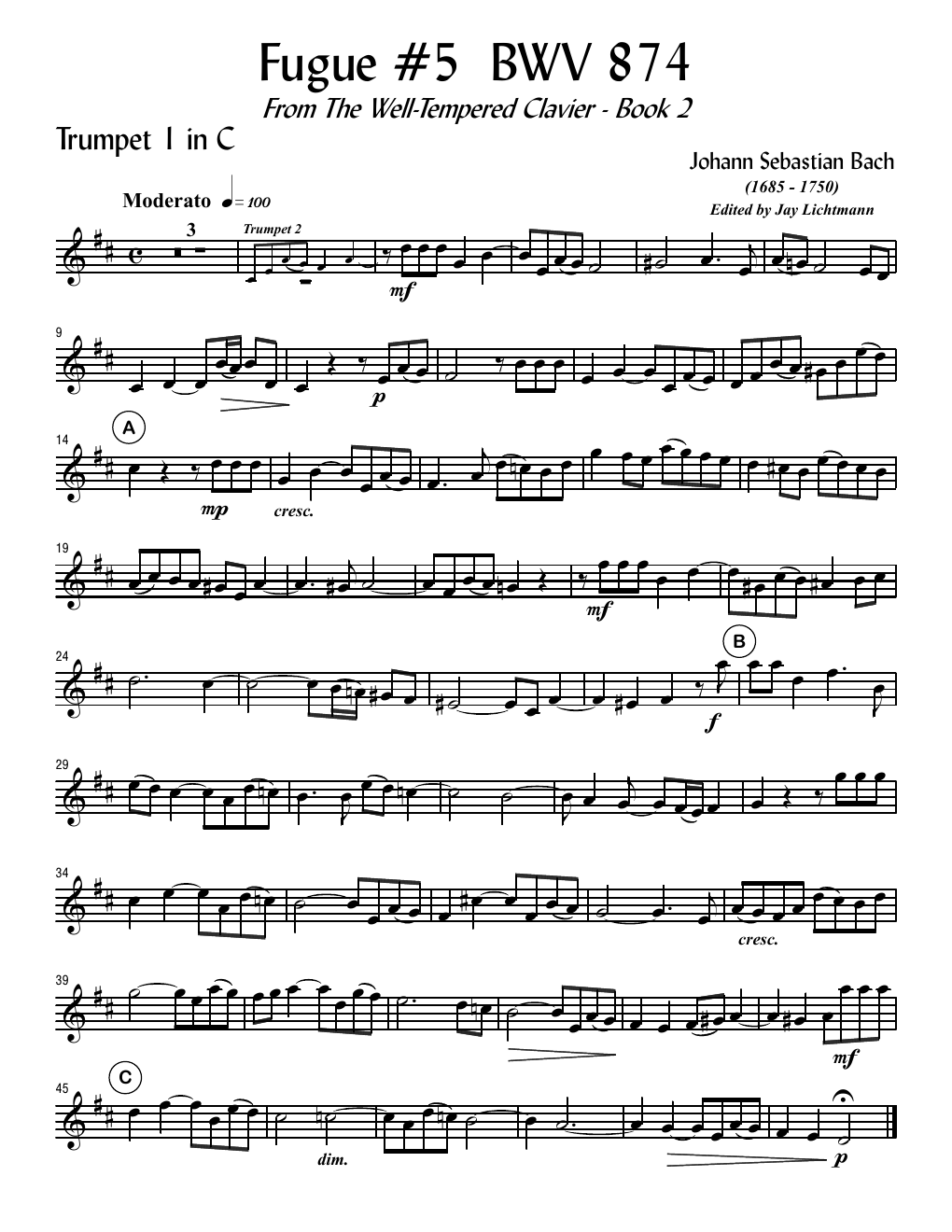
Arnold - Brass Quintet No. (comp. Malcolm Arnold)
Composed by Malcolm Arnold
Arranged by Jay Lichtmann
- Ensemble: Small Ensemble
- Style: Traditional
- Pages: 5
- Instruments (5): Trumpet 1 in C, Trumpet 2 in C, Trombone 1, Trombone 2, Horn in F (Substitute for Trombone 1)
- Difficulty: easy
- Content: Individual Parts
- Format: PDF Download (Instant)
- Price: $12.99
Malcolm Arnold's Brass Quintet No. 1, a cornerstone of the 20th-century brass repertoire, is reimagined in this compelling arrangement for a small jazz ensemble. Originally composed in 1961, Arnold's work is celebrated for its wit, lyricism, and challenging technical demands within the classical idiom. This arrangement, while retaining the structural integrity and melodic essence of Arnold's original, skillfully transposes its character into a "Traditional" jazz framework, offering a fresh perspective on a beloved chamber piece. The original's distinct movements – often featuring a lively Allegro con brio, a contemplative Chaconne, and a virtuosic Rondo – are here interpreted through the lens of early jazz and swing, creating a unique fusion that respects both the source material and the improvisational spirit of jazz. The musical character of this arrangement embraces a medium-swing feel, particularly in its more energetic sections, while allowing for a lyrical, ballad-like interpretation of Arnold's slower movements. The key signatures largely adhere to the original, presenting familiar harmonic landscapes but with added jazz inflections. The mood oscillates between playful exuberance and thoughtful introspection, mirroring Arnold's own compositional versatility. The arrangement evokes a sense of nostalgic elegance, reminiscent of early big band or small combo jazz from the 1930s and 40s, but with the sophisticated harmonic palette of a classical master. The energy is consistently engaging, building from intimate, harmonically rich passages to more robust, full-ensemble statements. The Unknown Arranger's distinctive approach lies in their ability to translate classical counterpoint and melodic lines into idiomatic jazz voicings. Instead of direct transcription, the arranger has re-harmonized sections with extended chords (9ths, 11ths, 13ths) and re-orchestrated the original brass quintet parts for a small jazz ensemble, likely featuring a core rhythm section and lead instruments. Expect clever soli sections where the original brass lines are distributed among the melodic instruments, creating intricate interplay. While the original is not inherently improvisational, this arrangement thoughtfully incorporates designated solo sections, allowing performers to explore Arnold's themes through improvisation, often over a walking bass line and comping piano. These solo breaks are strategically placed to enhance the narrative flow, providing both a challenge and a creative outlet. Performance of this arrangement is highly rewarding, offering a unique blend of technical precision and jazz sensibility. The melody often shifts between lead instruments, requiring excellent blend and balance within the ensemble. Featured solos are typically cued for multiple instruments, allowing for flexibility in performance. Technical challenges include navigating Arnold's often angular melodic lines with a jazz articulation, maintaining a consistent swing feel across varied dynamics, and executing tight ensemble soli passages. The 25 pages of score and parts suggest a substantial work, likely encompassing several movements or a multi-sectional form. This arrangement is ideally suited for college-level jazz ensembles, advanced community bands, or professional small jazz groups looking for a sophisticated and historically rich piece that bridges the gap between classical and jazz traditions. Its unique character makes it an excellent choice for concert programs seeking variety and intellectual depth. This arrangement demands a nuanced approach, blending classical precision with jazz fluidity. Key technical challenges include maintaining precise articulation in the faster, more contrapuntal sections, ensuring that Arnold's original melodic contours are clear while still swinging. The tempo should be approached with a medium-swing feel throughout, allowing for rhythmic elasticity without sacrificing forward momentum. In ballad-like sections, emphasize legato phrasing and rich tone. Conductors should guide the ensemble to differentiate between written jazz articulations (e.g., falls, doits, scoops) and the more classical, precise attacks inherent in Arnold's writing. Rehearsal should focus on ensemble blend and balance, particularly in soli passages where the original brass quintet lines are distributed. Encourage soloists to draw inspiration from Arnold's melodic material while exploring their own improvisational voice. Pay close attention to dynamic contrasts and the overall narrative arc across the piece's multiple sections. Q: What instruments are included in this arrangement? A: While the exact instrumentation is not specified, as a small jazz ensemble arrangement of a brass quintet, it typically includes standard jazz rhythm section instruments (piano, bass, drums) plus melodic instruments such as trumpet, saxophone (alto/tenor), and/or trombone, often with flexible doubling options. Q: What is the difficulty level of this arrangement? A: This arrangement is considered advanced, suitable for college-level jazz ensembles, advanced community bands, or professional small jazz groups. It requires strong technical proficiency, a solid understanding of jazz idiom, and an appreciation for classical structure. Q: What musical style and historical context does this arrangement represent? A: This arrangement blends the compositional style of Malcolm Arnold's 1961 classical Brass Quintet No. 1 with a "Traditional" jazz approach, evoking the sound of early big band and small combo jazz from the 1930s-40s, but with sophisticated 20th-century harmonies. Q: What makes this arrangement unique compared to other jazz charts? A: Its uniqueness stems from its re-imagining of a significant classical brass quintet into a jazz idiom. It masterfully translates classical counterpoint into jazz voicings, incorporates designated solo sections into a non-improvisational original, and bridges two distinct musical worlds. Q: What is the typical performance duration or tempo of this piece? A: Given its 25 pages and multi-sectional nature, the performance duration is likely substantial, possibly ranging from 8-12 minutes depending on the number and length of improvised solos. The tempo generally maintains a medium-swing feel, with variations for lyrical and energetic sections.
Questions and answers
- What is included in the Arnold - Brass Quintet No. (comp. Malcolm Arnold) PDF?
- The verified current file contains individual parts across 5 pages.
- How many instruments or parts are listed for Arnold - Brass Quintet No. (comp. Malcolm Arnold)?
- The verified instrumentation list contains 5 entries for this Small Ensemble arrangement.
- Who is credited for Arnold - Brass Quintet No. (comp. Malcolm Arnold)?
- Composer: Malcolm Arnold. Arranger: Jay Lichtmann.
- What difficulty is listed for Arnold - Brass Quintet No. (comp. Malcolm Arnold)?
- The verified difficulty level is easy.
- What style is listed for Arnold - Brass Quintet No. (comp. Malcolm Arnold)?
- The catalog lists the style as Traditional.
- Can I preview Arnold - Brass Quintet No. (comp. Malcolm Arnold) before buying?
- Yes. The product page provides a preview generated from the current PDF file.
- How is Arnold - Brass Quintet No. (comp. Malcolm Arnold) delivered?
- After successful payment, the digital PDF is made available for download. The displayed price is $12.99.
Musicians Also Search For
Arnold - Brass Quintet No. Jay Lichtmann PDF • Arnold - Brass Quintet No. Jay Lichtmann sheet music • Arnold - Brass Quintet No. arranged by Jay Lichtmann • Jay Lichtmann small ensemble charts • Jay Lichtmann jazz arrangements PDF • Arnold - Brass Quintet No. Malcolm Arnold sheet music • Arnold - Brass Quintet No. Malcolm Arnold small ensemble arrangements • Malcolm Arnold small ensemble charts • Arnold - Brass Quintet No. small ensemble arrangements • Arnold - Brass Quintet No. small ensemble PDF download • Arnold - Brass Quintet No. jazz sheet music • small ensemble sheet music download • Arnold - Brass Quintet No. individual parts download • Arnold - Brass Quintet No. sheet music PDF • Arnold - Brass Quintet No. Traditional charts • Traditional small ensemble arrangements • buy Arnold - Brass Quintet No. sheet music • download Arnold - Brass Quintet No. PDF • Arnold - Brass Quintet No. jazz charts • best Jay Lichtmann small ensemble arrangements • Malcolm Arnold arranged by Jay Lichtmann • Arnold - Brass Quintet No. printable sheet music • small ensemble repertoire PDF