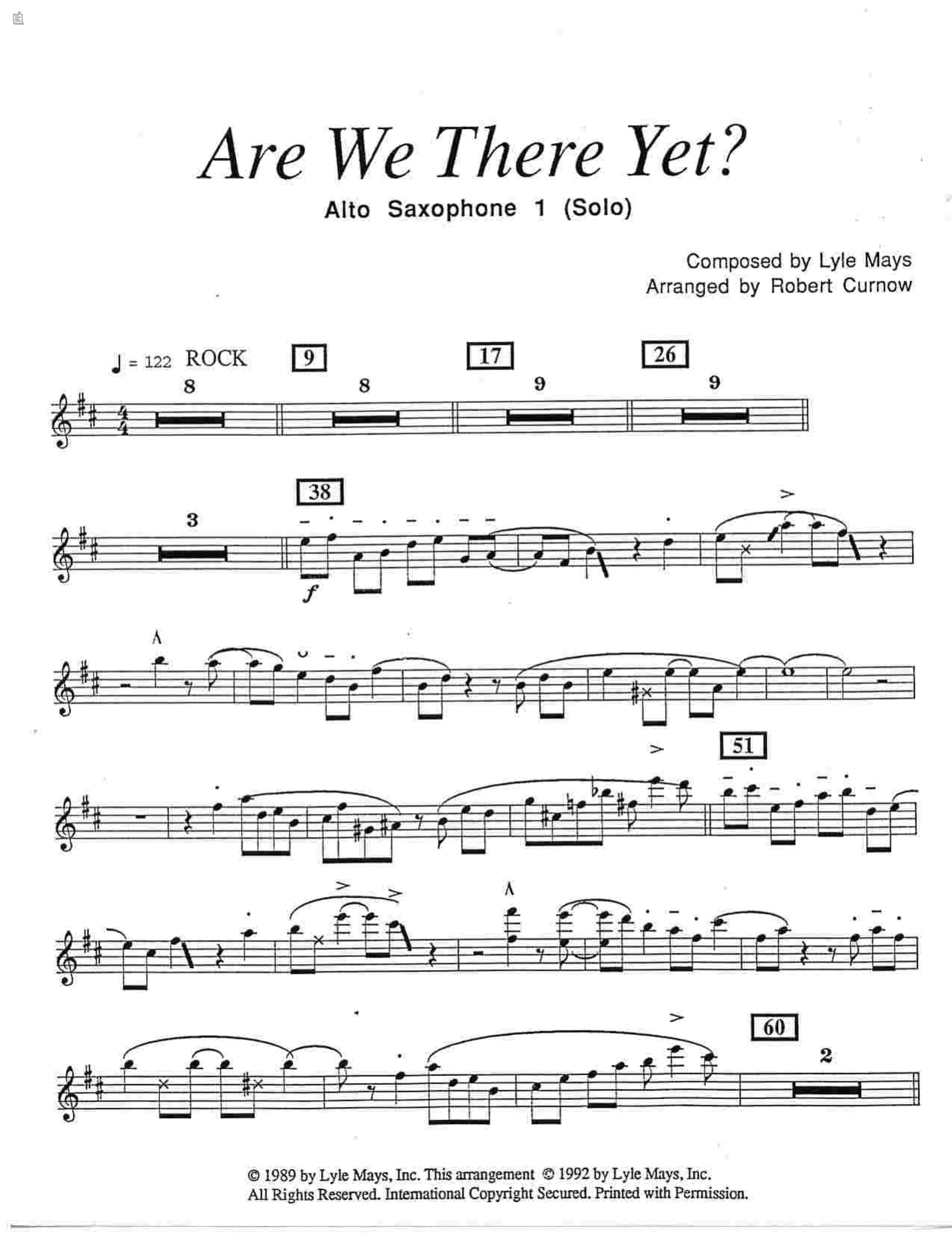
Are We There Yet (B.Curnow)
Composed by Bob Curnow
Arranged by Bob Curnow
- Ensemble: Big Band
- Pages: 54
- Instruments (17): Alto Saxophone 1 (Solo), Alto Saxophone 2 / Clarinet, Tenor Saxophone 1 / Clarinet and Triangle, Tenor Saxophone 2 / Clarinet and Anvil (pipe), Baritone Saxophone / Clarinet, Trumpet 1 / Flugelhorn, Trumpet 2 / Flugelhorn, Trumpet 3 / Flugelhorn, Trumpet 4 / Flugelhorn, Trombone 1, Trombone 2, Trombone 3, Bass Trombone 4, Synthesizer Keyboard, Guitar / Temple Blocks, Bass, Drums
- Difficulty: advanced
- Content: Individual Parts
- Format: PDF Download (Instant)
- Price: $24.99
Originally composed by keyboard virtuoso Lyle Mays for the Pat Metheny Group, "Are We There Yet" represents the pinnacle of late-20th-century contemporary jazz-rock fusion. First brought to life on landmark recordings, the composition captures the quirky, high-octane harmonic language and adventurous spirit that defined the Metheny-Mays collaborative output. Transformed into a powerhouse big band chart by veteran arranger and producer Bob Curnow, the piece bridges the gap between intricate progressive fusion and the bombastic traditions of powerhouse modern jazz orchestras. Driven by an explosive funk-rock groove in 4/4 time, the musical character is relentless, quirky, and electric with youthful adrenaline. Curnow’s arrangement exploits a vibrant color palette, utilizing dense, extended modal harmonies, playful syncopated motifs, and striking dynamic contrasts that alternate between punchy ensemble hits and wide-open, soaring textures. The emotional trajectory moves from edgy anticipation to ecstatic release, making it a masterclass in modern rhythmic tension. Curnow approaches the material with deep respect for Mays' original keyboard voicings while aggressively scaling up the textures for a 16-piece modern big band. The chart features thick brass scoring—calibrated for standard or expanded setups—interspersed with clever woodwind doublings and driving rhythm section patterns. Curnow avoids predictable patterns, employing angular horn solis and cascading counterlines that require precision articulation. The harmonic framework pushes beyond standard functional jazz changes, incorporating "out" sounds and dense clusters that demand careful tuning and acute vertical listening from every section. The tenor saxophone and trumpet sections take center stage, carrying the primary melodic weight alongside prominent featured solo space for tenor saxophone. Technical challenges abound, particularly in the rhythm section and lower horns, which must anchor a driving, interlocking funk feel while executing rapid-fire unison lines. The rhythm section parts—featuring essential synthesizer/keyboard and guitar components—are crucial for replicating the authentic Pat Metheny Group electronic-acoustic blend. Advanced high school, collegiate, and professional jazz ensembles will find this chart an exhilarating centerpiece for concerts and festival programs. Because it demands precise execution of complex fusion rhythms and mature stylistic awareness, it offers immense educational and artistic rewards for groups ready to venture beyond mainstream swing repertoire. Success with this chart depends heavily on establishing an unyielding, locked-in funk-rock groove right from the downbeat. The rhythm section—specifically drums, electric/acoustic bass, and guitar—must drive the tempo with authority, treating syncopated figures with strict metric precision rather than a laid-back swing feel. Key technical challenges include executing the fast, angular unison lines cleanly across the saxes and brass. Conductors should isolate tricky multi-measure rhythmic figures during sectional rehearsals, ensuring that articulation markings (staccatos, accents, and roof accents) are matched identically across all chairs. Special attention must be paid to the synthesizer and keyboard parts, which provide the shimmering, textural backdrop essential to capturing Lyle Mays' signature harmonic atmosphere. Horn players should approach "out" harmonic passages with confidence, listening closely across sections to balance altered chord extensions. Encourage soloists to lean into the modern, high-energy fusion vocabulary rather than relying solely on traditional bebop licks. Q: What instruments and parts are included in this arrangement? A: The 54-page publication includes a full conductor's score and complete parts for 16 instruments: 2 altos (with optional clarinet/doubles), 2 tenors (with optional clarinet/doubles), 1 baritone sax, 4 trumpets (doubling flugelhorn), 4 trombones (including bass trombone), synthesizer keyboard, guitar, bass, and drums. Q: What is the difficulty level of this chart? A: This arrangement is graded as advanced (medium-advanced to advanced), making it best suited for accomplished high school all-state bands, collegiate ensembles, and professional big bands. Q: What is the musical style and historical background of the piece? A: It is an energetic jazz-rock fusion chart written by Lyle Mays, famously adapted by Bob Curnow from the contemporary jazz repertoire of the Pat Metheny Group. Q: What makes this specific Bob Curnow arrangement unique? A: Curnow brilliantly translates complex, keyboard-driven progressive fusion into a high-octane big band idiom, retaining the quirky harmonies, intricate counterpoint, and driving rock energy of the original recording. Q: Is there a featured soloist and what is the approximate duration? A: The arrangement features prominent solo space designed primarily for the tenor saxophone, alongside robust ensemble features, with a performance duration of approximately 5 minutes.
Questions and answers
- What is included in the Are We There Yet (B.Curnow) PDF?
- The verified current file contains individual parts across 54 pages.
- How many instruments or parts are listed for Are We There Yet (B.Curnow)?
- The verified instrumentation list contains 17 entries for this Big Band arrangement.
- Who is credited for Are We There Yet (B.Curnow)?
- Composer: Bob Curnow. Arranger: Bob Curnow.
- What difficulty is listed for Are We There Yet (B.Curnow)?
- The verified difficulty level is advanced.
- Can I preview Are We There Yet (B.Curnow) before buying?
- Yes. The product page provides a preview generated from the current PDF file.
- How is Are We There Yet (B.Curnow) delivered?
- After successful payment, the digital PDF is made available for download. The displayed price is $24.99.
Musicians Also Search For
Are We There Yet Bob Curnow PDF • Are We There Yet Bob Curnow sheet music • Are We There Yet arranged by Bob Curnow • Bob Curnow big band charts • Bob Curnow jazz arrangements PDF • Are We There Yet Bob Curnow big band arrangements • Are We There Yet big band arrangements • Are We There Yet big band PDF download • Are We There Yet jazz sheet music • big band sheet music download • Are We There Yet individual parts download • Are We There Yet sheet music PDF • buy Are We There Yet sheet music • download Are We There Yet PDF • Are We There Yet jazz charts • best Bob Curnow big band arrangements • Are We There Yet printable sheet music • big band repertoire PDF