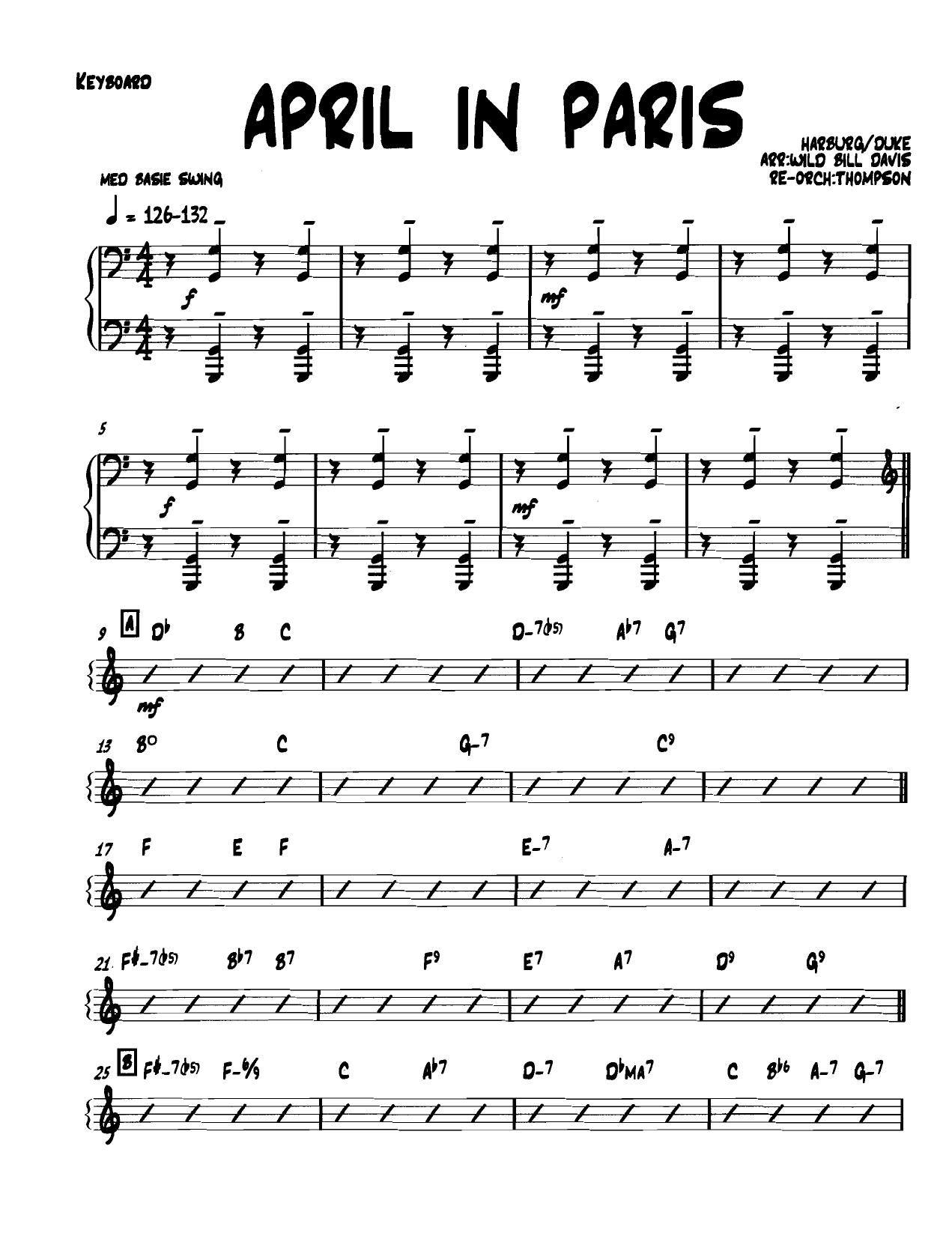
Aprilinparis Keyboard (W.Thompson)
Composed by E.Y. Harburg and Vernon Duke
Arranged by Wild Bill Davis, Thompson
- Ensemble: Small Ensemble
- Style: Jazz Standard
- Pages: 3
- Difficulty: easy
- Content: Sheet Music
- Format: PDF Download (Instant)
- Price: $12.99
"April in Paris," penned by the legendary songwriting duo E.Y. Harburg and Vernon Duke, emerged in 1932 as part of the Broadway musical revue *Walk a Little Faster*. While initially met with mixed reviews, partly due to the original singer Evelyn Hoey suffering from laryngitis on opening night, the song quickly transcended its theatrical origins to become a cherished jazz standard. Its lyrical ode to the romantic allure of springtime in the French capital, combined with Duke's harmonically rich and melodically distinctive composition, resonated deeply, securing its place in the Great American Songbook. The song gained widespread recognition through early recordings by artists like Freddy Martin in 1933, but it was Count Basie's iconic 1955 recording, featuring an arrangement by Wild Bill Davis, that truly cemented its status as a jazz classic, even earning induction into the Grammy Hall of Fame. This small ensemble arrangement of "April in Paris" (W. Thompson) captures the timeless elegance of the original while infusing it with the distinctive rhythmic vitality and harmonic sophistication characteristic of Wild Bill Davis's approach. Known for his pioneering work on the Hammond B-3 organ and his ability to bridge big band swing with organ-driven R&B, Davis's arranging style is often described as "playing more bigband than organ." This translates into arrangements featuring rich, layered harmonies and a powerful, swinging groove, even within a smaller instrumentation. The piece is typically performed at a medium swing tempo, allowing for both lyrical melodic interpretation and driving rhythmic propulsion. The mood is one of sophisticated romance, tinged with a nostalgic warmth, making it suitable for evoking a classic jazz club atmosphere. Harmonically, the original composition is noted for its oscillation between major and relative minor keys, utilizing both major and minor ii-V-I cadences to create tonal ambiguity and a distinct melancholic color, which this arrangement thoughtfully preserves and highlights. The arranger's treatment showcases Wild Bill Davis's signature techniques, including his use of block chords and a full, organ-like voicing that creates a larger-than-life sound for a small group. Expect intricate soli sections where instruments weave together in a cohesive, harmonically dense texture, reminiscent of a larger ensemble. The melody is typically carried by a lead instrument, often with harmonized counter-melodies or sustained chords from other voices, ensuring clarity while maintaining harmonic depth. Featured solo sections provide ample opportunity for improvisation, built over the song's classic AABA form and its engaging harmonic progression. Technical challenges include precise articulation within the swing feel, navigating extended harmonies, and maintaining dynamic control to shape the emotional arc of the piece. The rewarding aspect lies in the ensemble's ability to achieve a unified, powerful sound that belies its size, delivering a performance that is both musically engaging and emotionally resonant. This arrangement is ideally suited for college-level jazz ensembles, advanced community groups, and professional small combos. Its sophisticated harmonic language and the need for nuanced rhythmic interpretation make it an excellent vehicle for developing advanced ensemble skills. The arrangement's ability to project a full, rich sound with fewer players also makes it highly practical for groups seeking to maximize their sonic impact without the resources of a full big band. It offers a challenging yet highly gratifying performance experience, allowing musicians to delve into the historical context and musical genius of a true jazz standard through the lens of a master arranger. Conductors should emphasize a relaxed, yet precise medium swing feel, ensuring that the rhythmic pulse is consistently maintained without rushing. The harmonic density, a hallmark of Wild Bill Davis's style, requires careful attention to balance and blend within the ensemble; encourage players to listen across their sections to achieve a unified, rich chordal sound, particularly in the soli passages. Articulation is key to conveying the authentic jazz idiom; aim for a mix of legato phrasing on sustained notes and crisp, detached articulations on rhythmic figures. While specific special techniques like plunger mutes or falls are not explicitly notated as primary features, musicians should be prepared to incorporate standard jazz inflections and stylistic nuances appropriate to the swing era. Rehearsal time should be dedicated to isolating and perfecting the intricate voicings and transitions, ensuring that each instrument contributes to the overall harmonic tapestry. Focus on dynamic shaping to build tension and release, especially leading into and out of solo sections, and to highlight the lyrical quality of the melody. Q: What instruments/parts are included in this arrangement? A: This arrangement is designed for a small jazz ensemble, typically including a lead melody instrument (e.g., trumpet or alto saxophone), a harmony instrument (e.g., tenor saxophone or trombone), and a full rhythm section comprising piano, bass, and drums. Q: What is the difficulty level of this arrangement? A: This arrangement is rated as advanced intermediate to advanced. It requires musicians with solid technical proficiency, a strong understanding of jazz harmony, and experience with nuanced swing articulation and improvisation. Q: What style and historical context does this arrangement represent? A: This arrangement is a jazz standard in a medium swing style, originally composed by E.Y. Harburg and Vernon Duke in 1932. It draws heavily from the arranging style of Wild Bill Davis, particularly his influential work in the mid-20th century, bridging big band swing and organ-driven jazz. Q: What makes this arrangement unique compared to other versions of "April in Paris"? A: This arrangement is distinctive for its faithful adaptation of Wild Bill Davis's signature sound, characterized by rich, full voicings and intricate soli sections that create a "big band" feel within a small ensemble. It emphasizes harmonic depth and a driving swing, reflecting Davis's influential approach. Q: What is the typical performance duration or tempo for this piece? A: Performed at a medium swing tempo, this arrangement typically has a duration of approximately 3 to 5 minutes, depending on the number and length of improvised solos.
Musicians Also Search For
Aprilinparis Keyboard Wild Bill Davis, Thompson PDF • Aprilinparis Keyboard Wild Bill Davis, Thompson sheet music • Aprilinparis Keyboard arranged by Wild Bill Davis, Thompson • Wild Bill Davis, Thompson small ensemble charts • Wild Bill Davis, Thompson jazz arrangements PDF • Aprilinparis Keyboard E.Y. Harburg and Vernon Duke sheet music • Aprilinparis Keyboard E.Y. Harburg and Vernon Duke small ensemble arrangement • E.Y. Harburg and Vernon Duke small ensemble charts • Aprilinparis Keyboard small ensemble arrangement • Aprilinparis Keyboard small ensemble PDF download • Aprilinparis Keyboard jazz ensemble sheet music • small ensemble sheet music instant download • Aprilinparis Keyboard sheet music with parts • Aprilinparis Keyboard Jazz Standard chart • Jazz Standard small ensemble arrangements • buy Aprilinparis Keyboard sheet music online • download Aprilinparis Keyboard PDF • Aprilinparis Keyboard jazz chart • best Wild Bill Davis, Thompson small ensemble arrangements • E.Y. Harburg and Vernon Duke songs arranged by Wild Bill Davis, Thompson • Aprilinparis Keyboard printable sheet music • small ensemble repertoire PDF