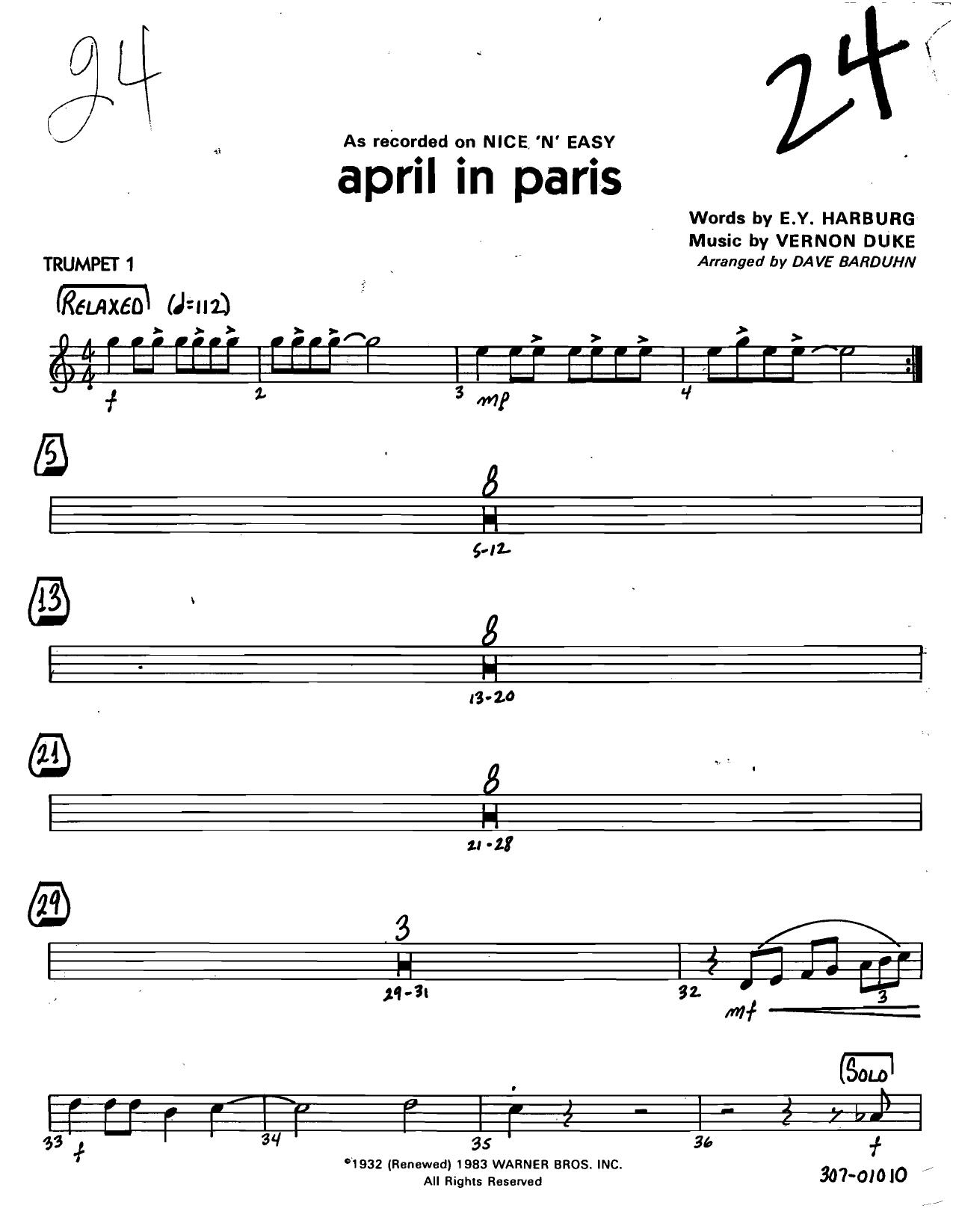
April In Paris (D.Barduhn)
Composed by Vernon Duke
Arranged by Dave Barduhn
- Ensemble: Big Band
- Pages: 27
- Instruments (17): Trumpet 1, Trumpet 2, Trumpet 3, Trumpet 4, Alto Sax 1, Alto Sax 2, Tenor Sax 1, Tenor Sax 2, Baritone Sax, Trombone 1, Trombone 2, Trombone 3, Trombone 4, Piano, Bass, Drums, Guitar
- Difficulty: medium
- Content: Individual Parts
- Format: PDF Download (Instant)
- Price: $24.99
Vernon Duke and E.Y. "Yip" Harburg penned "April in Paris" in 1932 for the Broadway revue *Walk a Little Faster*, but the composition found its true immortality in the jazz canon through iconic interpretations by Count Basie, Thelonious Monk, and countless vocalists. Representing the pinnacle of the Great American Songbook, the tune balances a sophisticated, cascading melodic contour with a nostalgic harmonic framework. Its status as an enduring jazz standard stems from its unique structural flexibility, transitioning seamlessly from wistful lyricism to driving rhythmic momentum, making it a masterclass in contrasting moods for modern ensembles. Dave Barduhn’s sophisticated big band interpretation transforms this classic standard into a vibrant showcase of ensemble dynamics and rich, contemporary harmonic coloring. Set in a buoyant medium-swing tempo, the chart opens with an inviting, atmospheric intro before establishing a steady, infectious groove. Barduhn utilizes lush, extended voicings in the brass and saxophones to evoke a sophisticated urban landscape, contrasting moments of delicate, transparent texture with roaring, high-energy full-ensemble interplay. The emotional trajectory shifts gracefully from reflective tenderness to exuberant, feet-tapping swing, capturing both the romantic yearning of the original lyric and the irrepressible energy of modern big band jazz. Renowned for his idiomatic writing and meticulous attention to ensemble balance, Barduhn crafts a chart where the melodic weight is shared thoughtfully across sections. The alto saxophone and trumpet sections frequently trade melodic duties, supported by rich, interlocking reed solis that demand precision articulation and unified phrasing. Solo opportunities are carved out organically within the arrangement, providing a spotlight for improvised features over harmonically rich changes. Technical challenges center primarily on maintaining a light, buoyant swing eighth-note feel at moderate tempos, demanding excellent internal time and section cohesion rather than sheer velocity, which ultimately makes the chart deeply rewarding for players and audiences alike. Advanced high school ensembles, collegiate jazz orchestras, and professional community big bands will find this arrangement to be an exceptional programming choice. It provides an ideal vehicle for teaching stylistic maturity, requiring younger players to master subtle dynamic shifts, dynamic shading, and stylistic phrasing. At the same time, its sophisticated harmonic palette offers enough depth and nuance to satisfy advanced musicians looking to refine their ensemble blend and swing articulation. Conductors should approach Dave Barduhn’s treatment of "April in Paris" with a primary focus on stylistic uniformity and relaxed, forward-moving time. Set at a comfortable medium-swing tempo, the rhythm section must lock into an unhurried, driving groove where the bassist outlines a clean, acoustic-style walking bassline and the drummer maintains a crisp, feather-light ride cymbal pattern. Avoid rushing the triplets in the melody; ensure the horn sections articulate their swing eighth notes with proper placement—long on the downbeats and accented, short notes on the upbeats. Rehearsal time should be heavily dedicated to the inner-voice balance of the saxophones during the soli sections, ensuring that the lead alto voice cuts cleanly without forcing the volume. Pay close attention to dynamic markings; the contrast between the muted, mysterious ensemble passages and the explosive, open-horn shout choruses defines the emotional arc of the chart. No extreme specialized mutes or unconventional extended techniques are required, allowing the ensemble to focus entirely on intonation, swing feel, and cohesive articulation. Q: What instruments and parts are included in the instrumentation for this arrangement? A: The 17-instrument big band instrumentation includes four trumpets, four trombones, five saxophones (two altos, two tenors, and baritone), and a standard four-piece rhythm section consisting of piano, guitar, bass, and drums. Q: What is the overall difficulty level of this Dave Barduhn arrangement? A: This chart is graded as medium-advanced, making it ideal for proficient high school jazz bands, collegiate ensembles, and professional community big bands seeking to develop advanced swing concepts. Q: What is the historical context and musical style of "April in Paris"? A: Originally composed by Vernon Duke in 1932, this arrangement treats the timeless standard in a contemporary medium-swing jazz style, building upon the rich tradition established by legendary big bands of the swing era and beyond. Q: What makes this specific arrangement by Dave Barduhn unique? A: Barduhn’s chart stands out due to its clever harmonic reharmonizations, sophisticated reed voicings, and a seamless structural flow that balances intimate, transparent ensemble sections with vibrant, full-ensemble shout choruses. Q: What is the recommended performance tempo and duration for this piece? A: The arrangement is set at a comfortable, swinging medium tempo (approximately quarter note = 120-126) and typically runs around 3.5 to 4.5 minutes depending on the length of the improvised solos.
Questions and answers
- What is included in the April In Paris (D.Barduhn) PDF?
- The verified current file contains individual parts across 27 pages.
- How many instruments or parts are listed for April In Paris (D.Barduhn)?
- The verified instrumentation list contains 17 entries for this Big Band arrangement.
- Who is credited for April In Paris (D.Barduhn)?
- Composer: Vernon Duke. Arranger: Dave Barduhn.
- What difficulty is listed for April In Paris (D.Barduhn)?
- The verified difficulty level is medium.
- Can I preview April In Paris (D.Barduhn) before buying?
- Yes. The product page provides a preview generated from the current PDF file.
- How is April In Paris (D.Barduhn) delivered?
- After successful payment, the digital PDF is made available for download. The displayed price is $24.99.
Musicians Also Search For
April In Paris Dave Barduhn PDF • April In Paris Dave Barduhn sheet music • April In Paris arranged by Dave Barduhn • Dave Barduhn big band charts • Dave Barduhn jazz arrangements PDF • April In Paris Vernon Duke sheet music • April In Paris Vernon Duke big band arrangements • Vernon Duke big band charts • April In Paris big band arrangements • April In Paris big band PDF download • April In Paris jazz sheet music • big band sheet music download • April In Paris individual parts download • April In Paris sheet music PDF • buy April In Paris sheet music • download April In Paris PDF • April In Paris jazz charts • best Dave Barduhn big band arrangements • Vernon Duke arranged by Dave Barduhn • April In Paris printable sheet music • big band repertoire PDF