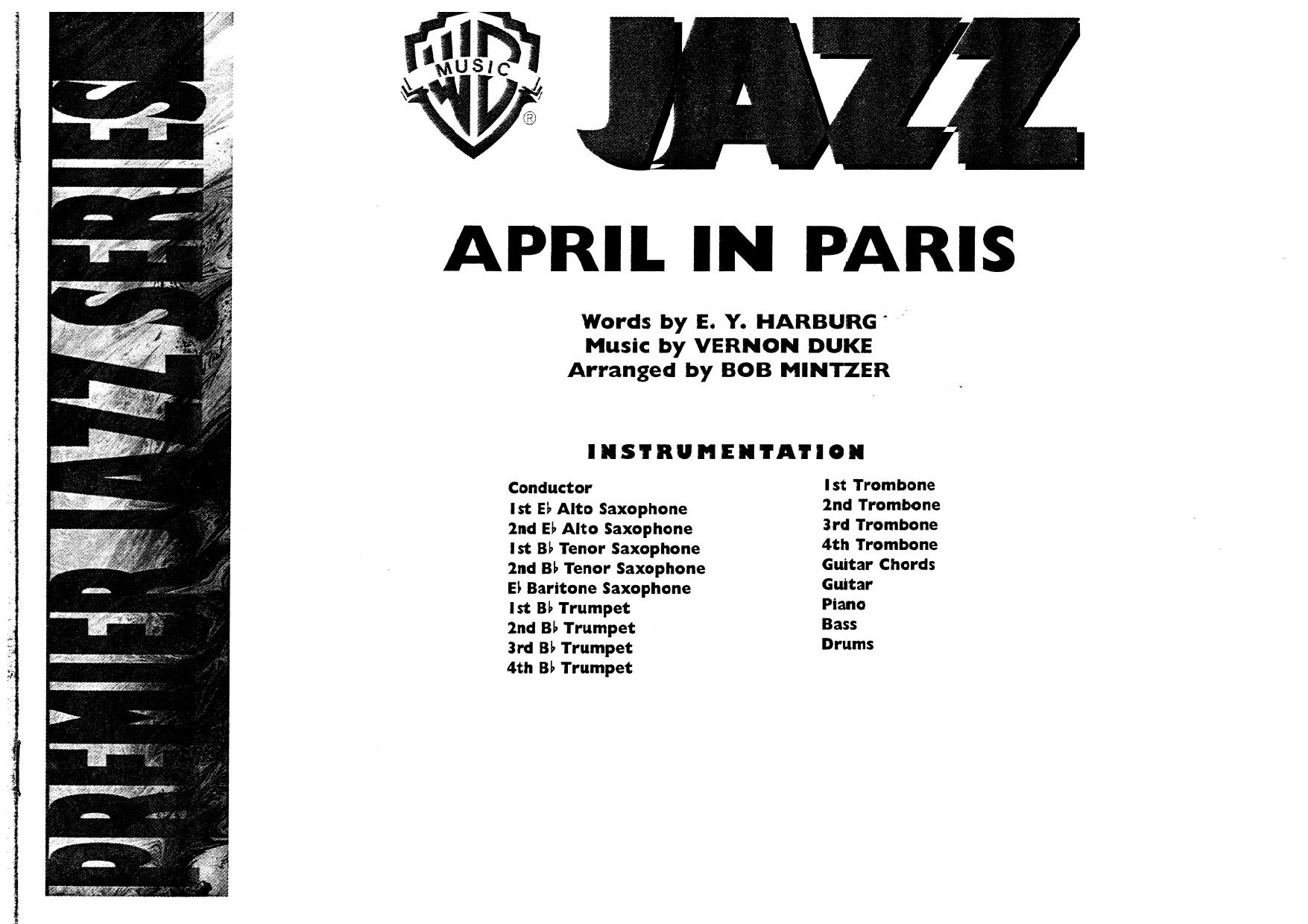
April In Paris (B.Mintzer)
Composed by Vernon Duke
Arranged by Bob Mintzer
- Ensemble: Big Band
- Pages: 69
- Instruments (17): 1st Eb Alto Saxophone, 2nd Eb Alto Saxophone, 1st Bb Tenor Saxophone, 2nd Bb Tenor Saxophone, Eb Baritone Saxophone, 1st Bb Trumpet, 2nd Bb Trumpet, 3rd Bb Trumpet, 4th Bb Trumpet, 1st Trombone, 2nd Trombone, 3rd Trombone, 4th Trombone, Piano, Guitar, Bass, Drums
- Difficulty: advanced
- Content: Individual Parts
- Format: PDF Download (Instant)
- Price: $24.99
Vernon Duke and E.Y. "Yip" Harburg penned "April in Paris" in 1932 for the Broadway revue *Walk a Little Faster*, but the tune immortalized itself in the jazz canon through definitive treatments by Count Basie, Thelonious Monk, and countless vocalists. Representing the pinnacle of American popular songcraft, its sophisticated harmonic architecture and sweeping melodic intervals have long invited creative reinterpretation. The composition bridges the gap between classic Tin Pan Alley structure and the expressive harmonic freedom demanded by modern jazz improvisers, anchoring itself firmly as a timeless standard that tests a band's lyricism and stylistic versatility. Bob Mintzer’s masterful big band treatment infuses this classic standard with a contemporary, high-energy groove while preserving the nostalgic warmth of the original melody. Eschewing a traditional slow ballad approach, Mintzer reimagines the chart with a driving, contemporary medium-swing pulse that propels the ensemble forward. The arrangement balances lush, intricate saxophone solis with punchy, brass-heavy interjections, creating a dynamic landscape that shifts effortlessly between intimate, exposed counterpoint and soaring, thunderous ensemble passages. The mood evolves from reflective sophistication to an infectious, rhythmic euphoria, evoking the vibrant energy of spring in an urban metropolis through rich, extended chord voicings and clever metric shifts. Renowned for his work with the Yellowjackets and the Count Basie Orchestra, Mintzer brings a signature composer's ear to this chart, favoring thick contemporary harmonies layered over traditional big band swing foundations. The saxophones act as a unified choir, navigating intricate linear writing that demands absolute rhythmic precision and a cohesive sectional blend. Brass sections are utilized for both aggressive punctuation and warm, harmon-muted backdrop textures, driving toward a sophisticated shout chorus that showcases Mintzer’s brilliant structural architecture. Solos are strategically integrated to allow featured improvisers space to stretch out over modern, yet accessible, chord changes that honor the parent melody. Advanced high school, collegiate, and professional big bands will find this arrangement an exceptionally rewarding centerpiece for concerts and festival repertoires. The primary technical challenges lie in maintaining a pristine, weightless swing feel at a brisk tempo, executing synchronized articulation across disparate instrument families, and balancing the dense, modern chord clusters. Ensembles capable of navigating subtle dynamic nuances and intricate rhythmic unisons will unlock a sophisticated, crowd-pleasing vehicle that highlights both individual virtuosic capabilities and collective ensemble discipline. Conductors should establish a crisp, energized medium-swing tempo right from the downbeat, ensuring the rhythmic subdivisions remain buoyant rather than heavy or rushed. The rhythm section is the engine here; the drummer should maintain a driving, conversational ride cymbal pattern with crisp hi-hat chicks on beats two and four, while the bassist walks a steady, modal-inflected line that locks tightly with the piano's comping voicings. Key technical hurdles involve the precision of the fast-moving saxophone soli lines and clean dynamic control during sudden volume shifts. Brass players must execute articulated accents without pinching their tone, particularly in the upper register shout choruses. Pay close attention to articulation markings—detached notes must be clipped and intentional, while legato phrases require a seamless, vocal-like connection. Rehearsal time is best spent isolating the horn sections to align intonation on Mintzer’s rich suspended and altered chords before integrating the full ensemble texture. Q: What instruments and parts are included in this arrangement? A: This 69-page publication includes a full conductor score alongside parts for a standard 17-piece big band instrumentation: 2 alto saxophones, 2 tenor saxophones, 1 baritone saxophone, 4 trumpets, 4 trombones, guitar, piano, bass, and drums. Q: What is the difficulty level of this Bob Mintzer chart? A: This arrangement is graded as advanced, making it best suited for collegiate, advanced high school, and professional big bands that possess strong reading skills, tight sectional cohesion, and rhythmic flexibility. Q: What is the musical style and historical context of this piece? A: Based on Vernon Duke’s 1932 standard, this chart reimagines the classic tune through a contemporary jazz lens, blending traditional swing elements with the modern harmonic vocabulary characteristic of arranger Bob Mintzer. Q: What makes this specific arrangement unique? A: Unlike traditional ballad treatments of the tune, Mintzer utilizes a driving medium-swing groove, sophisticated extended chord voicings, intricate saxophone line-writing, and a harmonically rich shout chorus that updates the standard for modern ensembles. Q: What is the performance duration and tempo feel of the arrangement? A: The arrangement runs approximately 4 to 5 minutes in duration and is set to a driving, energetic medium-swing tempo that requires a light, buoyant feel from the entire rhythm section.
Questions and answers
- What is included in the April In Paris (B.Mintzer) PDF?
- The verified current file contains a conductor score and individual parts across 69 pages.
- How many instruments or parts are listed for April In Paris (B.Mintzer)?
- The verified instrumentation list contains 17 entries for this Big Band arrangement.
- Who is credited for April In Paris (B.Mintzer)?
- Composer: Vernon Duke. Arranger: Bob Mintzer.
- What difficulty is listed for April In Paris (B.Mintzer)?
- The verified difficulty level is advanced.
- Can I preview April In Paris (B.Mintzer) before buying?
- Yes. The product page provides a preview generated from the current PDF file.
- How is April In Paris (B.Mintzer) delivered?
- After successful payment, the digital PDF is made available for download. The displayed price is $24.99.
Musicians Also Search For
April In Paris Bob Mintzer PDF • April In Paris Bob Mintzer sheet music • April In Paris arranged by Bob Mintzer • Bob Mintzer big band charts • Bob Mintzer jazz arrangements PDF • April In Paris Vernon Duke sheet music • April In Paris Vernon Duke big band arrangements • Vernon Duke big band charts • April In Paris big band arrangements • April In Paris big band PDF download • April In Paris jazz sheet music • big band sheet music download • April In Paris conductor score PDF • April In Paris individual parts download • April In Paris sheet music PDF • buy April In Paris sheet music • download April In Paris PDF • April In Paris jazz charts • best Bob Mintzer big band arrangements • Vernon Duke arranged by Bob Mintzer • April In Paris printable sheet music • big band repertoire PDF