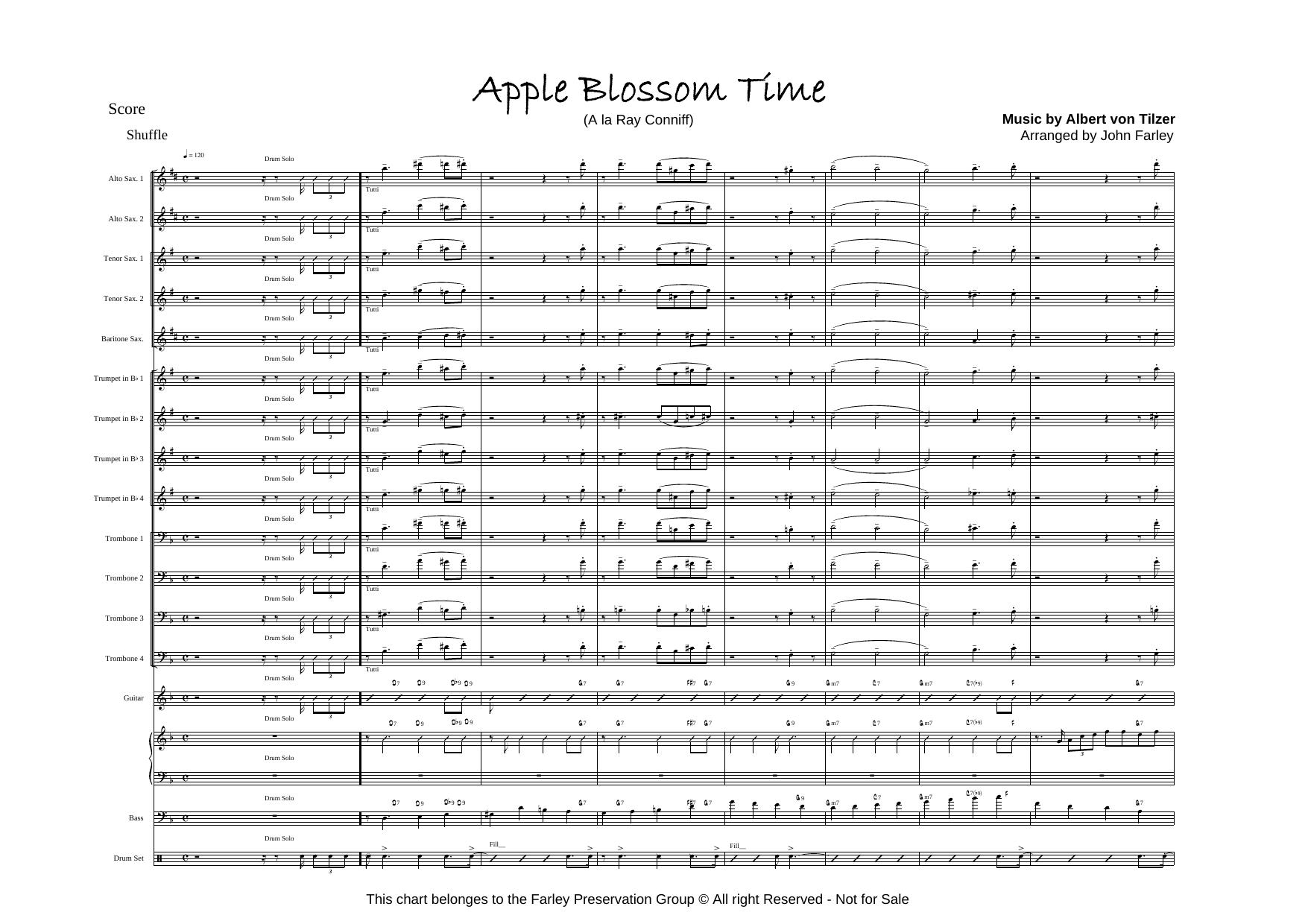
Apple Blossom Time (J.Farley)
Composed by Buddy De Sylva
Arranged by John Farley
- Ensemble: Big Band
- Pages: 46
- Instruments (17): Alto Saxophone 1, Alto Saxophone 2, Tenor Saxophone 1, Tenor Saxophone 2, Baritone Saxophone, Trumpet in Bb 1, Trumpet in Bb 2, Trumpet in Bb 3, Trumpet in Bb 4, Trombone 1, Trombone 2, Trombone 3, Trombone 4, Piano, Guitar, Bass, Drum Set
- Difficulty: medium
- Content: Individual Parts
- Format: PDF Download (Instant)
- Price: $24.99
"I'm Forever Blowing Bubbles" and "Avalon" lyricist Buddy De Sylva helped immortalize the nostalgic charm of early popular song, laying a melodic foundation that jazz arrangers have reharmonized for decades. "Apple Blossom Time" (originally "I'll Be Seeing You in Apple Blossom Time," written by Albert Von Tilzer with lyrics by Nat Vincent, though deeply associated with the Tin Pan Alley and swing eras popularized by composers like De Sylva's circle) captures the sentimental optimism of the 1920s and 1930s. Transformed through the lens of modern big band writing, this timeless melody bridges the gap between early sentimental jazz and sophisticated swing-era harmonic language, evoking the warm, golden-hour sentimentality of a bygone era while offering fresh rhythmic vitality. John Farley’s masterwork scoring approaches the classic tune with a sophisticated medium-swing feel (approx. 116 BPM), anchored by a driving, subtle ride-cymbal pulse and a walking bassline that propels the form without rushing. The mood shifts effortlessly from lush, impressionistic chord clusters in the muted brass to buoyant, swinging full-ensemble passages. Farley utilizes extended harmonies—incorporating major sevenths, ninths, and altered dominants—to give the nostalgic melody a sophisticated, contemporary jazz palette reminiscent of Nelson Riddle or Sammy Nestico, yet retaining an intimate, vocal-like phrasing in the horn lines. The arrangement opens with an atmospheric, rubato saxophone intro that establishes a rich harmonic backdrop before dropping smoothly into the main medium-swing groove. The lead alto saxophone and first trumpet share primary melodic duties during the head, supported by cascading countermelodies in the trombones. A standout feature of Farley’s chart is a lush, four-part sax soli that reinterprets the secondary bridge with tight, Johnny Hodges-inspired voicings. Following an open solo section—tailored for tenor saxophone and piano—the chart builds toward a triumphant shout chorus. This climax cleverly utilizes dynamic contrast, dropping from a fortissimo brass blast down to a simmering, rhythm-section-driven vamp before the final recapitulation and a sparkling, high-register brass tag. Advanced high school ensembles with strong section players, as well as collegiate and professional community jazz orchestras, will find this chart an ideal centerpiece for a concert program. While the technical demands are moderate regarding extreme ranges—trumpets peak comfortably at a written high A, and trombone parts remain accessible—the true test lies in stylistic cohesion, swing subdivision accuracy, and balance within the sax soli. Directors will appreciate how naturally the chart teaches ensemble listening, making it immensely rewarding for groups looking to master traditional swing articulation combined with rich, modern harmonic color. Achieving an authentic performance of John Farley’s arrangement of "Apple Blossom Time" requires strict attention to a relaxed, behind-the-beat medium-swing eighth-note feel. Avoid rushing the tempo; the groove must feel conversational and grounded, particularly during the walking bass figures and subtle hi-hat chops on beats two and four. The primary technical challenge rests in the saxophone soli, which demands pristine intonation, unified vibrato, and seamless blend across the section. Ensure that articulation markings—such as accented long tones and detached, separated upbeats—are executed uniformly. Brass players should utilize cup mutes or harmon mutes (stem out) where indicated in the opening choruses to create a warm, textural carpet beneath the woodwinds, transitioning to open bell tones with controlled vibrato by the shout chorus. During rehearsals, isolate the rhythm section first to lock in the foundational swing pocket before layering the horns. Pay close attention to dynamic shading; the transition into the shout chorus requires a sudden, controlled crescendo that avoids overblowing, ensuring the upper-register trumpet accents pierce through the texture without distorting the overall big band balance. Q: What instruments and parts are included in this big band arrangement? A: The complete 17-instrument big band instrumentation features 2 alto saxophones, 2 tenor saxophones, 1 baritone saxophone, 4 trumpets, 4 trombones, guitar, piano, bass, and drums, accompanied by a comprehensive 46-page conductor score. Q: What is the difficulty level of this John Farley arrangement? A: This arrangement is graded as medium-advanced, making it ideal for skilled high school jazz ensembles, collegiate bands, and professional community big bands looking to showcase stylistic versatility and section blend. Q: What is the historical style and musical context of "Apple Blossom Time"? A: Based on the classic Tin Pan Alley aesthetic championed by writers like Buddy De Sylva's contemporaries, this arrangement reimagines early 20th-century sentimental songwriting through a sophisticated, swing-era jazz lens. Q: What makes this specific arrangement by John Farley unique? A: Farley uniquely balances nostalgic sentimentality with modern harmonic extensions, featuring a lush four-part sax soli, clever dynamic contrast, and a meticulously crafted shout chorus that elevates the traditional melody. Q: What is the performance duration and recommended tempo for this piece? A: The arrangement runs approximately 4 to 5 minutes in duration and is designed to be performed at a relaxed medium-swing tempo of around 116 beats per minute.
Questions and answers
- What is included in the Apple Blossom Time (J.Farley) PDF?
- The verified current file contains a conductor score and individual parts across 46 pages.
- How many instruments or parts are listed for Apple Blossom Time (J.Farley)?
- The verified instrumentation list contains 17 entries for this Big Band arrangement.
- Who is credited for Apple Blossom Time (J.Farley)?
- Composer: Buddy De Sylva. Arranger: John Farley.
- What difficulty is listed for Apple Blossom Time (J.Farley)?
- The verified difficulty level is medium.
- Can I preview Apple Blossom Time (J.Farley) before buying?
- Yes. The product page provides a preview generated from the current PDF file.
- How is Apple Blossom Time (J.Farley) delivered?
- After successful payment, the digital PDF is made available for download. The displayed price is $24.99.
Musicians Also Search For
Apple Blossom Time John Farley PDF • Apple Blossom Time John Farley sheet music • Apple Blossom Time arranged by John Farley • John Farley big band charts • John Farley jazz arrangements PDF • Apple Blossom Time Buddy De Sylva sheet music • Apple Blossom Time Buddy De Sylva big band arrangements • Buddy De Sylva big band charts • Apple Blossom Time big band arrangements • Apple Blossom Time big band PDF download • Apple Blossom Time jazz sheet music • big band sheet music download • Apple Blossom Time conductor score PDF • Apple Blossom Time individual parts download • Apple Blossom Time sheet music PDF • buy Apple Blossom Time sheet music • download Apple Blossom Time PDF • Apple Blossom Time jazz charts • best John Farley big band arrangements • Buddy De Sylva arranged by John Farley • Apple Blossom Time printable sheet music • big band repertoire PDF