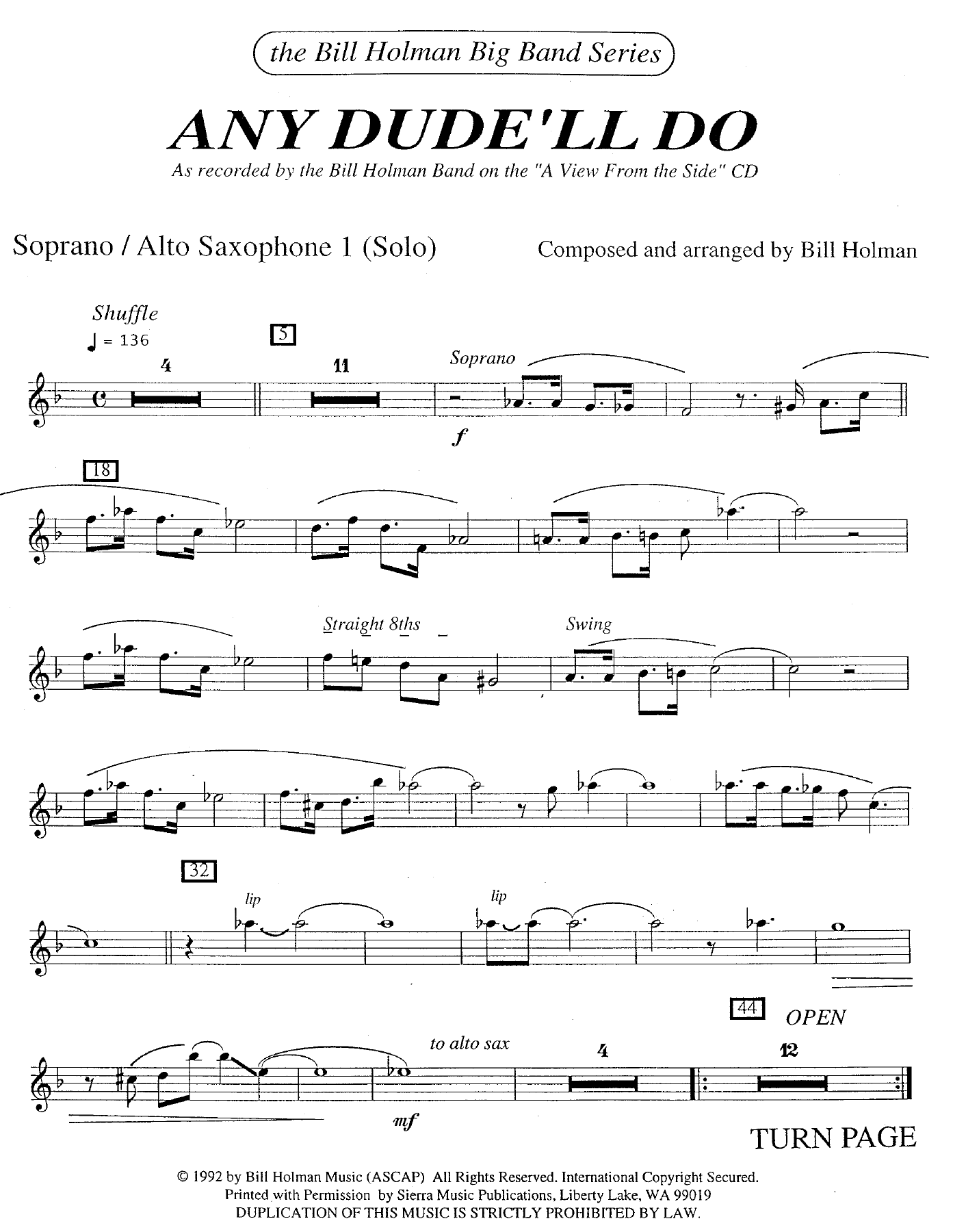
Any Dude'll Do (B.Holman)
Composed by Bill Holman
Arranged by Bill Holman
- Ensemble: Big Band
- Style: Jazz Standard
- Pages: 73
- Instruments (16): Soprano / Alto Saxophone 1 (Solo), Soprano / Alto Saxophone 2, Tenor Saxophone 1, Tenor Saxophone 2, Baritone Saxophone (Solo), Trumpet 1, Trumpet 2, Trumpet 3, Trumpet 4, Trombone 1, Trombone 2, Trombone 3, Bass Trombone 4, Drums (Solo), Bass, Piano
- Difficulty: advanced
- Content: Individual Parts
- Format: PDF Download (Instant)
- Price: $24.99
Bill Holman's "Any Dude'll Do" stands as a quintessential big band chart, embodying the sophisticated yet swinging ethos of West Coast Jazz that flourished in the mid-20th century. Composed and arranged by Holman himself, this piece is a testament to his unique harmonic language and rhythmic ingenuity, establishing it as a notable entry in the jazz standard repertoire for large ensembles. While not a "hit song" in the traditional sense, its enduring popularity among jazz musicians and educators stems from its masterful construction and the sheer joy it brings to both performers and listeners. It represents an era where intricate arrangements and melodic invention were paramount, often associated with bands like Stan Kenton's and Woody Herman's, where Holman's pen was frequently employed. Musically, "Any Dude'll Do" is typically performed at a bright medium-up swing tempo, maintaining a buoyant 4/4 feel throughout. The key often hovers around F or Bb major, allowing for a comfortable yet harmonically rich landscape. The mood is one of sophisticated exuberance, characterized by Holman's signature cool yet driving energy. It evokes the feeling of a vibrant, intelligent conversation among instruments, with moments of playful call-and-response interwoven with lush, tightly voiced harmonies. The piece is a masterclass in dynamic contrast, moving seamlessly from understated grooves to powerful, full-ensemble statements, always propelled by an infectious rhythmic undercurrent. Holman's arrangement of his own composition showcases his distinctive approach to big band writing. He is renowned for his linear voicings, often creating dense, interlocking lines across sections rather than block chords. This results in a transparent yet full sound, where individual instrument voices remain distinct within the ensemble. Expect intricate sax soli passages that demand precision and blend, often featuring unexpected melodic turns and chromaticism. The brass writing is equally inventive, employing a mix of tight, punchy figures and broader, sustained harmonies. While there isn't a traditional "shout chorus" in the most bombastic sense, the chart builds to powerful ensemble climaxes through layered textures and rhythmic intensity. Holman's use of extended harmonies and subtle dissonances adds a modern edge without sacrificing the swing feel. The melody is primarily carried by the saxophone section, often in unison or tight octaves, before being passed to the brass for contrasting statements. There are typically featured solo opportunities for tenor saxophone and trumpet, allowing for improvisational prowess within the structured framework. Technical challenges include the precise execution of fast, intricate lines in the sax soli, maintaining blend and balance in the brass, and navigating the dynamic shifts with sensitivity. The reward lies in the sheer musicality and the satisfaction of performing a truly classic, well-crafted big band chart. This arrangement is ideally suited for advanced high school, college, community, and professional big bands. Its demands on technical facility, ensemble precision, and stylistic understanding make it an excellent choice for groups looking to deepen their engagement with classic West Coast Jazz repertoire and master the nuances of Bill Holman's iconic writing. "Any Dude'll Do" requires a crisp, articulate approach to its medium-up swing tempo, ideally around quarter note = 180-200 BPM, maintaining a light but driving 4/4 feel. The primary technical challenge lies in the intricate saxophone soli sections, which demand exceptional precision in articulation, intonation, and rhythmic exactitude. Conductors should emphasize vertical alignment and a unified approach to phrasing within the saxes. Brass sections must execute tight, punchy figures with clarity, particularly in unison lines, while maintaining a warm, blended sound in sustained passages. Dynamic contrasts are crucial; practice moving from subtle piano grooves to powerful forte ensemble hits with control. There are no specific mute requirements beyond standard cup and straight mutes for brass, to be used judiciously for color. Rehearsal tips include isolating the sax soli for slow, methodical practice, focusing on individual lines before combining. Also, pay close attention to the rhythm section's interaction, ensuring a consistent, swinging foundation that propels the ensemble forward. Q: What instruments and parts are included in this arrangement? A: This arrangement includes parts for 17 instruments: Alto Saxophone 1, Alto Saxophone 2, Tenor Saxophone 1, Tenor Saxophone 2, Baritone Saxophone, Trumpet 1, Trumpet 2, Trumpet 3, Trumpet 4, Trombone 1, Trombone 2, Trombone 3, Bass Trombone, Piano, Bass, Drums, and Guitar. Q: What is the difficulty level of "Any Dude'll Do (B.Holman)"? A: This arrangement is considered advanced, suitable for college, community, or professional big bands. It demands strong technical proficiency, precise ensemble playing, and a solid understanding of jazz articulation and style. Q: What musical style and historical context does this arrangement represent? A: "Any Dude'll Do" is a quintessential example of West Coast Jazz from the mid-20th century. It embodies the sophisticated, harmonically rich, and often cooler-toned big band sound associated with arrangers like Bill Holman. Q: What makes Bill Holman's arrangement of "Any Dude'll Do" unique? A: Holman's unique approach is evident in his linear voicings, intricate sax soli passages, and sophisticated harmonic language. The chart features a transparent yet full sound, emphasizing individual instrumental lines within the ensemble rather than block chord voicings. Q: What is the typical performance duration and tempo for this piece? A: The typical performance duration for "Any Dude'll Do" is approximately 4-6 minutes, depending on the length of improvised solos. It is generally performed at a bright medium-up swing tempo, around quarter note = 180-200 BPM.
Questions and answers
- What is included in the Any Dude'll Do (B.Holman) PDF?
- The verified current file contains individual parts across 73 pages.
- How many instruments or parts are listed for Any Dude'll Do (B.Holman)?
- The verified instrumentation list contains 16 entries for this Big Band arrangement.
- Who is credited for Any Dude'll Do (B.Holman)?
- Composer: Bill Holman. Arranger: Bill Holman.
- What difficulty is listed for Any Dude'll Do (B.Holman)?
- The verified difficulty level is advanced.
- What style is listed for Any Dude'll Do (B.Holman)?
- The catalog lists the style as Jazz Standard.
- Can I preview Any Dude'll Do (B.Holman) before buying?
- Yes. The product page provides a preview generated from the current PDF file.
- How is Any Dude'll Do (B.Holman) delivered?
- After successful payment, the digital PDF is made available for download. The displayed price is $24.99.
Musicians Also Search For
Any Dude'll Do Bill Holman PDF • Any Dude'll Do Bill Holman sheet music • Any Dude'll Do arranged by Bill Holman • Bill Holman big band charts • Bill Holman jazz arrangements PDF • Any Dude'll Do Bill Holman big band arrangements • Any Dude'll Do big band arrangements • Any Dude'll Do big band PDF download • Any Dude'll Do jazz sheet music • big band sheet music download • Any Dude'll Do individual parts download • Any Dude'll Do sheet music PDF • Any Dude'll Do Jazz Standard charts • Jazz Standard big band arrangements • buy Any Dude'll Do sheet music • download Any Dude'll Do PDF • Any Dude'll Do jazz charts • best Bill Holman big band arrangements • Any Dude'll Do printable sheet music • big band repertoire PDF