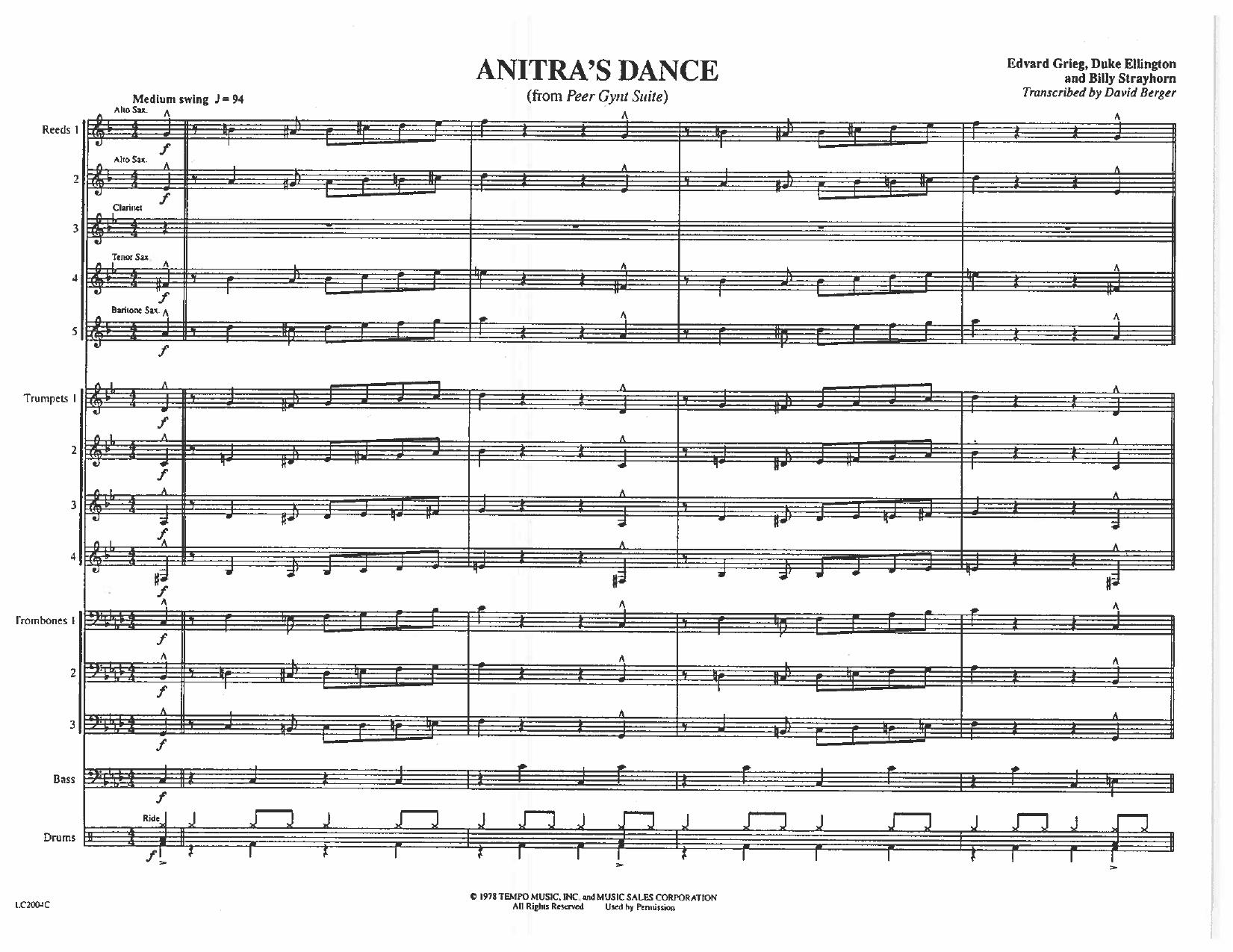
Anitra's Dance (D.Ellington)
Composed by Duke Ellington
Arranged by Duke Ellington & B.Strayhorn.D.Berger
- Ensemble: Big Band
- Pages: 60
- Instruments (14): Reed 1 Alto Sax, Reed 2 Alto Sax, Reed 3 Clarinet, Reed 4 Tenor Sax, Reed 5 Baritone Sax, Trumpet 1, Trumpet 2, Trumpet 3, Trumpet 4, Trombone 1, Trombone 2, Trombone 3, Bass, Drums
- Difficulty: advanced
- Content: Individual Parts
- Format: PDF Download (Instant)
- Price: $24.99
Edvard Grieg’s classic suite movement receives a transformative, mid-century modernist makeover in this definitive big band adaptation of "Anitra’s Dance," originally reimagined by the peerless collaborative partnership of Duke Ellington and Billy Strayhorn, and meticulously transcribed and edited for contemporary performance by David Berger. Emerging from Ellington’s fascination with reframing classical masterworks through the lens of Harlem jazz orchestration—much like his famous *Nutcracker Suite*—this chart bridges late-nineteenth-century Norwegian romanticism with the sophisticated harmonic palette of the 1960s Ellington Orchestra. Originally recorded during Ellington's prolific suite-writing era, this piece showcases how the master orchestrator could take a familiar, dainty thematic fragment and inject it with sultry subtext, exotic minor-key textures, and swinging urban sophistication. Driven by a slinky, feline medium-tempo groove rather than Grieg’s original frantic scamper, the arrangement trades classical lightweight whimsy for a sultry, midnight-oil atmosphere. The mood shifts masterfully between mysterious, muted brass coloring and lush, impressionistic reed voicings that linger on exotic suspended chords and minor-major seventh sonorities. Ellington and Strayhorn utilize unorthodox section pairings—such as pairing a low-register clarinet with sultry baritone saxophone—to create a sonic landscape that feels both theatrical and deeply rooted in the blues tradition. The rhythmic framework rests on a subtle, pulsating swing feel that demands absolute precision and immaculate time-feel from the rhythm section, avoiding heavy-handedness in favor of a cool, coiled-spring tension. David Berger’s authoritative transcription captures every nuance of the original manuscript scores, preserving the signature Ellingtonian voicings where trombones use plunger mutes to mimic human vocalizations and saxophones weave intricate, counter-melodic webs. The arrangement features prominent clarinet and alto saxophone leading the thematic statements, while shifting dynamic plateaus build an intoxicating momentum leading into the ensemble sections. Rather than relying on a traditional high-octane shout chorus, this chart achieves its climax through dense, shifting harmonic textures and clever interplay between the rhythm section and the horn tiers, challenging the ensemble to balance chamber-music transparency with big band power. Advanced high school, collegiate, and professional jazz ensembles will find this composition an extraordinary showcase for developing sophisticated sectional blend, dynamic control, and historical stylistic awareness. Because the chart relies heavily on subtle articulation, precise balance, and nuanced color rather than sheer velocity, it serves as an exceptional vehicle for teaching mature jazz phrasing. Performing this arrangement offers musicians a masterclass in Ellingtonian orchestration, providing a rewarding, highly memorable concert centerpiece that unfailingly captivates audiences with its brilliant fusion of classical heritage and jazz innovation. Navigating this sophisticated arrangement requires a keen focus on tonal color, dynamic subtlety, and stylistic authenticity. The tempo should remain a steady, relaxed medium swing; rushing the groove destroys the sultry, feline character essential to the piece. Conductors must ensure the rhythm section maintains an ultra-light, driving pulse on the ride cymbal and hi-hat, avoiding heavy downbeats. Technically, the primary challenge lies in the brass section's execution of plunger mutes and nuanced colorations. Players should practice coordinated "wah-wah" effects and ensure seamless blending across varied mutes (harmon, cup, and plunger). The reed section, featuring pivotal clarinet doubling, must balance intricate counterlines without ever masking the primary thematic statements carried by the lead alto and clarinet. Rehearsals should begin without the rhythm section to allow the horns to isolate intonation on close-position Ellingtonian voicings and complex suspended harmonies. Pay meticulous attention to dynamic markings; the transition from whisper-quiet subtones to punchy ensemble accents defines the dramatic arc of this unique masterwork. Q: What instruments and parts are included in this arrangement? A: This 60-page publication includes a full conductor score and individual instrumental parts for a standard 14-instrument big band lineup, specifically featuring Alto Saxophone 1, Alto Saxophone 2, Clarinet, Tenor Saxophone, Baritone Saxophone, brass, and a complete rhythm section. Q: What is the difficulty level of this big band chart? A: This arrangement is graded as advanced, making it ideal for collegiate ensembles, top-tier high school bands, and professional jazz orchestras capable of handling sophisticated ensemble phrasing and subtle dynamic control. Q: What is the historical background and musical style of this piece? A: Conceived in the jazz style, this piece represents Duke Ellington and Billy Strayhorn's visionary mid-century jazz adaptation of Edvard Grieg’s classical suite, merging romantic European programmatic themes with Harlem big band swing. Q: What makes this specific David Berger transcription unique? A: It faithfully reconstructs the rare Ellington-Strayhorn manuscript from historical recordings, capturing signature orchestration traits like plunger-muted brass, unconventional reed doublings, and lush, impressionistic chord voicings. Q: What is the recommended performance duration and tempo feel? A: The arrangement is set at a slinky, relaxed medium-swing tempo and typically runs between 3.5 to 5 minutes in performance, depending on the chosen pacing and stylistic breathing room.
Questions and answers
- What is included in the Anitra's Dance (D.Ellington) PDF?
- The verified current file contains a conductor score and individual parts across 60 pages.
- How many instruments or parts are listed for Anitra's Dance (D.Ellington)?
- The verified instrumentation list contains 14 entries for this Big Band arrangement.
- Who is credited for Anitra's Dance (D.Ellington)?
- Composer: Duke Ellington. Arranger: Duke Ellington & B.Strayhorn.D.Berger.
- What difficulty is listed for Anitra's Dance (D.Ellington)?
- The verified difficulty level is advanced.
- Can I preview Anitra's Dance (D.Ellington) before buying?
- Yes. The product page provides a preview generated from the current PDF file.
- How is Anitra's Dance (D.Ellington) delivered?
- After successful payment, the digital PDF is made available for download. The displayed price is $24.99.
Musicians Also Search For
Anitra's Dance Duke Ellington & B.Strayhorn.D.Berger PDF • Anitra's Dance Duke Ellington & B.Strayhorn.D.Berger sheet music • Anitra's Dance arranged by Duke Ellington & B.Strayhorn.D.Berger • Duke Ellington & B.Strayhorn.D.Berger big band charts • Duke Ellington & B.Strayhorn.D.Berger jazz arrangements PDF • Anitra's Dance Duke Ellington sheet music • Anitra's Dance Duke Ellington big band arrangements • Duke Ellington big band charts • Anitra's Dance big band arrangements • Anitra's Dance big band PDF download • Anitra's Dance jazz sheet music • big band sheet music download • Anitra's Dance conductor score PDF • Anitra's Dance individual parts download • Anitra's Dance sheet music PDF • buy Anitra's Dance sheet music • download Anitra's Dance PDF • Anitra's Dance jazz charts • best Duke Ellington & B.Strayhorn.D.Berger big band arrangements • Duke Ellington arranged by Duke Ellington & B.Strayhorn.D.Berger • Anitra's Dance printable sheet music • big band repertoire PDF